
**ELLA MCCAY**
I have no idea if Alissa Wilkinson, film critic for the New York Times, and Alison Willmore, film critic for New York magazine, are friends, or acquaintances, or if they even know each other—or if, based on their eerily similar names and work sites, they’re actually the same person. But all reviewers want to be considered independent thinkers, and no one wants to be labeled a copycat. So it was weirdly coincidental that, in assessing writer/director James L. Brooks’ *Ella McCay*, both Wilkinson and Willmore employed the same metaphor in their reviews’ opening paragraphs.
Wilkinson stated, “I am here with reassurances: Don’t worry. Your movie theater wasn’t leaking gas.” Willmore, meanwhile, called Brooks’ new comedy “gas-leak cinema at its finest,” adding that the film “makes you wonder if the characters have checked their carbon-monoxide detectors lately, because nothing they do resembles the behavior of human beings breathing in the recommended levels of oxygen to function normally.”
First of all: Ouch. Second of all: I get why both writers went with the gas-leak conceit, because it’s entirely fitting. Dreadful though it is, *Ella McCay* didn’t anger me the way other very-bad movies have, and didn’t exactly make me sad, either. It more accurately made me woozy, like I was still reeling from getting clocked in the head a minute prior.
While I don’t know whether the cast felt the same, the vast majority of distracted-seeming performers here appear engaged in subtextual messaging to their director: “Are you sure this is what you want, Jim?”
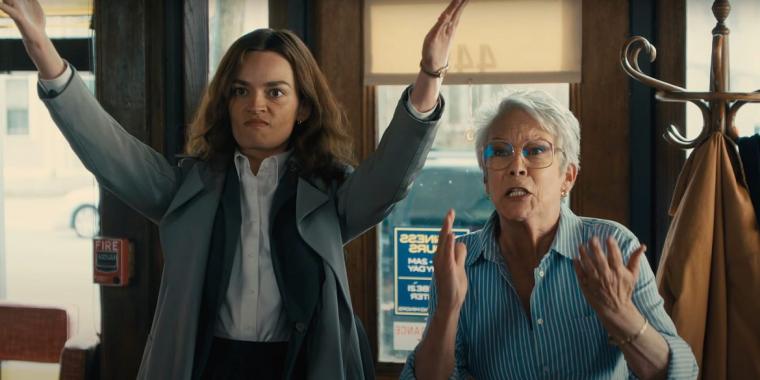
Brooks’ first feature since 2010’s *How Do You Know* isn’t the worst picture of 2025. It’s quite possibly the strangest, though, and suggests that not only has Brooks not made a film in 15 years, but perhaps hasn’t seen a film in 15 years. Right from the start, everything about *Ella McCay* is a little off-kilter, and that’s not counting our titular American being played, with acceptable charm and the most geographically generic of accents, by British-French actor Emma Mackey.
Ella is resigning and accepting a White House cabinet position—not that, you know, the incoming president’s name is ever uttered. Consequently, Ella will take over as Springfield USA’s anointed governor for 14 months, a promotion that thrills her evidently loving husband Ryan. I still can’t get myself to hate it.
There’s a nutty time-capsule quality to the project that’s endearing almost despite itself. Albert Brooks (no relation to the writer/director) is consistently appealing as the down-to-earth exiting governor, and it’s hard to turn up your nose to a movie in which, from moment to moment, literally anything can happen.
I’m still praying that 85-year-old James L. has at least one more feature film in him. Oscar-winning directors have surely ended their careers on worse than *Ella McCay*. But it’s beyond depressing to consider what those examples might be.
—
**SILENT NIGHT, DEADLY NIGHT**
Hard as it is to believe, there was a time when certain movies were actually picketed for their presumed depravity. William Friedkin’s notorious *Cruising*, in 1980, inspired gay-rights advocates to wave placards against the film for fetishizing the murder of homosexuals, while others were offended that the gay “lifestyle” was being represented on screen at all.
Martin Scorsese’s *The Last Temptation of Christ* reached a fever pitch of handmade-sign uproar long before the 1988 movie ever screened, its haters railing against any work that would imagine Jesus as a human being (and, not tangentially, a man who would make love to Mary Magdalene).
And in 1984, director Charles E. Sellier Jr.’s slasher flick *Silent Night, Deadly Night* was publicly, visibly scorned for daring to present Santa Claus as a serial killer—no matter that the killer wasn’t Santa, but just some poor orphaned kid whose very specific trauma led to him donning a St. Nick suit that evidently matched well with his ax.
Nowadays, of course, it’s doubtful that anyone would consider picketing… well, any film, really. Certainly not a low-rent Santa-as-slayer trifle, considering *Silent Night*’s 1984 original led to four sequels, a 2012 remake, and David Harbour as an actually murderous Claus in 2022’s gruesome action comedy *Violent Night*.
So now we have writer/director Mike P. Nelson’s *Silent Night, Deadly Night* reboot, which I managed to see without crossing a line of protesters. With all due respect to those who might still consider its premise revolting, if not actively irresponsible, the movie is kinda terrific.
Following the ’84 narrative with fidelity despite a few alterations and the pronounced addition of a supernatural angle, Nelson’s unrated indie is surprisingly moral and even somewhat touching. This supremely solid B-picture by multimedia company Bloody Disgusting is less reminiscent of *Terrifier 3* than of *Venom* or even, if you want to get highfalutin about it, Best Picture winner *Birdman*.
Again, our hero/villain is Billy Chapman (played as an 18-year-old by Robert Brian Wilson), who witnesses the childhood murder of his parents by a dude in a Santa suit. Again, the kid grows up to become a homicidal dude in a Santa suit himself—our first view of adult Billy finds him departing the motel room where his most recent victim lies in the bathtub.
Yet we quickly learn that, at the time of his parents’ killings, the soul of their executioner Charlie (Mark Acheson) effectively entered Billy’s body and is annually instructing him toward an Advent calendar of December executions, punishing the naughty and sparing the nice.
This is demonstrated, by Nelson, in having Charlie routinely engage in conversation with his literal inner demon—a conceit that proves both amusing (à la *Venom* and *Birdman*) and unexpectedly empathy-producing.
As we’re repeatedly reminded, only the naughty—the really, really naughty—are set up for the kill, and that lends a weird type of nobility to Billy’s actions. He’ll protect his new trinket-shop co-worker crush Pamela (Ruby Modine) and her sweet dad (David Lawrence Brown) to his last day.
But that aging, handsy creep at the store and the attendees of that neo-Nazi Christmas party? They’ve got to go.
Truth be told, I was hoping for more splatter—or rather, more inventive splatter—than Nelson’s feature delivered. While there’s a lot of bloodshed, almost none of it is presented memorably; even the staging of that ultimately corpse-filled neo-Nazi bash is disappointingly humdrum.
But Nelson’s movie is still genuinely funny when it should be, admirably vicious when it needs to be, and legit affecting when you don’t think it’ll be. Billy portrayer Wilson is a real find. He’s blessedly ordinary-looking and a little stocky—if not chubby—you can easily imagine Cooper Hoffman in the role. Wilson’s sincerity and sweetheart smile, though, keep you in Billy’s corner from moment one, and Modine matches him ideally. Their mutually eccentric other-ness and shared charisma give this “depraved” outing the almost-wholesome appeal of a 21st-century rom-com.
I had loads of unanticipated fun at *Silent Night, Deadly Night*, and wouldn’t be at all bothered to see a continuation during another yuletide season down the line.
That being said, any holiday-themed sequel would almost certainly be preferable to a follow-up to…
—
**OH. WHAT. FUN.**
I do my best to avoid the myriad of newly streaming Christmas comedies the way others avoid Santa-with-an-ax gore-fests, generally only breaking my vow of disinterest for titles that look like truly unforgettable monstrosities: the Will Ferrell/Ryan Reynolds *Spirited*, or the snowman-comes-to-life lunacy of *Hot Frosty*.
(*Spirited* was indeed wretched; *Hot Frosty*, dammit, was disappointingly inoffensive.)
But *Oh. What. Fun.*, which recently began streaming on Prime Video, genuinely piqued my interest.
To begin with, it was directed and co-written by Michael Showalter, who may not yet have helmed a masterpiece, but whose wholly worthy credits include *The Big Sick*, *Spoiler Alert*, *The Idea of You*, and two-time Oscar-winner *The Eyes of Tammy Faye*.
The movie’s lead was Michelle Pfeiffer, whom, for the better part of four decades, I have argued should be the lead in every movie released from now until her—or Hollywood’s—passing.
And the supporting cast, especially for a streaming debut, was truly ridiculous: two-time Oscar nominee Felicity Jones, Oscar nominee Danielle Brooks, Jason Schwartzman, Denis Leary, Chloë Grace Moretz, Dominic Sessa, Eva Longoria, *Reservation Dogs*’ Devery Jacobs, *Euphoria*’s Maude Apatow, and freaking Joan Chen.
How bad could this thing possibly be?
Sweet Jesus, I had no idea.
If James L. Brooks’ *Ella McCay* is a movie some of us might feel sorry for, Showalter’s *Oh. What. Fun.* is a movie some of us might feel aggressively hostile toward—if only because Pfeiffer appears to be the only one involved actively trying. But even her character is trying intensely trying.
In essence, this atrocity co-written by Chandler Baker is *Home Alone* if Pfeiffer played the Macauley Culkin role, and if instead of waging war on neighborhood burglars, our protagonist went completely batshit insane.
The story’s entire arc revolves around the star’s Texas homemaker Claire Clauster feeling typically overwhelmed when her family descends at Christmas, and subsequently embarking on an ill-advised walkabout after her family, like Kevin McCallister’s, accidentally forgets to bring her along on their travels.
There are essential differences, though.
The Chicago-based McCallister clan left eight-year-old Kevin alone en route to Paris. Claire’s clan, on Christmas Eve, leaves her en route to a holiday stage event a short drive away.
Kevin, in 1990, didn’t have access to his parents’ cell-phone numbers; they didn’t have cell phones. Claire, literally watching her family drive away without her, doesn’t think to call any of the half-dozen-plus numbers available to her, reveal their oversight, and drive ’round the block to pick her up; she goes home and wails “Hello?! Is anyone here?!” like the dipstick heroine of a horror movie.
Then she cries, and, in retribution for the perceived insult, drives cross-country to a taping of her favorite daytime talk show that’s airing a live episode on Christmas Day featuring winners of the “Mother of the Year” contest that Claire’s ungrateful kids didn’t submit her for.
Eventually, miraculously, she easily bypasses security and gains access to the studio, makes a public fool of herself, and becomes a media darling.
I swear to God that pint-size Macauley smacking Daniel Stern in the face with an anvil required less suspension of disbelief.
Look. I know the movie’s chief demographic isn’t expecting realism, and there is something to be said for Claire’s off-screen narration detailing how most Christmas stories are primarily devoted to dads at the expense of moms: *It’s a Wonderful Life*, *National Lampoon’s Vacation*, et cetera.
But *Oh. What. Fun.* is clichéd and terrible enough to make you grateful there aren’t more yuletide releases about harried matriarchs—and that should be the last feeling Showalter’s sickly holiday sweet should want to elicit.
Long-suffering Claire is effectively applauded for every noxious thing her character does, from her cruel (and pretty racist) treatment of Chen’s across-the-street neighbor, to her committing a felony at the local mall (shoplifting an expensive tchotchke and getting away with it), to her dropping the F-bomb on national television.
(Longoria’s show host, naturally, finds this serious FCC violation delightful and refreshing.)
It’s a movie seemingly written by, and for, psychopaths—or at least those functional ones who’ll root for its heroine regardless of her every repellent, occasionally criminal activity—because her kids don’t think to bring side dishes for their annual Christmas dinner.
—
*— End of Reviews*
https://www.rcreader.com/movies/youre-gonna-fake-it-after-all-ella-mccay