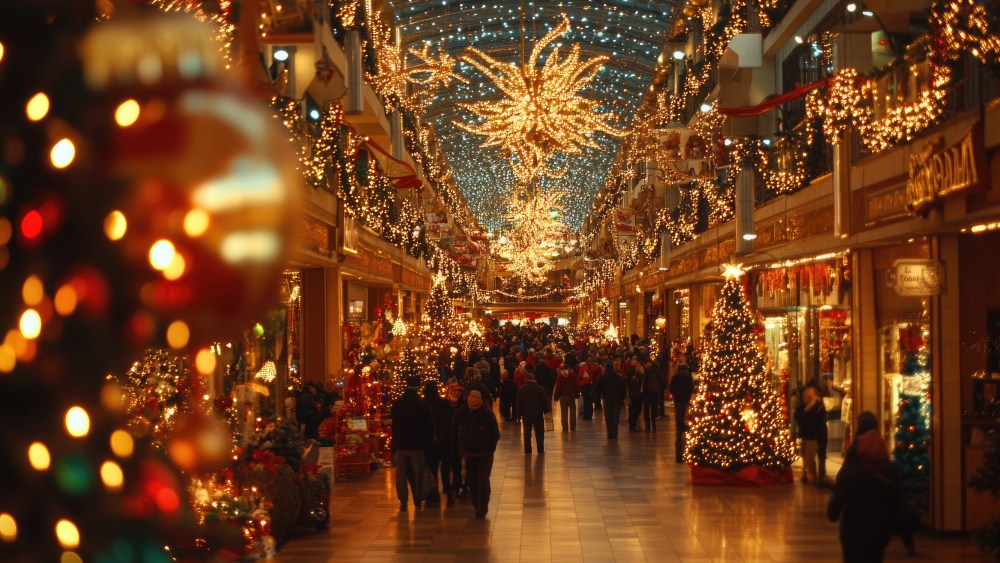
Retailers are heading into the heart of the holiday season with a heap of concerns, from consumers cutting back on non-essentials and anxious over the economy, to higher prices from tariffs, inflation and potential stockouts. Yet many retailers expect to pull through the 2025 holiday season with satisfactory, if modest, gains. Walmart, Amazon, Gap, TJX and Ross Stores have raised guidance for the year, reflecting confidence in the fourth quarter. And other retailers that have been performing well this year Aritzia, Vuori, Primark, Bloomingdale’s, Abercrombie & Fitch, Costco and Ann Taylor-parent Knitwell should emerge from the 2025 holiday season in decent shape. Several factors will fuel holiday gains. The S&P 500 index is up 11 percent this year, adding to the nation’s wealth factor. Also, newer channels for shopping, i. e. agentic commerce, are gaining traction, and channels that have around for awhile like mobile shopping, social media apps such as TikTok, livestreaming, and the resale market continue to increase in popularity. AI is also making it easier to personalize the shopping experience. So whatever makes shopping faster, easier and more convenient will stimulate purchasing. An Undercurrent of Uneasiness America’s mood is a bit brighter since the government shutdown ended, yet there remains an undercurrent of uneasiness over rising health, home and food costs, and the possibility of the economy deteriorating next year. “Economic uncertainty keeps the brain and nervous system in a constant state of anxiety and alertness. This makes it harder for people to manage holiday shopping and planning. Thus, we can’t simply enjoy the season,” said Dr. Hannah Nearney, clinical psychiatrist and U. K medical director at Flow Neuroscience, which develops brain stimulation solutions for mental well-being, in a statement. Still, retailers say consumers and their shopping patterns have shown resilience. “While we do study data that suggests there’s macro pressure, particularly on the low-income consumer, our customers are really responding to our price, value and style,” Richard Dickson, president and chief executive officer of Gap Inc., told WWD last week after the company reported robust third-quarter sales. “Our offerings are breaking through the competitive landscape so we’re feeling very confident and excited as we head into the holiday season.” But there’s plenty to keep brands and retailers on their guard. “Between tariffs, inflation, the shutdown and the situation at Saks Global, there’s been a lot to worry about,” one chief executive of a major brand told WWD, referencing Saks’ sales declines and late payments to vendors. “With the price changes, we were expecting a drop in unit sales, but we really haven’t seen that, so it seems any increase has been received better than expected. Our numbers have been pretty good, so that’s a positive for going forward.” One senior level apparel executive said the consumer prices at his brand are up this holiday season by 7 to 10 percent, though others in the supply chain would have absorbed some of the costs created by new tariffs. “I feel we have a very solid season in front of us,” said Michael Kliger, CEO of LuxExperience, operator of the Mytheresa, Net-a-porter and Mr Porter websites, last week, after the company reported its fiscal first-quarter results. “At Mytheresa, Q1 was plus 12 percent, and even though we are still negative at Net-a-porter and Mr Porter, we clearly see momentum in that business. We are just coming from a lower base, so not including any negative macro effects, we’re looking at a solid season. The U. S. continues to be quite strong. Europe continues to be very stable, with single-digit growth and Asia, we feel, has reached the bottom. It’s stable at a low level, but it’s stable.” Off-price stores, as well as dollar stores, appear headed for a decent holiday season. “Ross posted a stronger quarter than expected, with results showing that its core value shopper remained resilient despite lapsed SNAP [food stamp] benefits and broader tariff uncertainty weighing on household budgets,” said Suzy Davidkhanian, vice president of Emarketer, in an email. “Opportunistic buys and department-store excess helped margins and Ross’s no-frills, warehouse-style stores delivered exactly what budget-conscious families needed this season strong, compelling assortment mix at sharp price points. Holiday gifting may still skew toward essentials for this shopper, but the quarter underscores that the lower-income consumer is holding up better than many feared.” Modest Holiday Sales Gains Seen The National Retail Federation predicts that retail sales for the November and December period will grow between 3. 7 percent and 4. 2 percent, surpassing $1 trillion for the first time in 2025. The trade organization also expects 186. 9 million people in the U. S. will shop at one point or another during the Thanksgiving Day through Cyber Monday period, which is 3. 5 million more than last year. But not all industry sources are as sanguine. Deloitte projects holiday sales growth of just 2. 9 to 3. 4 percent, and others are even more bearish. Target, which is one of the largest retailers in the country, sees its sales declining by a low single-digit percentage in the fourth quarter. The discounter is being impacted by both macro issues and its own internal merchandising issues. Home Depot’s results, too, are not very encouraging. While the home improvement chain is believed to be gaining some market share, Home Depot’s third-quarter comparable sales in the U. S. rose just 0. 1 percent, and net earnings were flat. “Our results missed our expectations primarily due to the lack of storms in the third quarter, which resulted in greater than expected pressure in certain categories. Additionally, while underlying demand in the business remained relatively stable sequentially, an expected increase in demand in the third quarter did not materialize,” said Ted Decker, chairman, president and CEO, in a statement. “We believe that consumer uncertainty and continued pressure in housing are disproportionately impacting home improvement demand.” Bed, Bath & Beyond also experienced a tough third quarter. Its net revenue declined 17. 4 percent due to lower customer demand, though the company did cite significant operational improvements, including an 85 percent improvement in both adjusted EBITDA and gross margin. Digging further into NRF’s outlook, the percent gain for the holiday season the trade organization forecasts is lower than the 4. 3 percent gain experienced last year. Also, the U. S. inflation rate is just over 3 percent and on the rise lately. That means that “real” holiday retail sales will grow around 1 percent, based on NRF’s projection for nominal sales which are not adjusted for inflation. The American Shopping Spirit Still, consumers show a willingness to spend even while being pickier, and worried about the rising costs of living, and next year’s economy. “Americans like to buy stuff. They will find a way to make the holiday work, regardless of tariffs, the government shutdown and inflation,” said John Harmon, managing director of technology and research at Coresight. “We think holiday is on track to grow 3 to 3. 5 percent which is a normal, not exceptional season. The holiday quarter isn’t shaping up to be a blockbuster; it’s shaping up to be a balancing act. Consumer spending is holding steady rather than surging, with families prioritizing essentials, tightening discretionary budgets, and making more deliberate choices even as inflation cools and sentiment improves. It’s creating one of the most nuanced holiday seasons in years; not a slowdown, not a boom, but a careful middle ground that says as much about shoppers as it does about retailers.” Higher-income consumers, meaning those earning more than $100, 000 a year, are more positive, Harmon said. “They will be driving holiday spending this season, but everyone is trading down, even high-income consumers.” Industry researchers and pundits say the best deals will be found on Black Friday and Cyber Monday and that those two sales days haven’t lost their relevance, even if some of the business then is being siphoned away by retailers triggering holiday campaigns as early as October, and launching Black Friday deals days before the actual date. Price Promoting Pivots Accenture’s annual Holiday Shopping Survey of more than 7, 500 shoppers in 10 countries, conducted online between August and September this year, indicated that 77 percent will shop on Black Friday and Cyber Monday. Forty-five percent indicated they will come prepared with a list of items they want to buy. As of early November, 58 percent of consumers said they have already started their in line with the last five years. On average, holiday shoppers have completed around one-quarter of their planned purchases. Industrywide, price promoting this season isn’t expected to be as steep as in recent years. Retailers will be more strategic, and less inclined to run storewide sales. “When it comes to Black Friday and holiday deals this year, shoppers can expect them to look a little different,” said Stephanie Carls, retail insights expert from RetailMeNot, a website and app to find discounts, coupon codes and cashback offers, in response to a query from WWD. “Tariffs are already influencing the holiday shopping season, and many retailers are absorbing some of these costs to avoid significantly raising their prices. As a result, the deals we see, and how steep they are, may be affected.” She said the top items consumers plan to gift are clothing and accessories, followed by gift cards and toys. Total gift card spending is expected to reach $29. 1 billion, up from $28. 6 billion in 2024, according to RetailMeNot research. Consumers plan to purchase between three to four gift cards and expect to spend an average of $171. 32 per person. Restaurants remain the most popular gift card type (27 percent), followed by bank-issued cards (25 percent), department stores (25 percent) and coffee shops (20 percent). Coresight’s Harmon said this will be the first holiday season of agentic commerce. “Consumers were already using AI to discover and research products,” said Harmon, adding that a Coresight survey in October indicated that more than half of American consumers were using AI frequently or occasionally. In September, in a move that could dramatically change how people purchase goods online, OpenAI and Shopify reached an agreement that will let consumers make purchases from the ChatGPT chatbot without leaving the artificial intelligence-generated conversation. Etsy, Salesforce, Walmart and Target followed suit. “The customer experience is very rich using ChatGpt,” Harmon said. “For example, if you are looking for a slim backpack for $100, you can get a lot more information, and if the product is on Etsy, Walmart and Shopify you can hit a buy button and the transaction is done. That’s the agentic part. It can communicate with the retailer and initiate a transaction,” skipping the links. “It makes it a lot more convenient to buy things.” He sees agentic commerce as a trend just beginning, and not necessarily a big trend this holiday season, though there are signs indicating it will be big in the future. Weatherwise, the holiday outlook is good. Conditions across much of the country should spur traditional holiday gift categories like cold weather accessories and sweaters, and not deter driving to malls, according to a report from Planalytics, which predicts the weather to help retailers plan and manage their inventories and understand consumer shopping patterns. “The week of Thanksgiving will start warmer than normal for a large part of the country, especially across the Plains and South. As the week progresses, a system will drive colder air into the West and then spread it eastward into the Plains and Midwest by Wednesday into Thursday, creating a more seasonally chilly feel in these regions and strengthening demand for coats, cold-weather accessories, comfort foods, and hot beverages,” Planalytics said. “By Black Friday weekend, many key markets will trend colder than normal. This setup will be favorable for winter-driven categories such as outerwear, boots, hats and gloves, electric heat, and seasonal food and beverages as shoppers respond to both promotions and the more wintry feel. We are monitoring the potential for wintry conditions to affect parts of the Plains and Midwest, which could create travel challenges over the holiday weekend. Major coastal Northeast cities will face a lower risk of impactful snow, limiting the potential for widespread disruption even as colder temperatures still support seasonal demand.”.
https://wwd.com/business-news/retail/holiday-2025-what-retailers-and-prognosticators-anticipate-1238354235/
Holiday 2025: What Retailers and Prognosticators Expect