Tag Archives: round-the-clock

Israel halts aid to Gaza ‘until further notice’ as renewed fighting tests ceasefire

The fragile ceasefire in Gaza faced its first major test Sunday as an Israeli security official announced that the transfer of aid into the territory was halted “until further notice” following a Hamas ceasefire violation. Concurrently, Israeli forces launched a wave of strikes.

The official, who spoke on condition of anonymity pending a formal announcement, confirmed the suspension just over a week since the start of the U.S.-proposed ceasefire aimed at ending two years of war.

Earlier on Sunday, Israel’s military reported that its troops came under fire from Hamas militants in southern Gaza, with two soldiers later confirmed killed in the area. In response, the Israeli military said it struck dozens of what it described as Hamas targets.

Health officials in Gaza reported that at least 29 Palestinians were killed across the territory, including children.

### Ceasefire Tensions and Reactions

A senior Egyptian official involved in the ceasefire negotiations told reporters that “round-the-clock” contacts were ongoing to deescalate the situation. This official also spoke on condition of anonymity.

There was no immediate comment from the United States.

Israeli Prime Minister Benjamin Netanyahu directed the military to take “strong action” against any ceasefire violations but stopped short of threatening a return to war.

According to the Israeli military, militants fired on troops in parts of Rafah city controlled by Israel under the ceasefire agreement. Meanwhile, Hamas accused Israel of multiple ceasefire violations and claimed it had lost contact with its remaining units in Rafah for months, denying responsibility for any incidents in those areas.

### Strikes in Gaza Raise Fears of Renewed Conflict

Palestinians expressed deep concern about the potential return to war.

“It will be a nightmare,” said Mahmoud Hashim, a father of five from Gaza City, who appealed to U.S. President Donald Trump and other mediators to prevent the ceasefire’s collapse.

An Israeli airstrike on a makeshift coffeehouse in Zawaida town in central Gaza killed at least six Palestinians, according to Gaza’s Health Ministry, which is run by Hamas.

Another strike near the Al-Ahly soccer club in the Nuseirat refugee camp killed at least two people. The strike hit a tent, wounding eight others, according to Al-Awda Hospital, which received the casualties.

The hospital also received the bodies of four people killed in a strike on a school sheltering displaced families in Nuseirat.

Further casualties included six killed in a tent in Nuseirat, one at a charging point west of Nuseirat, and four at a house in Bureij camp.

In Khan Younis, a strike hit a tent in the Muwasi area, killing at least four people, including a woman and two children, according to Nasser Hospital.

Another strike in Beit Lahiya in northern Gaza killed two men, the Shifa Hospital reported.

### Identification of More Hostage Remains

Israel identified the remains of two hostages released by Hamas overnight. Netanyahu’s office said the bodies belonged to Ronen Engel, a father from Kibbutz Nir Oz, and Sonthaya Oakkharasri, a Thai agricultural worker from Kibbutz Be’eri.

Both were believed killed during the Hamas-led attack on southern Israel on October 7, 2023, which initiated the ongoing war.

Engel’s wife, Karina, and two of his three children were kidnapped and later released in a ceasefire agreement in November 2023.

Over the past week, Hamas has handed over the remains of 12 hostages. The armed wing of Hamas, the Qassam Brigades, stated they found the body of a hostage and would return it on Sunday “if circumstances in the field” allowed, warning that any Israeli escalation would hinder search efforts.

### Border Crossing and Hostage Remains Dispute

Israel has pressed Hamas to fulfill its ceasefire obligation to return the remains of all 28 deceased hostages. As a result, the Rafah border crossing between Gaza and Egypt remains closed “until further notice.”

Hamas cites the war’s devastation and Israeli military control of parts of Gaza as reasons for the slow handover. Israel suspects Hamas has access to more bodies than it has returned.

Meanwhile, Israel has released 150 Palestinian bodies back to Gaza, including 15 on Sunday, according to Gaza’s Health Ministry. These bodies, many in an advanced state of decomposition, have not been identified by Israel nor has their cause of death been disclosed.

Currently, only 25 have been identified by the Health Ministry, which posts photos of the bodies online to assist families.

Previously, Israel and Hamas exchanged 20 living hostages for over 1,900 Palestinian prisoners and detainees.

### Next Steps in Ceasefire Negotiations

A Hamas delegation, led by chief negotiator Khalil al-Hayya, arrived in Cairo to follow up on the ceasefire’s implementation with mediators and other Palestinian groups.

The next phases are expected to focus on disarming Hamas, Israeli withdrawal from additional controlled areas in Gaza, and future governance of the devastated territory.

Hamas spokesman Hazem Kassem stated on Saturday that the second phase of negotiations “requires national consensus,” adding that Hamas has initiated discussions to “solidify its positions.”

The U.S. plan suggests establishing an internationally backed authority to govern Gaza. Kassem reiterated that Hamas will not participate in the postwar governing body, instead calling for a body of Palestinian technocrats to manage day-to-day affairs.

“For now, government agencies in Gaza continue to perform their duties, as the (power) vacuum is very dangerous,” he said.

### Status of the Rafah Border Crossing

Before the war, the Rafah crossing was the only one not controlled by Israel. It has been closed since May 2024, after Israel assumed control of the Gaza side.

A full reopening would facilitate medical treatment, travel, and family visits for Palestinians, many of whom have family connections in Egypt.

On Sunday, the Palestinian Authority’s Interior Ministry in Ramallah announced procedures for Palestinians wishing to enter or exit Gaza through Rafah.

Palestinian embassy staff in Cairo will issue temporary travel documents to those leaving Gaza. Those seeking to enter Gaza must apply at the embassy.

### Casualties and Humanitarian Toll

The Israel-Hamas conflict has killed more than 68,000 Palestinians, according to Gaza’s Health Ministry, which does not differentiate between civilians and combatants. The ministry maintains detailed casualty records considered generally reliable by U.N. agencies and independent experts.

Israel disputes these figures but has not presented its own official count.

Thousands more remain missing, according to the Red Cross.

The Hamas-led militants killed around 1,200 people, mostly civilians, and abducted 251 during the October 7 attack that sparked the war.
https://www.wptv.com/world/israel-at-war/israel-halts-aid-to-gaza-until-further-notice-as-renewed-fighting-tests-ceasefire

More saber-rattling

Driven by the political exigency of the Bihar elections, India’s leadership has reignited an old fire. Prime Minister Narendra Modi’s invocation of Operation Sindoor and threats to change geographies have been followed by his defence minister’s explicit threat regarding the Sir Creek. This is reckless brinkmanship.

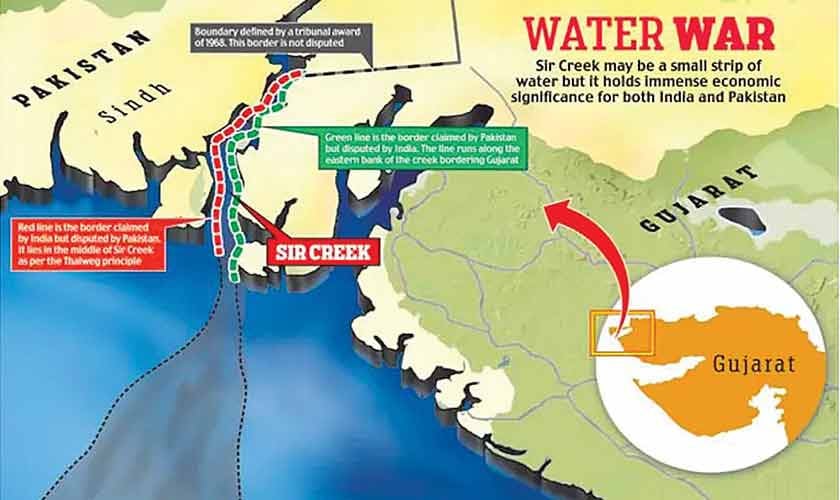
The Sir Creek area is a 96-kilometre-long tidal estuary located in the Indus Delta, forming part of the border between Sindh and India’s Gujarat. It is among Pakistan’s most strategically crucial and ecologically sensitive areas. Lying at the edge of the Indus River Delta, vital shipping routes and fishing grounds, it holds significant economic and geopolitical importance. Its proximity to the international maritime boundary with India makes it a geopolitically sensitive zone.

Control of Sir Creek is essential for safeguarding Pakistan’s maritime boundaries and preserving its exclusive economic zone (EEZ), which is abundant in marine resources. The estuary’s ever-shifting tidal surges and sediment deposition render nautical charts unreliable and navigation challenging. To secure the frontier, naval and marine personnel must conduct frequent surveillance and patrols, often in hovercraft and boats, even on foot, through the treacherous terrain.

Pakistan claims rights, in accordance with the Bombay Government Resolution of 1914, to the entire waters surrounding and fed by the creek, says Rear Admiral Foad Baig, a former director general of Pakistan Maritime Security Agency. This agreement, part of the Surveyor General’s Map, fixed the border on the creek’s eastern bank. Pakistan’s position is, therefore, based on upholding this pre-existing, fixed boundary. It has argued that the Thalweg principle, which places the boundary mid-stream, is inapplicable as the creek is a non-navigable estuary and the border was never intended to shift with the channel.

Demonstrating its commitment to a peaceful solution, Pakistan prioritised bilateral resolution. This led to a joint survey in 2007 and an exchange of agreed-upon maps. However, this process was stopped when, following the Mumbai terrorist attacks, India withdrew in 2008.

Despite the Indian position on Sir Creek, Pakistan’s claim to an extended Continental Shelf 150 NM beyond the EEZ was accepted in March 2015. This granted Pakistan 50,000 sq km of seabed territory, giving legal control over natural resources in this offshore area, says Rear Admiral Foad Baig.

The Sir Creek dispute dates back to the April 1965 Rann of Kutch battle. Some 20 years ago, the Pakistan Navy established its Coastal Command. The strategic initiative was designed to enhance amphibious and expeditionary warfare capabilities and ensure naval readiness. Pakistan Marines were raised about two decades ago and mandated to defend the creeks area southeast of Karachi, he adds.

Pakistan Marines operate in one of the most challenging environments worldwide. Rear Admiral Baig says, for the forces deployed here, the Sir Creek sector is a relentless, physical trial. It is a world of oozing mudflats where the ground shifts with the tides. Tactics are shaped by these constant transformations.

The marines conduct relentless patrols and surveillance, navigating the difficult terrain to monitor activity and gather intelligence. Their deployment in this fluid and strategically vital border is critical to defend against infiltration, smuggling, and illegal fishing, he says.

The marines endure exceptionally harsh conditions defined by oppressive humidity, scorching heat, and salt-laden winds. The unstable, waterlogged terrain rules out conventional roads, making small boats and hovercraft the sole lifelines for transport and supply.

Baig says the difficult geography also affords strategic advantage. “The marshy land forbids any rapid ingress of the enemy,” he says. “Also, the environment offers excellent opportunities for camouflage. We have better geography on our side, making operations a little more convenient.”

As both navies maintain a forward posture, deployment is no longer limited to periods of hostility. Pakistan Marines remain in a state of perpetual readiness, sustaining a forward presence to enable strategic deployment beyond primary bases.

To maintain a high level of vigilance, the Navy and the Marines employ a robust, integrated surveillance architecture. Through round-the-clock Marine Domain Awareness, the Navy maintains real-time tracking and monitoring of hostile navies, he says. Intelligence flows seamlessly from this system, ensuring tactical and operational flexibility.

This intelligence is constantly fed to layered defences comprising long-range missiles, air defence systems, an unmanned force, and drone units. This is meant to deny the element of surprise to enemy forces.

Despite the Indian position on Sir Creek, Pakistan’s claim for an extended Continental Shelf 150 NM beyond the EEZ was accepted in March 2015. This added 50,000 sq km of seabed territory, granting legal control over natural resources in this offshore area.

Rear Admiral Foad Baig says Pakistan’s operational planning employs innovative tactical approaches that leverage the complex creek terrain to neutralise the adversary’s numerical advantage. Being a porous zone, Sir Creek could be targeted for a false-flag operation. Rear Admiral Baig highlights this is a persistent risk.

This could involve a fabricated account of an incident involving a fisherman’s boat or aggressive maneuvers targeting the Karachi Port. Alternatively, there may be an attempt to infiltrate the defences so that saboteurs can strike key harbour infrastructure. Such tactics and strategies have been war-gamed repeatedly, he says.

Through plans integrated with the Pakistan Army and Air Force, the Pakistan Marines maintain a qualitative edge. “We have no aggressive designs against anyone, but by the Grace of Allah, we can effectively blunt any mischief in a befitting manner.”

This vigilant posture is deemed essential as India is building up its military presence in the area, bringing more BSF units, naval assets, and special operations (MARCOS) forces along the coast. The Indian mobilisation has been supported by infrastructure upgrades and air bases. In the face of this mobilisation, the Pakistan Navy and Pakistan Marines have maintained a robust and resilient watch.

**Recent Threats**

Responding to recent statements by Indian leaders with regard to Karachi and Port Qasim, the Inter-Services Public Relations (ISPR) said: “The people and Armed Forces of Pakistan have the capability and resolve to take the fight to every nook and corner of the enemy’s territory.”

Several months ago, Lt Gen Ahmed Sharif Chaudhry had highlighted this capability by emphasising Pakistan’s potential to strike deep into India, particularly targeting its industrial base in the east. He had warned that in the event of an Indian misadventure, Pakistan could retaliate with precision strikes against counter-value targets in India’s military-industrial complex, including eastern economic hubs such as Kolkata, Jamshedpur, and Bhubaneswar, which remain within reach of missiles fired from the Karachi harbour.

These assertions of military capability are framed by a deepening apprehension over Indian intentions. In a stark assessment of regional tensions, former ambassador Naghmana Hashmi highlights a grave warning issued by Pakistan’s former National Security Advisor Nasir Janjua. Janjua has said that India is capable of launching a missile attack on Pakistan.

Hashmi expresses particular concern that Prime Minister Modi, preoccupied apparently with the upcoming Bihar election, might resort to dangerous actions for domestic political gain. The schedule of the Bihar elections makes the threat immediate. Modi could use a limited military strike to rally nationalist voters, she says.

Hashmi cautions against dismissing Indian threats as mere electoral rhetoric, noting that Modi and the Indian military leadership could use kinetic force to avenge the enormous humiliation faced by them. The aggressive posturing comes at a delicate time for India, as it navigates growing friction with the United States, a key strategic partner.

While these bilateral tensions are likely a temporary strain rather than a lasting rupture, they add pressure on New Delhi. The US is not going to abandon its broad strategic plans for the region, which depend heavily on India as a counterweight to China.

Hashmi says that the May 2025 conflict exposed India’s vulnerability and weaknesses across various domains. She says the US stance is a clear message to India to deliver on its side of the strategic partnership and unequivocally side with the West against China and Russia.

Hashmi says that preventing Sindoor-2 requires demonstrating matching preparedness. Pakistan must strengthen its defences and regional alliances to deter India’s ambitions and ensure stability in the face of geopolitical shifts.
https://www.thenews.com.pk/tns/detail/1350033-more-saber-rattling