Tag Archives: hence

Dogecoin Price Could Bounce Very Quickly If This Happens At $0.166

The Dogecoin price has generally followed the trajectory of other altcoins relative to Bitcoin, experiencing deeper declines compared to the pioneer cryptocurrency. These declines have left the leading meme coin by market cap in the red, pushing it back down to levels not seen since 2023. As a result, Dogecoin is now in a precarious position where it needs to make a major move, or investors risk further declines as the altcoin struggles to find support.

### Next Trajectory for the Dogecoin Price

Bitguru, in an analysis on X, outlined where the Dogecoin price currently stands and what could determine its next move. It all comes down to a critical level that could send the price in either direction — a point where both bulls and bears are fighting for dominance. This key level is $0.166.

According to the crypto analyst, Dogecoin has been in a clear downtrend for some time, with no strong indications of a reversal. Sideways movement has been the prevailing trend, and catalysts that could trigger another rally have yet to materialize.

Recently, Dogecoin was rejected at $0.1823, a major resistance level for the digital asset. This rejection has put sellers back in control as the price moves toward the critical $0.166 mark. It’s important to note that this $0.166 level lies just above a major support area at $0.16, making it imperative for bulls to reclaim and hold this price to prevent further declines.

### Bearish Signals and Market Challenges

Another challenge Dogecoin faces is the formation of lower highs, which is a bearish signal for any cryptocurrency. Lower highs indicate weakening buyer strength and growing seller dominance. If this pattern continues, it could pave the way for further declines rather than a recovery.

Over the past weekend, the Dogecoin price attempted a rebound but was ultimately pushed back down, as Bitcoin struggled to maintain its position around $95,000.

### What’s Next for Dogecoin?

For bulls to regain momentum and push Dogecoin higher, reclaiming the $0.166 level is the immediate task. Failure to do so with sufficient momentum could lead to a deeper correction. Should the decline continue, the next major support is expected at $0.15 — a level where buying interest could potentially trigger a short-term rebound.

In summary, Dogecoin remains at a critical juncture. The battle between buyers and sellers at the $0.166 level will likely dictate the altcoin’s near-term trajectory, with significant implications for investors and the broader market sentiment.
https://bitcoinethereumnews.com/tech/dogecoin-price-could-bounce-very-quickly-if-this-happens-at-0-166/

The impossibility of perfect fairness in transaction ordering

For decades, research in distributed systems, especially in Byzantine consensus and state machine replication (SMR), has focused on two main goals: consistency and liveness. Consistency means all nodes agree on the same sequence of transactions, while liveness ensures the system continues to add new ones.

Still, these properties do not stop bad actors from changing the order of transactions after they are received. In public blockchains, that gap in traditional consensus guarantees has become a serious problem. Validators, block builders, or sequencers can exploit their privileged role in block ordering for financial gain—a practice known as maximal extractable value (MEV).

This manipulation includes profitable frontrunning, backrunning, and sandwiching of transactions. Because transaction execution order determines validity or profitability in DeFi applications, the integrity of transaction ordering is vital for maintaining fairness and trust.

## Introducing Transaction Order-Fairness

To address this critical security gap, **transaction order-fairness** has been proposed as a third essential consensus property. Fair-ordering protocols ensure that the final order of transactions depends on external, objective factors, such as arrival times (or receiving order), and is resistant to adversarial reordering.

By limiting how much power a block proposer has to reorder transactions, these protocols move blockchains closer to being transparent, predictable, and MEV-resistant.

## The Condorcet Paradox and the Impossibility of Ideal Fairness

The most intuitive and strongest notion of fairness is **Receive-Order-Fairness (ROF)**. Informally defined as “first received, first output,” ROF dictates that if a sufficient number of transactions (tx) arrive at a majority of nodes earlier than another transaction (tx′), then the system should order tx before tx′ for execution.

However, achieving this universally accepted “order fairness” is fundamentally impossible unless all nodes can communicate instantaneously (i.e., operating in an instantly synchronous external network). This impossibility arises from a surprising connection to social choice theory, specifically the **Condorcet paradox**.

The Condorcet paradox illustrates how, even when every individual node maintains a transitive internal ordering of transactions, the collective preference across the system can result in non-transitive cycles. For example:

– A majority of nodes receive transaction A before B,
– A majority receive B before C,
– A majority receive C before A.

Hence, the three majority preferences form a loop (A → B → C → A). This means that no single consistent ordering of transactions A, B, and C can satisfy all majority preferences simultaneously.

This paradox demonstrates why perfectly achieving Receive-Order-Fairness is impossible in asynchronous networks or even in synchronous networks with long external network delays.

## Hedera Hashgraph and the Flaw of Median Timestamping

Hedera, which employs the Hashgraph consensus algorithm, seeks to approximate a strong notion of receive-order fairness (ROF). It assigns each transaction a final timestamp, computed as the median of all nodes’ local timestamps for that transaction.

However, this approach is inherently prone to manipulation. A single adversarial node can deliberately distort its local timestamps and invert the final ordering of two transactions, even when all honest participants received them in the correct order.

**Example:**

Consider five consensus nodes (A, B, C, D, and E) where Node E acts maliciously. Two transactions, tx₁ and tx₂, are broadcast to the network. All honest nodes receive tx₁ before tx₂, so the expected final order should be tx₁ → tx₂.

But adversary Node E assigns:

– tx₁ a later timestamp (3)
– tx₂ an earlier timestamp (2)

to skew the median.

When the protocol computes medians:

– For tx₁, timestamps are (1, 1, 4, 4, 3) → median is 3
– For tx₂, timestamps are (2, 2, 5, 5, 2) → median is 2

Because the final timestamp of tx₁ (3) is greater than that of tx₂ (2), the protocol outputs tx₂ → tx₁, reversing the true order observed by all honest nodes.

This example shows a critical flaw: the median function, although seemingly neutral, can be exploited by even a single dishonest participant to bias the final transaction order.

As a result, Hashgraph’s often-touted “fair timestamping” offers only a surprisingly weak notion of fairness. It fails to guarantee receive-order fairness and depends on a permissioned validator set rather than on cryptographic guarantees.

## Achieving Practical Fairness Guarantees

To circumvent the theoretical impossibility revealed by Condorcet, practical fair-ordering schemes must relax the fairness definition.

The **Aequitas** protocols introduced the criterion of **Block-Order-Fairness (BOF)**, or batch-order-fairness.

BOF dictates that if sufficiently many nodes receive a transaction tx before another transaction tx′, then tx must be delivered in a block *before or at the same time* as tx′. That is, no honest node can deliver tx′ in a block after tx. This relaxes ROF’s strict requirement of “must be delivered before” to “must be delivered no later than.”

### Practical Example of BOF

Consider three consensus nodes (A, B, and C) and three transactions: tx₁, tx₂, and tx₃.

A transaction is considered “received earlier” if at least two of the three nodes (a majority) observe it first. Applying majority voting to determine the global order:

– tx₁ → tx₂ (agreed by A and C)
– tx₂ → tx₃ (agreed by A and B)
– tx₃ → tx₁ (agreed by B and C)

These preferences create a loop: tx₁ → tx₂ → tx₃ → tx₁, which means strict ROF is impossible.

**BOF resolves this by grouping all conflicting transactions into the same batch or block instead of forcing one to come before another.** The protocol outputs:

> Block B₁ = {tx₁, tx₂, tx₃}

From the protocol’s perspective, all three transactions happen simultaneously. Inside the block, a deterministic tie-breaker (such as a hash value) decides the exact execution order.

This approach ensures fairness for every pair of transactions and maintains a consistent final transaction log where each transaction is processed no later than the ones preceding it.

Importantly, BOF does **not** result in partial ordering. Every node still agrees on a single, linear sequence of transactions. Transactions inside each block remain arranged in a fixed execution order.

When no conflicts occur, the protocol achieves the stronger ROF property.

## Limitations of Aequitas and the Introduction of Themis

While Aequitas successfully achieves BOF, it faces significant challenges:

– Very high communication complexity.
– Guarantees only **weak liveness**, meaning a transaction’s delivery is guaranteed only after completing the entire Condorcet cycle it belongs to. This could cause arbitrary delays if cycles chain together.

To improve upon this, the **Themis** protocol was introduced, enforcing the same strong BOF property but with improved communication efficiency.

Themis uses three key techniques:

1. **Batch Unspooling**
2. **Deferred Ordering**
3. **Stronger Intra-Batch Guarantees**

### Themis Protocol in Action

In its standard form, Themis requires each participant to exchange messages with most nodes, causing communication cost to grow quadratically with network size.

However, in **SNARK-Themis**, nodes use succinct cryptographic proofs to verify fairness without direct communication with every other participant. This optimization reduces communication complexity to linear growth, enabling scalability in large networks.

**Example:**

Five nodes (A-E) receive transactions tx₁, tx₂, and tx₃ with differing local orders due to network latency, forming a Condorcet cycle.

Instead of waiting for the cycle to resolve completely, Themis:

– Identifies all transactions in the cycle as a **strongly connected component (SCC)**
– Outputs them as a batch-in-progress:

> Batch B₁ = {tx₁, tx₂, tx₃}

By doing this, Themis keeps the system live and avoids stalling by allowing continued processing of new transactions while finalizing internal batch order.

## Summary: The Evolution of Fairness in Distributed Systems

The concept of perfect fairness in transaction ordering may seem straightforward: whoever’s transaction reaches the network first should be processed first.

However, as the Condorcet paradox illustrates, this ideal cannot hold in real distributed systems. Nodes experience different transaction orders, and conflicting views prevent any protocol from always producing a universally “correct” sequence without compromise.

Hedera’s Hashgraph attempts to approximate this ideal via median timestamps but relies more on trust than proof. A single dishonest participant can skew the median and flip transaction order, showing that “fair timestamping” is not truly fair.

Protocols like Aequitas and Themis move the discussion forward by acknowledging what is achievable. Instead of chasing the impossible, they redefine fairness to preserve order integrity under real network constraints.

This evolution draws a clear line between perceived fairness and provable fairness. True transaction-order integrity in decentralized systems must rely not on reputation, validator trust, or permissioned control, but on cryptographic verification embedded within the protocol itself.

*This article does not contain investment advice or recommendations. Every investment and trading decision involves risk, and readers should conduct their own research.*

*The views expressed here are the author’s alone and do not necessarily reflect the views of Cointelegraph. Cointelegraph does not endorse the article’s content or any product mentioned. Readers assume full responsibility for any decisions related to the products or companies discussed.*
https://bitcoinethereumnews.com/tech/the-impossibility-of-perfect-fairness-in-transaction-ordering/


$140,000,000 in Stellar Open Interest Hint at What’s Next for XLM Price

Stellar (XLM) has recorded a 1.16% increase in its four-hour open interest despite the asset’s continued price decline on the market. According to data from CoinGlass, while the 24-hour open interest declined by 11.27%, recent activity within the past four hours shows that traders are betting on a possible rebound.

### Stellar Four-Hour Futures Signal Bullish Sentiment

Open interest reflects the total value of futures contracts that investors have open on XLM. A high percentage generally indicates bullish confidence among investors. The negative 11.27% change about 24 hours ago revealed uncertainty regarding the price direction. However, the four-hour figure of 1.16% as of press time suggests that bullish sentiment is gradually gaining traction.

These traders have committed $140 million, or 465.24 million XLM, to the asset’s futures market. Among exchanges, Binance traders showed the most bullish stance, committing $37.62 million, which represents 27.21% of the total open interest. Bitget, Bybit, and OKX followed with commitments of $24.96 million, $21.95 million, and $14.21 million, respectively.

### Price Performance and Market Activity

Although traders are anticipating a price rebound, Stellar has yet to show positive momentum. At press time, XLM was trading at $0.3011, marking a 7.65% decline over the past 24 hours. The token slipped from an intraday high of $0.3284 amid ongoing market volatility.

However, trading volume has increased by 49.48%, reaching $419.94 million. This uplift in engagement could serve as a catalyst for a price reversal in the near term.

### Could Stellar’s 2025 Rally and DeFi Growth Spark a Price Recovery?

The bullish sentiment among traders may be rooted in Stellar’s strong year-to-date performance. As of September 2025, XLM had surged 288%, significantly outperforming both Bitcoin and Ethereum, which recorded gains of 88% and 73%, respectively.

Earlier in the year, Stellar briefly surpassed the $0.40 resistance level, reaching $0.4036 during the “Uptober” rally before broader market fluctuations triggered a sharp pullback.

Many investors and analysts had anticipated a major breakout, driven largely by Stellar’s milestones in the decentralized finance (DeFi) space. The platform has seen increased adoption, with nearly 400 million XLM locked as it attracted more users, including institutional investors.

Although this growing adoption has not yet translated into a sustained price rally, the current uptick in open interest might provide the spark needed for a recovery back towards the $0.40 level.

Stay tuned for updates on Stellar’s price action and market developments as traders closely watch for signs of a potential turnaround.
https://u.today/140000000-in-stellar-open-interest-hint-at-whats-next-for-xlm-price

A life in lines

Our palms are filled with lines of various kinds—sharp and clear, light and deep, small, repeated, and crossed. To an ordinary eye, they appear as an incomprehensible web. To a palmist, they form a code: a pattern to be read, analysed, and interpreted to reveal personality, trace the past, describe the present, and foresee the future. Each palm is a unique map, a mark of identity.

Hence, the thumbprint is used to sign property contracts, rental agreements, or, in cases of illiteracy, official documents such as passports, national identity cards, or driving licences. Signatures are another form of identification. They are used to open bank accounts, draw cheques, or apply for jobs. One signs a greeting card just as readily as a secret file.

For artists, signatures carry special meaning: they appear on paintings, beneath prints, embedded in bronzes, or behind canvases, often accompanied by a date or year, testifying to authorship and presence. Yet many artists, from the ancient to the contemporary, have chosen not to sign their work at all—perhaps in agreement with Robert Rauschenberg, who once remarked that a signature is merely the final layer of an image.

For most people, the first stage of an artwork is a sketch. It is later developed or enlarged into a more complex piece. For others, drawing is an independent creation. Whether a step towards a larger project or a self-contained entity, drawing offers freedom unmatched by what is usually regarded as the resolved work. It allows the artist to observe, experiment, exploit, and diverge—to think visually without constraint.

This freedom of approach is evident in Ijaz ul Hassan’s *Sketchbook: An Eye for the Familiar & the Exquisite.* Edited by Sadia Pasha Kamran and featuring an exclusive essay by Rahat Naveed Masud, the book has been published by Dr Musarrat Hasan.

The volume is significant not only for understanding the process of an artist who has worked for more than six decades, but also for exploring how an artist responds to external stimuli, shifting contexts, environments, and encounters that shape creative expression. The essays by Kamran and Masud provide a backdrop that is both contextual and historical, but it is the excerpts from the artist’s own writings—drawn from various publications and placed alongside his drawings—that offer the deepest insight into his aesthetics, shaped by recurring yet diverse motifs.

The book reads like a tome of pictorial diaries, long kept in closets until Dr Musarrat Hasan, a close collaborator, chose to bring them to light. In his foreword, Ijaz ul Hassan confirms:

> “The sketches compiled in this book are the outcome of travels across the world with Musarrat.”

An original artwork—whether two-dimensional, sculptural, digital, installation-based, or time-bound—inevitably becomes a flattened image when printed in a book, reduced to a uniform dimension and surface. Yet, to truly engage with Ijaz ul Hassan’s drawings, one must consider their original format.

Dr Musarrat Hasan’s contribution in preserving, cataloguing, and recalling the physical and contextual backgrounds of these works is immense. With few exceptions, all were made in small sketchbooks the artist carried with him on his travels. Dr Hasan also reveals that, during his teaching years at the National College of Arts, Ijaz ul Hassan would advise his students always to keep a sketchbook at hand—a principle reflected in his own practice.

For him, drawing was not merely an act of depiction but of perception: he believed that one truly begins to see only when one draws. No wonder these travelogues now appear as the imprint of an artist’s hand—the outcome of his observations, a documentation of his thoughts, and a recollection of his many trips and adventures.

These memories are catalogued by location, subject matter, and genre, rather than in chronological order, thereby preserving the spontaneity evident in the drawings themselves—an immediacy that reflects how the artist looked at and inscribed the world around him.

The components of that world are varied: flora and fauna, human figures, heritage sites, buildings, cities, landscapes, art-historical references, and instances of political commentary. The collection also includes his preparatory drawings for mosaics and murals, a visual response to the Taliban’s attack on the APS children, quick sketches of unknown passengers at airports, portraits of family and close friends, and studies of ordinary objects, often annotated with intimate or humorous remarks.

In one drawing, dated March 8, 2015, Hassan sketched a few bananas with the wry caption, “A bunch of miserable bananas,” recalling Pablo Neruda’s *Odes to Common Things*. Another, depicting Ustad Nusrat Fateh Ali Khan mid-performance, bears the line, “Nusrat Fateh executing a passage with full-throated passion.”

The lines that record the visible world and those that express thought through language are, in essence, intertwined.

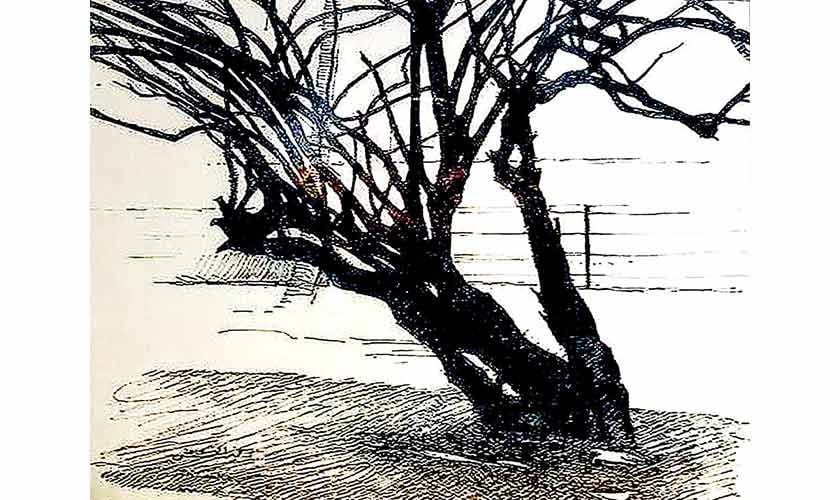
There are drawings of trees and flowers; his prison cell during Zia’s military dictatorship; views of Murree and Nathia Gali; glimpses of the Mediterranean, Italy, and the United States; as well as sketches from Rio de Janeiro, including the distinctive silhouette of Christ the Redeemer atop Mount Corcovado.

Among the most striking works in this collection are rapid depictions of the Pyramids, the outline of the Sphinx, and the portrait of a mummified Ramses II resting in his coffin. From the boats of Venice and Sri Lanka to the minarets of mosques and church towers, from the rocks of Afghanistan to the Isles of Scilly, and from the intricate details of a few leaves to the expanse of a garden, the artist’s inquiring gaze remains unyielding.

Perhaps one key element lies in a seemingly minor detail: his choice of small notebooks having blank pages on which to record his observations in pen and ink. Although the publication includes a few larger works and pencil drawings, the majority of reproductions are taken from the compact sketchbooks the artist carried wherever he went.

Making drawings or sketches is a common practice among artists across disciplines, yet Ijaz ul Hassan’s relationship with his medium adds another dimension to the work on paper. In addition to being a painter, Hassan is a leading writer on art and culture, the author of *Painting in Pakistan* (1991), one of the key texts on the country’s modern art, as well as numerous essays in catalogues and journals.

An avid reader who studied literature at Cambridge, his relationship with pen and paper extends beyond that of an image-maker who merely transcribes the visible world onto a surface, whether paper, canvas, stone, or any other material.

The difference lies in the act of writing itself. When drawing from nature or one’s surroundings, the artist is immediately engaged with a tangible subject—one that may shift or evolve during the process, yet maintains a kind of fidelity from the outset. Writing, by contrast, is a plunge into an undefined terrain. Ideas drift in the mind, and the act of writing becomes an attempt to translate them into words. It is, in essence, a quest to capture the unknown—a pursuit that continues until the text takes form or reaches its end.

When one examines the drawings gathered in this book, one realises that the artist’s hand never changes, whether he is capturing the quick likeness of a parrot, a branch in bloom, a peach, the profile of his wife, or the form of a sailboat. The hand that shapes his handwriting and signatures also guides these marks.

The lines that record the visible world and those that express thought through language are, in essence, intertwined—confirming that his immediate response to, in Laura Cummings’ phrase, everything he experiences, from the quotidian to the momentous, may differ in medium or form, yet remains unified in spirit.

The content and form of these drawings are not unlike the first draft of an author’s manuscript, from a time before the computer era. They are not displays of the artist’s technical prowess, nor were they intended as exhibition pieces. (Indeed, many were salvaged, cleaned, and separated from old, deteriorating boxes by Dr Musarrat Hasan.) Instead, they serve as records of how a remarkable mind finds new angles, details, and pleasures in objects both grand and mundane, familiar and strange, static and shifting—all through the medium of drawing.

Dr Hasan recalls travelling with Ijaz ul Hassan in the winter of 1965, driving from the United Kingdom to Pakistan. During that 45-day journey, she loaded a 24-exposure roll of film into their camera; only three photographs were taken.
https://www.thenews.com.pk/tns/detail/1350005-a-life-in-lines