
WASHINGTON — The U. S. military said it killed three people Monday in a strike on an alleged drug-smuggling vessel in the Caribbean Sea as part of the Trump administration’s monthslong campaign against alleged traffickers. Monday’s attack brought the death toll to at least 151 people since the Trump administration began targeting those it calls “narcoterrorists” in small vessels in early September. As with most of the military’s statements on the more than 40 known strikes, U. S. Southern Command said it targeted alleged drug traffickers along known smuggling routes. The military did not provide evidence that the vessel was ferrying drugs but posted a video on X that showed a small boat with outboard engines being destroyed. “Intelligence confirmed the vessel was transiting along known narco-trafficking routes in the Caribbean and was engaged in narco-trafficking operations,” Southern Command stated in a post on X. “Three male narco-terrorists were killed during this action.” President Donald Trump has said the U. S. is in “armed conflict” with cartels in Latin America and has justified the attacks as a necessary escalation to stem the flow of drugs into the United States. But his administration has offered little evidence to support its claims of killing “narcoterrorists.” Critics have questioned the overall legality of the strikes as well as their effectiveness, in part because the fentanyl behind many fatal overdoses is typically trafficked to the U. S. over land from Mexico, where it is produced with chemicals imported from China and India.
https://abcnews.com/US/wireStory/us-military-strikes-alleged-drug-boat-caribbean-sea-130426274
Tag Archives: narco-trafficking

EXCLUSIVE: DoW Legal Advisor: ‘Boat With Cocaine, Terrorists Heading to Poison Americans Is Legit Target’
RedState Exclusive
December 5, 2025
Washington, D.C.
As Democrats escalate their attacks following Capitol Hill briefings by U.S. Special Operations Command commander Admiral Frank M. Bradley, prominent military defense attorney and former Trump Navy lawyer Tim Parlatore told RedState that politicians are deliberately mischaracterizing lawful combat actions.
In an exclusive interview, Parlatore laid out the legal distinction at the heart of the controversy:
“You have a boat full of cocaine and terrorists heading to this country to poison and kill Americans. That’s a legitimate target,” Parlatore said.
“You then do battle damage assessment. The boat and the cargo remain legitimate military targets that SOUTHCOM has been ordered to put on the bottom of the ocean.”
Parlatore referred to the death of drug traffickers resulting from the second strike as “collateral damage.”
These comments stand in sharp contrast to statements made on Wednesday by top Democrats immediately after viewing classified drone footage.
Democrat Rep. Jim Himes (CT-4) described the video as “one of the most troubling things I’ve seen in my time in public service.”
Democrat Rep. Adam Smith (WA-9) accused U.S. forces of firing on “two shirtless people clinging to the bow of a capsized and inoperable boat,” declaring Admiral Bradley bears “ultimate responsibility” for a possible war crime.
Senator Jack Reed (D-RI) said he was “deeply disturbed” and demanded the immediate release of the unedited footage.
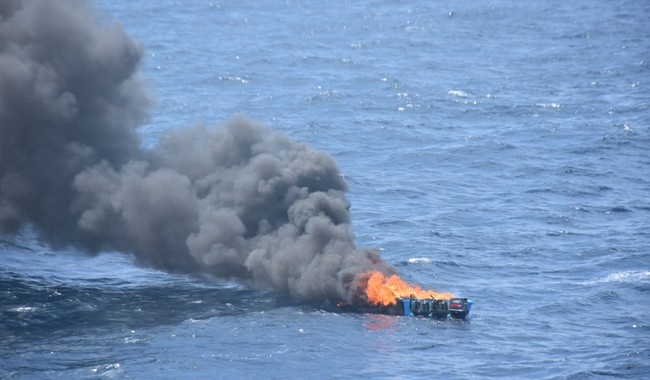
Undeterred by such criticism, SOUTHCOM announced a successful lethal kinetic strike yesterday, December 4, confirming the destruction of a narco-trafficking vessel carrying illicit narcotics and killing four male narco-terrorists in international waters.
Despite the clear mission success in disrupting cartel routes, Democrats appear poised to attack every aspect of the operation.
Admiral Bradley personally appeared on Capitol Hill to defend Operation Southern Spear, which has seized or destroyed hundreds of tons of narcotics since September.
The left-wing attacks are built on a now-debunked Washington Post story alleging Secretary of War Pete Hegseth issued an illegal “kill them all” order.
**READ MORE:** [WaPo’s Botched Hegseth Hit Job Proves the Pentagon Desperately Needs New Media](#)
Admiral Bradley’s testimony delivers a devastating blow to the Democratic narrative surrounding the drug boat story. The four-star commander and Bronze Star with Valor recipient now faces intensifying partisan scrutiny that military legal experts like Parlatore argue isn’t grounded in the law of armed conflict at sea.
In conversation with RedState, Parlatore drew a direct historical parallel to emphasize his point, citing one of the most celebrated moments in U.S. Navy history:
“Take the Battle of Midway. One of the Japanese carriers we blew up was burning, dead in the water, no longer able to fight or launch aircraft, and it was full of wounded Japanese sailors. You know what we did? We kept throwing torpedoes into it until it went to the bottom of the ocean. And that was lawful. The goal was to put the ship down so it couldn’t be towed back, repaired, and put back into the fight. The goal was not to kill all the wounded Japanese sailors on board.”
Parlatore argued that this example shows sinking a disabled enemy vessel—even one carrying wounded personnel—has been standard naval practice for generations and remains fully consistent with the law of armed conflict at sea.
—
**Editor’s Note:**
Do you enjoy RedState’s conservative reporting that takes on the radical left and woke media? Support our work so that we can continue to bring you the truth.
https://redstate.com/rc-maxwell/2025/12/05/exclusive-dow-legal-advisor-boat-with-cocaine-terrorists-heading-to-poison-americans-is-legit-target-n2196866

The expert conversation: What’s Trump’s endgame in Venezuela?
If there is a strategy behind recent U.S. actions regarding Venezuela, it is not entirely clear. Perhaps there is one, but it has yet to be fully articulated. A good strategy always begins with clear goals. So, what exactly is the U.S. trying to achieve?
There seem to be at least two possibilities — and of course, it could be both.
One potential goal is removing Nicolás Maduro from power. Maduro has long been an anti-American dictator, detrimental both to Venezuela and the United States. The second possibility focuses on border security and stopping narco-trafficking.
### What Are the Major Steps?
The most prominent recent military development has been the buildup of forces. Is this solely about striking drug-carrying vessels? It appears to be more than that.
If the objective is to remove Maduro, is the expectation that he might self-deport? Senators Rick Scott and Lindsey Graham have floated similar ideas publicly, suggesting Maduro should go to Russia or China.
Alternatively, could this buildup be a preparation for strikes on Venezuelan mainland targets, possibly even Maduro himself? The U.S. has traditionally maintained a policy against assassinating foreign leaders, but President Trump seems willing to break norms.
The President has stated his top priority is stopping the flow of illicit drugs into the United States. In the Caribbean, countries like Trinidad and Tobago have been supportive of strikes on vessels suspected of drug trafficking.
### Signaling to the Region and Beyond
This posture is also a signal to other countries in the region and globally, demonstrating how serious this administration is about security and drug interdiction. The U.S. has increased pressure on other countries in the hemisphere, such as Colombia, which faced sanctions and was decertified as cooperative with the U.S. on drug-control efforts due to policy disagreements with President Gustavo Petro.
Secretary of State Marco Rubio, from his Senate days, has been very clear: he wants to see Maduro removed. For Rubio, given his Cuban heritage, this is deeply personal—the rise of dictators and the erosion of civil liberties in Venezuela resonates strongly.
### Maduro’s Days May Be Numbered
As the President mentioned on *60 Minutes*, he wants Maduro gone and sees his days as numbered. However, the question remains: to what extent is the U.S. willing to go to advance Maduro’s removal?
It is expected there will be limited strikes on Venezuelan territory linked to illicit drug activities.
Across the region, Maduro is widely seen as a destabilizing force. Venezuela’s economic collapse, political repression, and erosion of rights have created the largest mass migration crisis the Western Hemisphere has seen. The crisis impacts not only the U.S. southern border but also countries like Chile, which are experiencing unprecedented migrant influxes.
### Focus on the Western Hemisphere in the National Defense Strategy
There are indications that the Western Hemisphere will receive more emphasis in the Trump administration’s forthcoming National Defense Strategy (NDS) than in previous versions. Security and stability in the hemisphere arguably require Maduro’s removal, as his regime contributes to regional instability.
Every national defense strategy underscores the importance of homeland defense, and for this administration, the Western Hemisphere is priority number one, with the Indo-Pacific and China following.
This increased focus is evident in the unique military buildup in the region, unlike anything seen in years.
### Differing Views Within the Administration
Within the administration, there appear to be different camps with varying views on Venezuela.
Secretary Rubio and National Security Advisor Jake Sullivan represent voices seeking Maduro’s removal. Conversely, members of the “MAGA restraint” camp prioritize border security and drug interdiction, and are wary of direct military conflict with Venezuela. This camp is wary of costly, protracted military interventions, having criticized past U.S. involvements in Iraq and Afghanistan.
For now, these camps agree on applying increased pressure against Venezuela, but there is no clear, coherent strategy that everyone supports.
### Peace Through Strength: The Administration’s Approach
President Trump has often used the phrase “peace through strength,” emphasizing deterrence over extended military campaigns. He is skeptical of drawn-out wars like those in Iraq, Afghanistan, Syria, and Ukraine, but open to short, sharp, and decisive actions.
Examples include the strikes against Iranian General Qasem Soleimani and operations targeting Iran’s nuclear program.
In this context, limited strikes against drug infrastructure in Venezuela or possibly regime targets align with this approach. However, a full-scale, boots-on-the-ground regime-change operation—akin to Panama or Grenada—is unlikely under this administration.
### Maduro’s Grip on Power
Historically, attempts to overthrow Maduro have been quickly suppressed. Cuban agents embedded within the Venezuelan military provide early warnings, and the regime has fractured military communications to prevent mass uprisings.
Maduro maintains control partly through illicit activities—drug trafficking, illegal gold mining, arms dealing, and human smuggling—which enrich the regime and key military figures.
If U.S. efforts can significantly degrade these illicit enterprises, Maduro’s financial resources to maintain loyalty among generals may diminish, potentially encouraging military leaders to consider alternative futures.
### Unique Context and Democratic Alternatives
Unlike other countries targeted for U.S. intervention without clear democratic successors, Venezuela has established opposition leaders waiting in the wings.
A presidential election a year ago reportedly elected Edmundo González (according to publicly available vote data), who currently lives in exile. María Corina Machado, a Nobel Peace Prize laureate, remains active within Venezuela, fighting for the democratic government elected last year.
Venezuela’s vast natural resources and oil reserves also offer key economic potential that could support stability.
### Offers to Leave and the Importance of Democratic Transition
Maduro has reportedly offered to leave power, but those offers have been rejected by the U.S. administration. If Maduro does step down, it is crucial to prevent a henchman from simply taking over.
Robust support exists for Venezuela’s democratic opposition, but it is equally important to make clear to the Venezuelan military that their future depends on supporting a transition grounded in democratic principles.
—
In summary, while the U.S. objectives regarding Venezuela seem focused on both removing Maduro and combating narcotics trafficking, a fully-fledged, unified strategy remains elusive. What is clear is an increased emphasis on security in the Western Hemisphere and willingness to apply pressure through military and diplomatic means short of full-scale intervention. The future course will likely balance these elements while remaining mindful of regional dynamics and the complexities of Venezuelan politics.
https://www.atlanticcouncil.org/blogs/new-atlanticist/the-expert-conversation-whats-trumps-endgame-in-venezuela/