Tag Archives: republican-leaning

Longtime Houston Rep. Al Green switching to 18th Congressional District in run for reelection

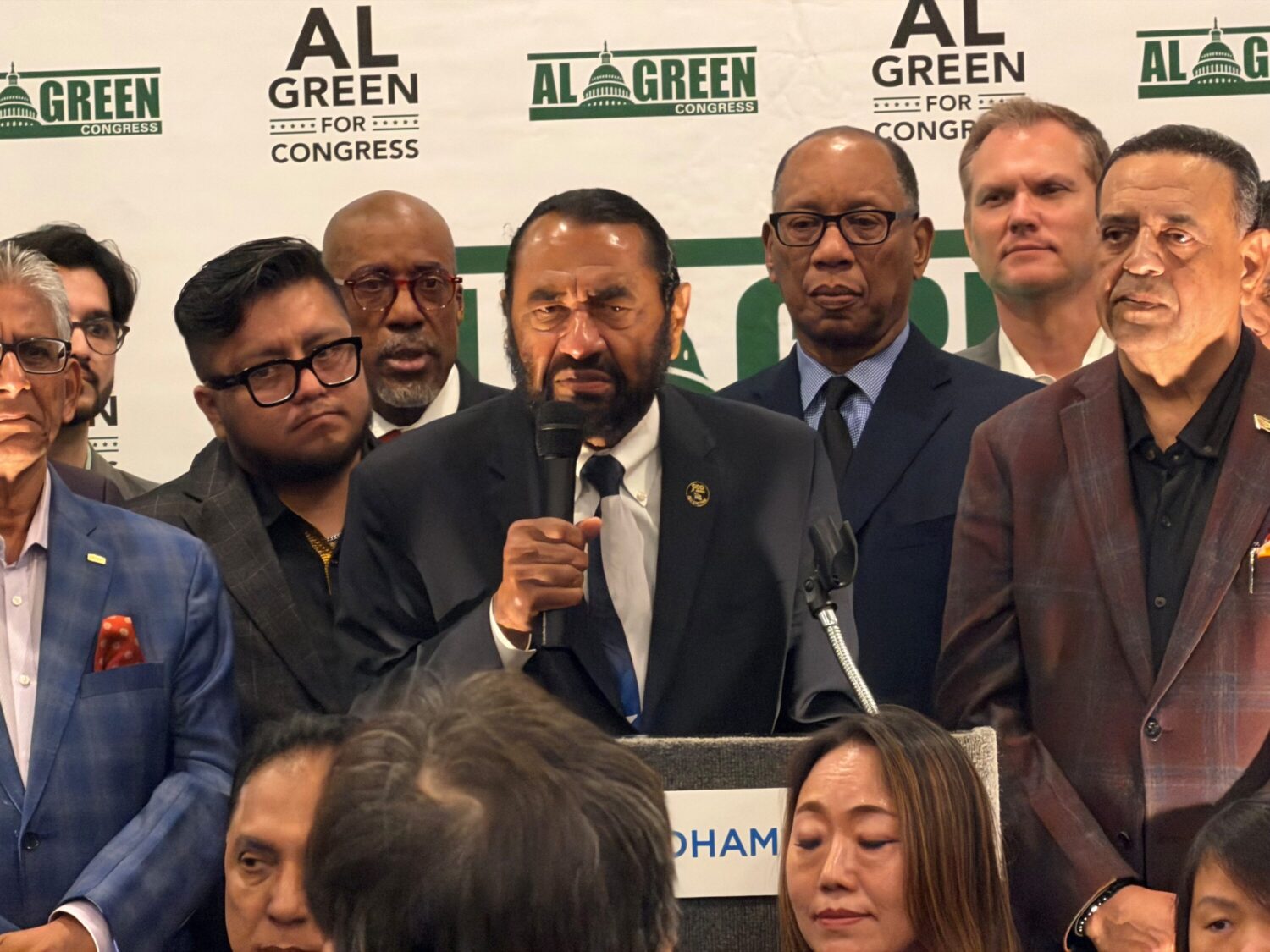
U.S. Rep. Al Green (D-Houston) ended months of speculation Friday night by declaring himself a candidate for Texas’ 18th Congressional District in 2026.

“We are here tonight, friends, because we refuse to allow President Donald Trump to decide for us who is going to represent us in the Congress of the United States of America,” said Green, speaking at his campaign kickoff event at the Wyndam Houston near NRG Park.

Green has represented Texas’ 9th Congressional District for more than 20 years. He became one of the central targets of Republican redistricting efforts this past summer, following intense pressure from Trump and Gov. Greg Abbott. State lawmakers moved the 9th from solidly Democratic territory in south and southwest Houston to Republican-leaning areas in eastern Harris County and Liberty County.

Much of Green’s traditional base, not to mention his own home, was redrawn into the 18th Congressional District. Green had stated as early as August that, while he would be on the ballot in 2026, he would not be a candidate for the 9th.

In the March primary, he likely will face the winner of a special election runoff to complete the term of the late U.S. Rep. Sylvester Turner, who served in the 18th District from January until his death in March. The runoff is between acting Harris County Attorney Christian Menefee and former Houston City Council member Amanda Edwards, both fellow Democrats.

“We’re going to fight for all sides of the 18th and 9th congressional districts, because these districts have come together now as one, and while they are the 18th, the 18th is the number that’s on the district, most of the people have come from the 9th congressional district,” Green said. “And I’m going to ask that you in the 9th now and in the 18th now as they exist, let’s start now to unify.”

The redistricting map is currently under legal challenge. A collection of civil rights groups and individuals have asked a panel of three federal judges to issue an injunction blocking the map from taking effect in time for the 2026 election. The panel has yet to issue a ruling, and the candidate filing period for that election begins Saturday.

Green is trying to claim the mantle of two of the three previous members of Congress for the 18th District, both of whom he had worked alongside: U.S. Rep. Sheila Jackson Lee, who died in July 2024 at the age of 74, and Turner, who died in March at the age of 70. Green himself is 78 and will be 79 by Election Day 2026.

He enters the primary just days after the first round of the special election to fill the remainder of Turner’s term. Menefee is 37, and Edwards is 43. Green alluded to the age difference, without naming his potential opponents in the Democratic primary, with a line reminiscent of one used by President Ronald Reagan against former Vice President Walter Mondale during the 1984 presidential campaign.

“There is some question about age, and I want you to know that I will not make an issue about anybody’s youthfulness,” Green said. “I think that people who are of age can run, so I want them to run.”

Green stressed his actions in office in making the case for the votes of residents of the new 18th Congressional District.

“You know that I will stand up to Donald Trump because you saw me do it,” Green said. “You know that I will fight for your health care because you’ve seen me do it. You know that I believe in raising the minimum wage to $25 an hour, because you’ve heard me say it.”

Green argued that, if Democrats retook control of both houses of Congress, they needed to pass the John Lewis Voting Rights Act, the George Floyd Justice in Policing Act, and the Protecting the Right to Organize (PRO) Act, overriding the use of the filibuster in the Senate if necessary, as Republicans had done in confirming Supreme Court Justice Neil Gorsuch, a Trump appointee.

“If we had used that rule, we could have prevented people from deciding now that where you are from does not allow you to buy land in the state of Texas,” Green said, in reference to Texas’ recently enacted Senate Bill 17. “We can protect people who happen to be of Asian ancestry, who have money in their pocket that they want to spend in this country to buy land, and they only want it for a residence, for a business.”

Finally, Green leaned into his record of having filed multiple articles of impeachment against Trump.

“I celebrate the people who are going to make sure that the Trumps of the world don’t have an opportunity to serve in office one day longer than they’ve already been there, which is why, when I go back to Congress, I promise you, I will file additional articles of impeachment to remove Donald Trump from office.”
https://www.houstonpublicmedia.org/articles/news/politics/2025/11/07/535536/al-green-18th-congressional-district-march-primary-houston-democrat/


Texas lawsuit targets Tylenol

Get your daily dose of health and medicine every weekday with STAT’s free newsletter, Morning Rounds. Sign up here.

### Remember Bugaboo Creek Steakhouse?

A colleague in the newsroom mentioned the name yesterday, and although I hadn’t thought about it in decades, the smell instantly came back to me. Also, the talking Christmas tree.

### NIH Says There Are No Banned Words. Hundreds of Grants Were Changed Anyway.

There’s no formal list of banned words or phrases at the NIH, officials say. And yet, researchers changed the titles of more than 700 multi-year grants from 2024 to 2025, according to an analysis by former agency leader Jeremy Berg.

The vast majority of those edits involved removing words like “equity” and “disparities” that denote an area of study clearly and consistently condemned by the Trump administration. Such compromises can alter the course of a project and the questions scientists address.

STAT’s Anil Oza spoke with nine current and former NIH officials, as well as five outside researchers, who described the often demoralizing and ambiguous process.

“What is infuriating about it is the fact that we cannot access the ground truth. There is no ground truth,” one NIH program officer said. “Was it necessary to censor this person’s work? I don’t know.”

For another sense of the stakes: Anil told me that he reached out to 150 outside researchers to find five who would speak to him, “which I think shows the fear people have about losing their funding,” he said in a DM.

Read more on implicitly banned words, and what it all means for the future of science.

### Texas Lawsuit Targets Tylenol

Texas Attorney General Ken Paxton (R) filed a lawsuit yesterday accusing Tylenol’s makers of deceptively marketing the drug to pregnant mothers and asserting unproven claims linking its main ingredient, acetaminophen, to autism risk.

The suit alleges that the companies violated Texas consumer protection laws by hiding the danger that acetaminophen posed to fetuses and young children — again, unproven.

Texas also alleges that Johnson & Johnson fraudulently transferred liabilities arising from Tylenol to Kenvue to shield assets against lawsuits.

The suit was filed in rural Panola County and requests a jury trial in the Republican-leaning East Texas county of about 23,000 people.

Read more.

### The Surprising Impact of Organ Donation Opt-Out Policies

Many countries have adopted an opt-out approach to organ donation, where every eligible person is a donor after death unless they choose to opt out. This policy has been shown to increase both registration rates for deceased organ donation and actual donations made by deceased donors.

However, a study published yesterday in *PNAS Nexus* found that overall, countries can still be left undersupplied using this strategy because fewer people become living organ donors.

Researchers analyzed data from 24 countries that implemented opt-out policies between 2000 and 2023. The results showed a 7% increase in deceased donors but a significant 29% drop in living donors overall, driven by a reduction in altruistic donations (organs donated to non-family members).

The researchers believe this is due to a community assumption that the opt-out policy has eradicated any previous organ shortage. Clearer communication about the effectiveness of the strategy, and the continuing need for living donors, may be the best way forward, the authors conclude.

### What Are Those Weight Loss Drugs Called, Again?

On a recent weekday, STAT’s Alex Hogan went to the epicenter of biotech: Kendall Square in Cambridge, Mass. When he asked industry workers on their lunch breaks what those blockbuster weight loss drugs are called, most said the same thing: Ozempic.

But of course, that’s not technically the generic name for GLP-1 medications.

In Alex’s latest video for his Status Report series, he explores the possibility that Ozempic could someday lose its trademark if the name becomes the generic term for an entire category of product — think: Dumpster, aspirin, thermos.

“If you’re a trademark lawyer, you have this conflicting instinct,” law professor Robin Feldman told Alex. “You want the name to be on the tip of people’s tongues so they buy it without inciting ‘genericide,’ as it’s called.”

Watch the video now. It’s a fascinating topic, and Feldman provides great insight, including why genericide is less common in the pharmaceutical space. On top of that, you’ll also get to see Alex shred on some (name brand!) Rollerblade inline skates.

### The Wrong Name for a Huge Problem?

In 2021 — when everything I knew about AI chatbots came from Vauhini Vara’s brilliant, prescient personal essay in *The Believer* — Valerie Black was a Ph.D. student researching how people use chatbots for help coping with suicidal thoughts.

Black argued then that it wasn’t necessarily crazy or unusual for people to do so, highlighting how few outlets exist to discuss suicidal ideation.

But these days, the language of insanity is exactly how many describe society-level problems with chatbots. The bots hallucinate, while people report AI psychosis.

For example, “the term AI psychosis shifts focus away from misinformation as an addressable issue, implying that the problem is something inherent to AI or the user’s psyche,” Black writes.

Read more on what Black sees as the bait-and-switch strategy of large language model (LLM) companies navigating these discussions.

In a related First Opinion essay published today, two researchers and clinicians argue that doctors need to start asking patients about chatbot use.

### What We’re Reading

[Additional links or summaries could go here.]

Stay informed and engaged with STAT’s coverage of these critical health and science stories.
https://www.statnews.com/2025/10/29/health-news-tylenol-texas-lawsuit-nih-glp-1/?utm_campaign=rss