
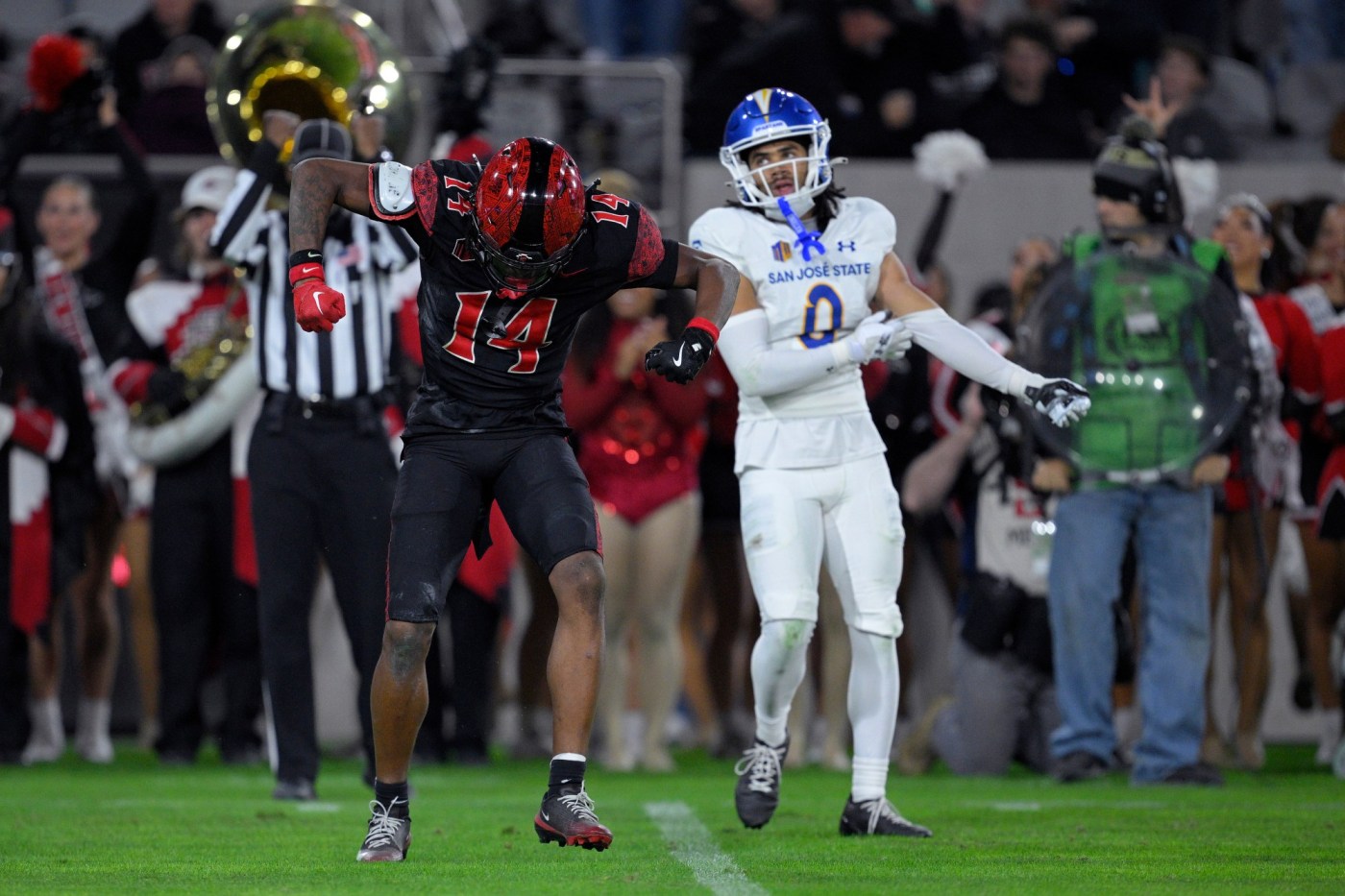
San Jose State’s 25-3 loss to San Diego State on Saturday night was mostly caused by the Spartans’ self-inflicted wounds that created too big of a deficit to battle back from at Snapdragon stadium. On top of two turnovers and a pair of missed field goals, it didn’t help that the Spartans also lost starting quarterback Walker Eget in the first quarter. “It was kind of indicative of this year. The kicking game hurt us and we had big turnovers,” said Spartans coach Ken Niumatalolo, whose team has a minus-9 turnover margin and has made just 58 percent of its field goal attempts (11-for-19). Eget suffered an apparent leg injury and was later seen on the sideline using crutches after going 4-for-8 for 32 yards and an interception. While not revealing many details, Niumatalolo struck an ominous tone when asked about Eget’s injury. “I’ll just say it didn’t look good,” Niumatalolo said. “Haven’t got anything official but we’ll find out in a little bit.” Eget’s injury forced freshman quarterback Tama Amisone to take over the offense. Amisone, a 5-foot-11, 184-pound product of Hawaii’s Kapolei High, utilized his duel-threat abilities to give the Aztecs a different look. He rushed for a team-high 75 yards on 13 runs while completing 15 of 27 passes for 104 yards and an interception. The San Diego State defense, which is ranked first in the Mountain West while allowing just 12. 5 points per game, held the Spartans to 268 yards of offense and out of the end zone. The Aztecs had seven tackles for loss, including four sacks. After electing to receive the ball at the outset, the Spartans quickly put themselves in trouble when Eget was intercepted by ex-McClymonds High of Oakland standout Dwayne McDougle on the third play of the game. The first of McDougle’s two interceptions set up the Aztecs at the Spartans’ 20-yard line. They scored six plays later on Lucky Sutton’s 1-yard touchdown run. San Jose State moved into field goal range on its next offensive drive, but kicker Denis Lynch slipped while attempting a 43-yard field goal that had no chance of success. Fellow Spartans kicker Mathias Brown, kicking from the left hash, then went 1-for-2 on his field goal attempts in the first half, making a 37-yarder and missing a 39-yarder. Despite their offensive woes, the Spartans’ defense looked much-improved in interim defensive coordinator Bojay Filimoeatu’s first game since taking over for longtime coach Derrick Odum, who was fired on Monday. San Jose State’s defense limited the Aztecs offense to just 248 yards total yards and 5-for-13 on third downs. But the SJSU offense was never able to capitalize. “If we could have just mustered up something on offense, I feel like our defense could have kept their juice,” Niumatalolo said. “I thought the defense rallied and that was a testament to Bojay.” San Jose State (3-8, 2-5 MWC) has now lost three games in a row, its longest losing streak since 2023. Meanwhile, San Diego State (9-2, 6-1 MWC) put itself in position to clinch the conference’s regular-season title with a victory next Friday night against New Mexico. With Amisone in the game and without Eget, the nation’s second-leading passer with 3, 015 yards, the Spartans emphasized the run game heavily. The Spartans’ offensive philosophy change Saturday night was by necessity, though. “We got beat up front,” Niumatalolo said. “It’s hard to throw the football when the quarterback is running for his life.” SJSU running backs Steve Chavez-Soto (51 yards, 14 carries) and Viliami Teu (23 yards, five carries) combined for 74 yards on 19 attempts for a combined 133 rushing yards for SJSU. Like Eget, Amisone had to leave the game due to an undisclosed injury. While he received medical attention on the sideline, Spartans freshman quarterback Robert McDaniel, a UCLA transfer, took over for their final drive of the game. McDaniel finished the game 1-for-3 passing for minus-1 yard. San Diego State’s offense was missing its top two wide receivers as both Jordan Napier and Jacob Bostick were ruled out of the game with injuries. The Aztecs offense struggled to get the passing game going without them as quarterback Jayden Denegal went just 4-for-8 for 16 yards until the two-minute warning. But Denegal completed a 52-yard bomb to Donovan Brown to move the ball to the SJSU 4. This set up a 1-yard TD sneak by Denegal, giving SDSU an 18-3 lead. Senegal finished 8-of-16 for 81 yards passing.. SJSU finishes the season 0-6 on the road and will close its season at home next Saturday at 7: 30 p. m. against Fresno State in the annual battle for the Valley.
https://www.santacruzsentinel.com/2025/11/23/san-jose-state-loses-quarterback-walter-eget-in-25-3-loss-to-first-place-san-diego-state/
Tag Archives: self-inflicted

Jackson State gets back on track, dominates Florida A&M 41-16
Jackson State got back on track Saturday with a commanding 41-16 victory over Florida A&M in Tallahassee. The win was pivotal; a loss would have thrown the SWAC East championship race into utter chaos. With the victory, JSU re-establishes control over its destiny.
The Tigers entered the game without starting quarterback Jacobian Morgan, who suffered a lower-leg injury in the previous week’s game against Grambling State. Head Coach T.C. Taylor successfully pivoted the offensive game plan, relying entirely on the run game with backup Jarad Lockhart under center. Jackson State’s revamped offense focused almost exclusively on the ground, rushing 56 times and compiling a massive 392 total rushing yards—a figure that alone exceeded FAMU’s total offense for the night (202 yards).
Lockhart, who only attempted 10 passes (completing five with one passing touchdown), used his legs effectively, rushing eight times for 37 yards. The ground attack was powered by the running back room: Ahmad Miller led the effort with 19 carries for 165 yards and one touchdown, including a 64-yard scamper; Donerio Davenport finished with 16 carries for 112 yards and a score; and Travis Terrell Jr., whom many fans have long advocated to be featured more heavily, rushed nine times for 29 yards and scored a touchdown.
While the score was a defensive battle at halftime (10-3), Jackson State exploded in the second half, outscoring FAMU 31-13. This demoralizing loss further heats up the hot seat for FAMU Head Coach James Colzie III.
On the following Monday’s SWAC call, Coach Colzie expressed deep frustration that his team failed to capitalize against the injury-depleted Jackson State squad, noting their performance was plagued by poor decisions and self-inflicted wounds. “We started the game, you know, mishandling the kickoff, having to start a drive at the minus 11 and then obviously having to start on the next drive at the minus one,” Colzie detailed.
He specifically pointed to offensive inefficiency that crippled their ability to sustain drives: “We were running, we had a lot of third down the longs, man, third down, the extra longs. Right. And that’s not the recipe for success, especially offensively.”
FAMU finished the game failing to convert on 10 of their 11 third-down attempts, which validated Colzie’s concerns about getting into “third down and long” situations against a stout defense.
Looking ahead, Florida A&M now faces a difficult road game against the UAPB Golden Lions, who are riding high after snapping a five-year losing streak against Southern University with a dominant 40-21 win. UAPB will be looking to secure a victory against a struggling FAMU team to further raise the stock of their program.
Meanwhile, Jackson State will look to continue its winning momentum when they host Mississippi Valley State. Both games are set to kick off on Saturday at 3 p.m. EST.
https://clutchpoints.com/hbcu/jackson-state-gets-back-on-track-dominates-florida-am-41-16

Insider calls out ‘comical’ problem after Jaguars London embarrassment
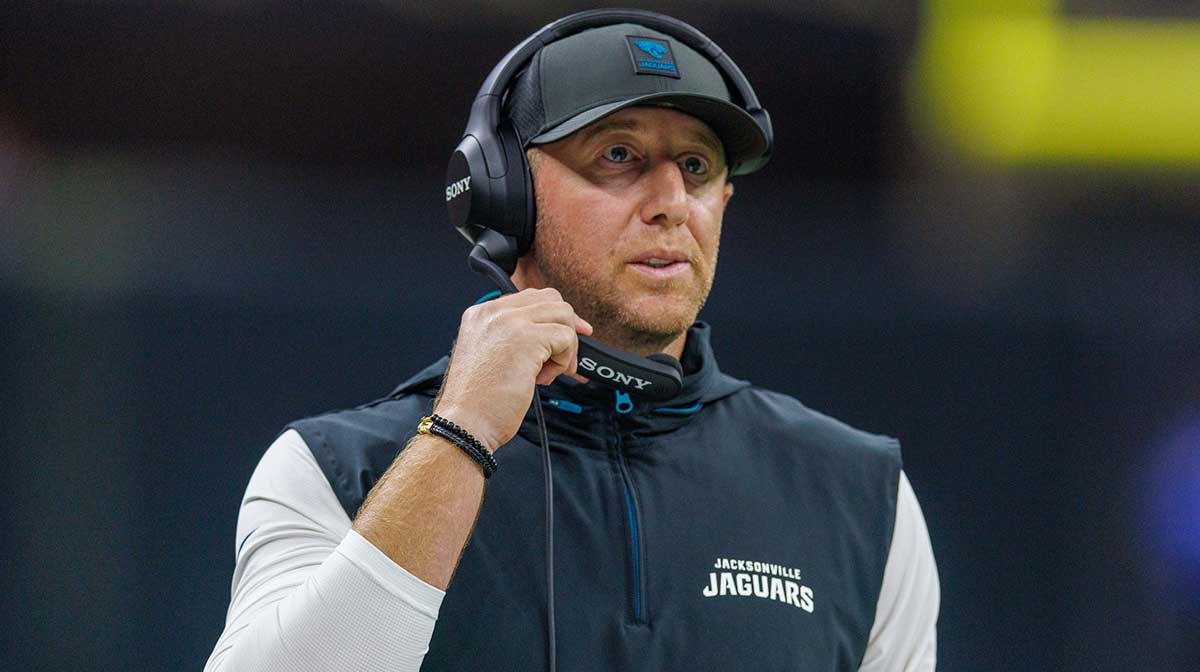
The Jacksonville Jaguars’ trip to London was supposed to be a statement game. Instead, it turned into an embarrassing 35-7 loss to the Los Angeles Rams that left head coach Liam Coen searching for answers and questioning his own approach.
Following the blowout, Coen didn’t shy away from self-criticism. “Like, what am I doing as the head football coach that’s not clear right now? How am I communicating these things? How are we practicing these things? That’s what I’ve got to look at,” he said.
Coen added that everything, from coaching methods to player usage, will be evaluated during the team’s bye week. “We’ve got to look at personnel in all three phases, how we’re utilizing it, how we aren’t utilizing it, and where do we need to use guys more, use guys less. It’s all going to get evaluated. Got a long flight home and some days off to do that,” he explained.
Quarterback Trevor Lawrence echoed his coach’s frustrations, pointing to execution and energy as the biggest problems. “We have to start games faster,” Lawrence said. “There are some plays that I got to make early to get us going. It’s not like we didn’t have a good plan. Some self-inflicted wounds if we can clean that up and just stay on schedule.”
Still, the most glaring issue wasn’t the play-calling or game plan; it was the drops. The Jaguars’ official site called the repeated mistakes “almost comical,” though no one wearing teal was laughing after six consecutive drives ended scoreless inside Rams territory.
Wide receiver Brian Thomas Jr., once one of Jacksonville’s most reliable playmakers, continues to struggle, while tight end Johnny Mundt and running back D’Ernest Johnson also added costly drops in key moments. “These are the kinds of mistakes that kill drives,” the team’s report noted. “The de-evolution of a star receiver continues to befuddle.”
If there was one bright spot, it was rookie Travis Hunter. The two-way phenom finally had his breakout performance, leading the team with eight receptions for 101 yards and his first NFL touchdown, while also breaking up a pass on defense.
Despite the effort, Jacksonville heads into the bye week 4-3 after two straight losses, with plenty of questions and little time to find answers. As Coen put it, “We’ve got to figure it out.”
https://clutchpoints.com/nfl/jacksonville-jaguars/jaguars-news-insider-calls-out-comical-problem-after-london-embarrassment

For Mainers impacted by gun violence, red flag referendum is personal
James LaPlante remembers hearing how Robert Card was experiencing paranoia in the months before he killed 18 people and injured a dozen more in the Lewiston mass shooting. It sounded familiar. Three years earlier, LaPlante’s brother, Stephen, was worried his friends were spreading lies that he was a pedophile and that a grocery store clerk who giggled was in on the rumor. Card had made similar claims to friends and family. LaPlante contacted police after his brother started stockpiling guns, but police said there wasn’t enough evidence for them to intervene and LaPlante was unable to get his brother the help he needed to stop him from acting on his worst impulses. In 2020, Stephen died from a self-inflicted gunshot wound. His brother’s death is the reason LaPlante now supports a red flag law in Maine a proposal that would allow family members, in addition to police, to initiate a weapons removal process if a person poses a risk to themselves or others. The law also would eliminate the requirement in Maine’s existing yellow flag law that a person first be taken into custody for a mental health evaluation. “The big thing for the red flag law for me is it enables family members to take action,” said LaPlante, who lives in South Portland. “And family members are the ones who are going to know if someone is in a mental health crisis.” LaPlante is among dozens of Mainers who have pleaded with lawmakers over the last two years for stronger gun control. After the Legislature failed to take up a red flag proposal last year in the aftermath of the Lewiston mass shooting, gun safety advocates organized a signature gathering campaign to get a citizen’s initiative on the ballot. That measure will now go to voters statewide on Nov. 4 as Question 2. Many people directly impacted by gun violence support a red flag law family members, like LaPlante, and friends who have lost loved ones to gun suicides, as well as survivors of the Lewiston shooting and victims of other crimes involving firearms. Opponents, some of whom also survived the mass shooting, say it weakens due process for gun owners and have argued that a red flag law already in place in 21 other states would not have prevented what happened in Lewiston. “They could have used the yellow flag here in Maine and they never did,” Destiny Johnson, a Lewiston survivor, says in a campaign video released this week urging people to vote no on Question 2. ‘IT COULD HAVE ALLOWED ME TO GO TO THE COURTS’ LaPlante encouraged his brother to move in with their mother in Naples after he got caught up in drugs and was “hanging with the wrong crowd” in Massachusetts, where the brothers had grown up. At one point, he said, Stephen was voluntarily committed to a mental hospital after attempting suicide. The move to Maine was good for Stephen at first, LaPlante said, but he still struggled with bipolar disorder that prevented him from working. His mental health worsened when the pandemic hit. He stopped playing guitar and started focusing on collecting replica and BB guns, and eventually real firearms. “During COVID, his paranoid ideations very quickly went to, ‘Society is going to collapse and I have to be ready for it, and people are after my stuff,’” LaPlante said. “He started to just amass weapons.” LaPlante said he got particularly concerned after his brother woke their mother up in the middle of the night while he was on the roof with a rifle looking for people he thought were coming to take their belongings. Around the same time, he said Stephen became convinced friends of his from Massachusetts were spreading rumors that he was a pedophile. “Being in that scenario was really hard,” LaPlante said. “I felt stuck.” LaPlante said he contacted police but was told there wasn’t much they could do unless Stephen committed a crime. In his research on the yellow flag law, which had just taken effect in July 2020, he found that police were struggling to arrange the mental health assessments needed to confiscate firearms. Stephen died in September. LaPlante said he believes the outcome could have been different had a red flag law been in place. “It could have allowed me to go to the courts and say as a family member that I’m concerned he has been suicidal in the past,” he said. Supporters of the red flag law say it could be especially helpful in reducing firearm suicides, and research has shown that red flag laws in other states can be an effective part of suicide prevention. LEWISTON SURVIVORS’ VIEWS While police initially struggled to connect with medical practitioners to conduct the required mental health assessments in the early days of the yellow flag law, a telehealth contract with the Portland nonprofit behavioral health provider Spurwink has since helped streamline the process. Then, a state investigation into the Lewiston shooting which found it could have been used by law enforcement increased awareness and training among police, and its use has skyrocketed. State officials recently announced the law has been used more than 1, 000 times, all but 81 of those coming after the Oct. 25, 2023, mass shooting. But some survivors still say a red flag law would be beneficial. Among the most vocal is Arthur Barnard, whose son Artie Strout was killed at Schemengees Bar & Grille. Barnard has lobbied at the State House in favor of the law and last month appeared in an ad on behalf of the Yes on Question 2 campaign. “Nobody knows if a family member is off-kilter faster than a family member,” Barnard said in an interview. “I believe that. Who knows that person better than their family?” Jennifer Zanca of Auburn, who was shot in the left shoulder at Schemengees, is also in favor of a red flag law. Zanca said that while she generally favored gun safety laws prior to the shooting, it made her think harder about what can be done to prevent such violence. “I just feel like what we’re doing is not working,” she said. “It’s getting worse.” The red flag proposal offers a more streamlined alternative and gives families a way to remove weapons from a person in crisis, she said. “I feel safe knowing there are laws in place to take away guns from people who are having a mental health crisis, or who have gone psychotic and their family members see that,” Zanca said. She was part of a group of four friends who went to Schemengees for dinner following a golf outing the night of the shooting. Among them was Johnson, the woman who recently appeared in the video for Protect Maine − No Red Flag, a group opposing Question 2 that is led by the Sportsman’s Alliance of Maine with a powerful lobby. In testimony before the Legislature last spring, Johnson elaborated on her opposition to a red flag law, saying Mainers need to be able to defend themselves in public places. “Why would the state of Maine put a red flag law in place now, when they never enforced the yellow flag law to begin with?” she said in written testimony. IS MAINE’S CURRENT LAW ENOUGH? David Trahan, executive director of the Sportsman’s Alliance, who worked with Gov. Janet Mills to pass the yellow flag law, is a leading opponent of Question 2. He said he empathizes with anyone impacted by gun violence, including the many victims and survivors who have testified to lawmakers in support of a red flag law. “But I’d love to sit down and talk with some of them because I believe our (yellow flag) law is better than red flag, and so does the governor, and so do state police,” Trahan said, referring to Mills’ and Maine State Police’s opposition to the red flag proposal. State police have said that family members can already initiate weapons removal by contacting law enforcement, and have expressed concerns that it will be more dangerous for them to try and remove weapons because the changes could mean someone is not already in protective custody when police go to remove their guns. Supporters of the red flag law refute the idea that weapons removal would be more dangerous, saying law enforcement have inherently dangerous jobs and red flag laws are already working safely in several other states. Mills has said that the yellow flag law, which she helped draft with gun rights and safety groups, has already proven effective, while also protecting Second Amendment rights. She has argued it’s important for police to be involved in navigating what can be a confusing court process and that it’s the responsibility of law enforcement, not private citizens, to protect the public. LaPlante says he doesn’t see the option to use red flag as something that would be burdensome for family members, and said it is set up to work more quickly than the existing law. “You’re giving people the opportunity to seek help,” LaPlante said. “That’s not a burden.” He and other proponents acknowledge that it’s not a guarantee to prevent a loved one’s suicide or another mass shooting and point out that there are other steps Maine could also take to improve gun safety, such as closing background check loopholes and improving access to mental health care. But they said it’s a step in the right direction and that there’s no harm in giving families the choice of another tool. “This law is about preventing gun tragedies and saving lives,” said Judi Richardson, whose daughter, Darien Richardson, died after she was shot in a home invasion in Portland in 2010. Richardson and her husband, Wayne, are gun owners who didn’t think too much about whether Maine’s laws could be improved prior to their daughter being killed, she said. Then they started connecting with other families around the country who had been impacted by gun violence, and said it opened their eyes to the need for change. While the home invasion and homicide are still unsolved, Richardson said she can’t say if a red flag law would have helped in her daughter’s case. But she said it can generally improve safety. “It may not pertain in my situation, but if we can prevent other injuries and deaths, that’s what we’re advocating for,” Richardson said.
https://www.centralmaine.com/2025/10/16/for-mainers-impacted-by-gun-violence-red-flag-referendum-is-personal/