Tag Archives: tamaki

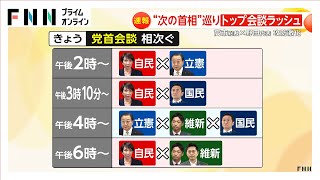
Battle for Japan’s Next Prime Minister Intensifies

However, Tamaki offered no clear response, later telling reporters that if he were chosen as prime minister, “policy management would still be difficult” and that “differences remain” between the parties.

The day began with a high-profile meeting between Takaichi and Constitutional Democratic Party leader Noda, which observers described as Takaichi’s de facto declaration to run in the prime ministerial vote. Noda said he asked whether the LDP planned to run alone or seek support from other parties, to which Takaichi replied that “nothing has been decided yet.”

Noda also revealed that he raised the possibility of the LDP seeking cooperation from Komeito if opposition parties were to unite behind a single candidate, a suggestion that seemed to catch Takaichi off guard.

Later in the day, Takaichi met Tamaki again for about 30 minutes, reiterating her desire to advance policies quickly and jointly rather than focusing solely on forming a parliamentary majority. Tamaki, however, remained cautious, saying that while there had been some convergence on issues such as security legislation and nuclear policy, significant gaps persisted.

He added that even if a coalition of the Constitutional Democratic Party, Japan Innovation Party, and Democratic Party for the People were formed, it would likely have to operate as a minority government, making policy implementation difficult. Tamaki also noted that while many of his party’s basic policies align with those of Takaichi and the LDP, trust had been undermined in the past, referencing broken promises during the Ishiba administration.

Talks among the three opposition leaders lasted about an hour and are expected to continue next week. Meanwhile, attention is now turning to a scheduled meeting between Takaichi and Japan Innovation Party leader Yoshimura in the evening, as speculation grows over whether the two parties might discuss a potential coalition.
https://newsonjapan.com/article/147286.php


Komeito’s Exit Triggers Fierce Battle Over Japan’s Next Prime Minister

Hopes within the Liberal Democratic Party (LDP) of bringing the Democratic Party for the People (DPP) into a new alliance to secure a lower house majority have been dashed. The DPP signaled skepticism over joining a coalition that would not function meaningfully, casting doubt on the possibility of a stable partnership.

Currently, the LDP holds 196 seats on its own, while the Constitutional Democratic Party (CDP) controls 148. Opposition parties argue that a united front among the top three opposition groups could surpass the ruling party’s numbers. The CDP has even suggested backing DPP leader Tamaki as prime minister in a joint opposition strategy.

Tamaki has expressed readiness to serve if chosen but stressed the need for policy alignment before any partnership could form. Leaders of the Japan Innovation Party echoed this call for deeper consensus on policy priorities, warning that cooperation without shared principles would be difficult.

Even Komeito, now in opposition, has not ruled out cooperating with opposition forces on specific policies. However, it remains unlikely to support a non-LDP prime ministerial candidate outright, given its history of joint policymaking with the LDP. The party also emphasized that resolving the politics and money scandals contributing to the coalition’s collapse is essential for regaining public trust.

Political analysts say three main scenarios now loom:

1. The LDP could delay the prime ministerial vote while seeking a new coalition partner.
2. Opposition parties could unite to seize power, potentially elevating Tamaki to the premiership.
3. Takaichi could form a minority government, possibly calling a snap election after passing a supplementary budget.

Any of these outcomes would leave Japan facing a period of political instability and legislative gridlock.

Commentators warn that the upheaval has exposed deeper issues in Japan’s democracy. Notably, only 0.7% of the electorate participated in the LDP leadership vote that elevated Takaichi, despite her finishing third in the initial parliamentary ballot. This highlights the outsized influence of party factions in the process.

Critics suggest that Takaichi’s “Japan is back” slogan signals a return to the Abe-era policies of aggressive monetary easing and corporate stimulus. This raises questions about whether such an agenda truly serves the public interest amid stagnant wages, demographic decline, and fiscal strain.

Furthermore, scandals surrounding the Unification Church, the Moritomo Gakuen document falsification case, and the return of controversial figures linked to past political wrongdoing have further eroded public trust and fueled Komeito’s frustration.

With pressing challenges such as social security reform, foreign policy strategy, and support for a struggling middle class still unresolved, commentators argue that Japan is at a turning point. The question now is whether a new era of cooperative, citizen-driven democracy can emerge from the current turmoil or whether entrenched political dynamics will once again prevail.
https://newsonjapan.com/article/147251.php

Tamaki Rules Out Alliance With CDP

TOKYO, Oct 12 — The Democratic Party for the People leader Yuichiro Tamaki reaffirmed on October 11 that his party will not cooperate with the Constitutional Democratic Party of Japan (CDP) in unifying opposition candidates for the upcoming prime minister designation vote in the next extraordinary Diet session.

Tamaki stated, “We cannot work with the current CDP. Our basic policies are fundamentally different.”

The CDP has been calling on other opposition parties to rally behind a single candidate for the prime minister selection and has reportedly told the Democratic Party for the People that Tamaki himself is a strong contender. However, Tamaki reiterated that his party would not accept the proposal, citing major differences in core policies, including national security and nuclear energy.

In response, CDP Secretary-General Jun Azumi pointed out that both parties, along with their largest backer Rengo, had already agreed in April on “basic policies concerning the nation’s core principles” and issued a joint statement.

“We have already formed a common position, so there is no point in debating what should be done now,” Azumi said.
https://newsonjapan.com/article/147243.php