

According to studio estimates on Sunday, “Wicked: For Good” earned $150 million from North American theaters in its first days in theaters and $226 million globally. Universal Pictures’ two-part “Wicked” gamble continues to defy gravity at the box office. Just a year after part one brought droves of audiences to movie theaters around the country, even more people bought opening weekend tickets to see the epic conclusion, “Wicked: For Good.” According to studio estimates on Sunday, “Wicked: For Good” earned $150 million from North American theaters in its first days in theaters and $226 million globally. Not only is it the biggest opening ever for a Broadway musical adaptation, unseating the record set by the first film’s $112 million launch, it’s also the second biggest debut of the year behind “A Minecraft Movie’s” $162 million. “The results are just fantastic,” said Jim Orr, who heads domestic distribution for Universal. “Some films can deliver a false positive when tickets go on sale early but these results speak for themselves.” Universal began rolling out “Wicked: For Good” in theaters earlier this week, with previews on Monday ($6. 1 million from 1, 050 theaters) and Wednesday ($6. 5 million from 2, 300 theaters). By Friday it was playing in 4, 115 North American locations and had raked in $68. 6 million. IMAX showings accounted for $15. 5 million, or 11%, of its domestic haul a November record for the company. IMAX CEO Rich Gelfond said in a statement that the strong market share shows, “our momentum carries into demos and genres beyond our traditional core, including families.” As with the first film, women powered opening weekend, making up around 71% of ticket buyers according to PostTrak exit polls. Critics were somewhat mixed on the final chapter, but audiences weren’t: An overwhelming 83% of audiences said it was one they would “definitely recommend” to friends. As far as foot traffic is concerned, the box office tracker EntTelligence estimates that about 2 million more people came out for “Wicked: For Good’s” first weekend than for “Wicked’s.” Jon M. Chu directed both “Wicked” films, starring Cynthia Ervio and Ariana Grande. The first film made over $758. 7 million worldwide and received 10 Oscar nominations (winning two, for costume and production design ). The question is how high “Wicked: For Good” can soar. Combined, the two films cost around $300 million to produce, not including marketing and promotion costs. “The first film paved the way,” Orr said. “It’s really become a cultural event I think audiences are going to be flocking to theaters for quite some time to come.” Two other films also opened in wide release this weekend, but further down on the charts behind a buffet of holdovers. Searchlight Pictures opened its Brendan Fraser film “Rental Family” in 1, 925 theaters where it earned $3. 3 million. The Finnish action film “Sisu: Road to Revenge,” a Sony release, also played in 2, 222 theaters. It earned an estimated $2. 6 million. Second place went to “Now You See Me: Now You Don’t” with $9. 1 million in its second weekend, followed by “Predator: Badlands” with $6. 3 million in weekend three. “The Running Man” followed in fourth place with $5. 8 million, down 65% from its debut last weekend. Although this weekend the box office was more of a winner takes all scenario, “Wicked: For Good’s” success is vitally important for the exhibition industry as a whole as it enters the final weeks of the year. “It sets up a very strong final homestretch of the year,” said Paul Dergarabedian, Comscore’s head of marketplace trends. After the slow fall season, the Thanksgiving blockbusters could not arrive soon enough. Early next week, “Zootopia 2” enters the mix and is also expected to drive big crowds to the cineplex over the holiday break. Thanksgiving is often one of the biggest moviegoing frames of the year, Dergarabedian said, and both “Wicked 2” and “Zootopia 2” will benefit. Last year “Wicked,” “Moana 2” and “Gladiator II” helped power a record five-day frame. The running domestic box office is currently hovering around $7. 5 billion, according to Comscore. Before the pandemic, the annual box office would regularly hit $11 billion, but the post-pandemic goal has lessened to $9 billion. The big question now is whether titles like “Wicked: For Good,” “Zootopia 2” and “Avatar: Fire and Ash” can push the industry over that threshold. With final domestic figures being released Monday, this list factors in the estimated ticket sales for Friday through Sunday at U. S. and Canadian theaters, according to Comscore: 1. “Wicked: For Good,” $150 million. 2. “Now You See Me: Now You Don’t,” $9. 1 million. 3. “Predator: Badlands,” $6. 3 million. 4. “The Running Man,” $5. 8 million. 5. “Rental Family,” $3. 3 million. 6. “Sisu: Road to Revenge,” $2. 6 million. 7. “Regretting You,” $1. 5 million. 8. “Nuremberg,” $1. 2 million. 9. “Black Phone 2,” $1 million. 10. “Sarah’s Oil,” $711, 542.
https://www.boston.com/culture/movies/2025/11/23/wicked-for-good-is-even-more-popular-than-the-first-soaring-to-a-226-million-global-debut/
Tag Archives: distribution

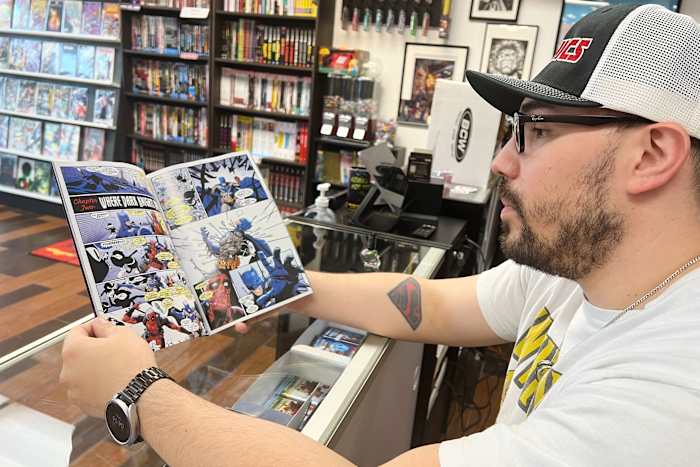
Comic books once stoked fears of crime, but a California city wants to confront that history
SACRAMENTO, Calif. On a recent day at Sacramento native Lecho Lopez’s comic shop in the city, his 5-year-old nephew read his first word aloud: “bad.” It was from a graphic novel. There was irony in that being his first word, because Lopez credits comic books with many positive things in his life. That’s why he supports repealing a city ordinance dating back to 1949 that bars the distribution of many comic books to kids and teens. It’s not enforced today. “It’s a silly law,” said Lopez, who has a red-and-black tattoo of the Superman logo on his forearm, in an interview at his store, JLA Comics. “A lot of good things come out of comic books.” A City Council committee unanimously voted this week to advance the repeal and designate the third week of September as “Sacramento Comic Book Week.” It now heads to the full council for a vote. The ban applies to comic books prominently featuring an account of crime that show images of illegal acts such as arson, murder or rape. In the mid-20th century, as comic books were on the rise, fears spread over their impact on children, with some arguing they could lead to illiteracy or inspire violent crime. The industry decided to regulate itself, and local governments from Los Angeles County to Lafayette, Louisiana passed bans to shield certain comics from young people. While some cities like Sacramento still have those laws on the books, they are rarely if ever enforced. Now, proponents of repealing the Sacramento law say it’s necessary to reflect the value of comics and help protect against a modern wave of book bans. Local artist pushes for repeal Comic book author Eben Burgoon, who started a petition to overturn Sacramento’s ban, said comics “have this really valuable ability to speak truth to power.” “These antiquated laws kind of set up this jeopardy where bad actors could work hard to make this medium imperiled,” he said at a hearing Tuesday held by the city council’s Law and Legislation Committee. Sacramento is a great place to devote a week to celebrating comics, Burgoon said. The city has a “wonderful” comic book community, he said, and hosts CrockerCon, a comics showcase at a local art museum, every year. Sam Helmick, president of the American Library Association, said “there is no good reason” to have a ban such as Sacramento’s on the books, saying it “flies in the face of modern First Amendment norms.” The history behind comic book bans The movement to censor comics decades ago was not an aberration in U. S. history, said Jeff Trexler, interim director of the Comic Book Legal Defense Fund, which fights to protect the free-speech rights of people who read or make comics. New York, for example, created a commission in the 1920s dedicated to reviewing films to determine whether they should be licensed for public viewing, based on whether they were “obscene” or “sacrilegious” and could “corrupt morals” or “incite crime,” according to the state archives. “Every time there’s a new medium or a new way of distributing a medium, there is an outrage and an attempt to suppress it,” Trexler said. The California Supreme Court ruled in 1959 that a Los Angeles County policy banning the sale of so-called “crime” comic books to minors was unconstitutional because it was too broad. Sacramento’s ban probably doesn’t pass muster for the same reason, Trexler said. There’s not a lot of recent research on whether there’s a link between comic books and violent behavior, said Christopher Ferguson, a professor of psychology at Stetson University in Florida. But, he said, similar research into television and video games has not shown a link to “clinically relevant changes in youth aggression or violent behavior.” Comic-book lovers tout their benefits Leafing through comics like EC Comics’ “Epitaphs from the Abyss” and DC’s and Marvel’s collaboration “Batman/Deadpool,” Lopez showed an Associated Press reporter images of characters smashing the windshield of a car, smacking someone across the face and attacking Batman using bows and arrows the kinds of scenes that might be regulated if Sacramento’s ban were enforced. But comics with plot lines that include violence can contain positive messages, said Benjamin Morse, a media studies lecturer at the University of Nevada, Las Vegas. “Spider-Man is a very mature concept,” said Morse, who became an “X-Men” fan as a kid and later worked at Marvel for 10 years. “It’s a kid who’s lost his parents, his uncle dies to violence and he vows to basically be responsible.” Lopez’s mother bought him his first comic book, “Ultimate Spider-Man #1,” when he was around 9 years old, he said. But it was “Kingdom Come,” a comic featuring DC’s Justice League, that changed his life at a young age, with its “hyper-realistic” art that looked like nothing he’d ever seen before, he said. He said his interest in comic books helped him avoid getting involved with gangs growing up. They also improved his reading skills as someone with dyslexia. “The only thing that I was really able to read that helped me absorb the information was comic books because you had a visual aid to help you explain what was going on in the book,” Lopez said. And a comic book can offer so much more, Burgoon said at this week’s hearing. “It makes imaginative thinkers,” he said. “It does not make widespread delinquency. It does not make societal harm.”.
https://www.clickorlando.com/entertainment/2025/11/22/comic-books-once-stoked-fears-of-crime-but-a-california-city-wants-to-confront-that-history/

Orlando church hosts nighttime food drive to meet growing demand amid rising costs
**Central Florida Food Pantries See Surge in Demand Amid SNAP Pause and Rising Grocery Prices**
ORLANDO, Fla. — With the pause in SNAP benefits, delayed pay for some federal workers, and rising grocery prices, food pantries across Central Florida are experiencing a surge in demand for donations. However, for many people who work during the day, finding time to attend traditional daytime food drives can be challenging.
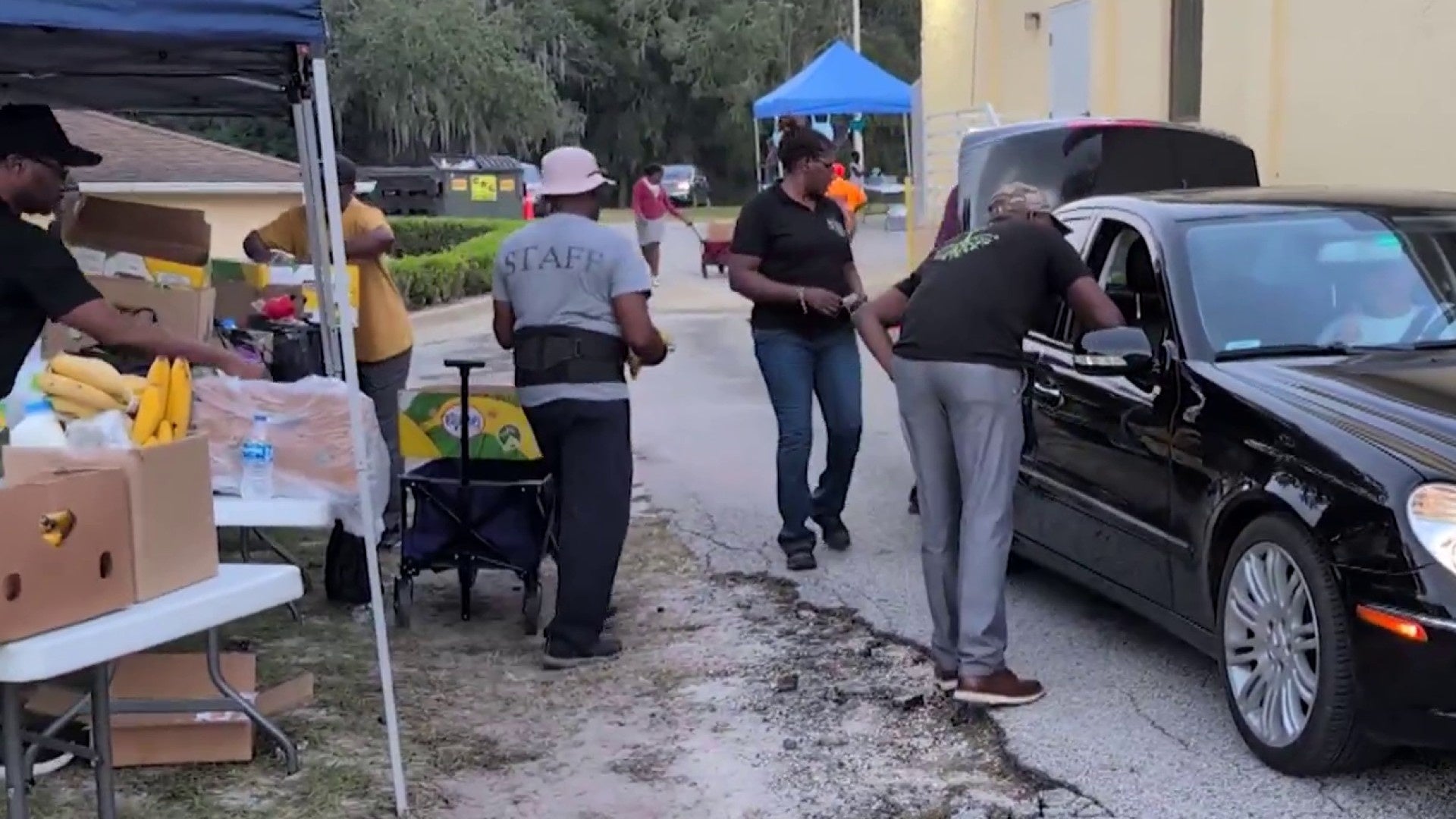
To address this, the North Orlando Seventh-day Adventist Church has introduced a nighttime food distribution event, aimed at helping families who can’t make it to daytime giveaways.
“I work in the daytime, so it’s perfect,” said Shanoi Reid, a mother of two, who stopped by the event right after getting off work. “I just got off at 5:30 p.m. and came right on over.” Reid shared that her family currently relies on food assistance after temporarily losing SNAP benefits. “I normally get them, but right now I’m not,” she explained. “This was a good resource for us.”
Others waiting in line echoed similar struggles. Many are working full-time jobs yet still do not qualify for government aid. One mother of six noted, “They said I make too much at $18.50 an hour. I work, but I don’t make enough to afford everything.”
Pastor Gregory Carol emphasized the importance of the evening distribution, highlighting its convenience. Families can remain in their vehicles while volunteers load boxes of food directly for them. “Food insecurity hits everybody,” he said. “Not just the unemployed. There are a lot of people who have their regular jobs and still need help.”
Organizers packed about 150 boxes of food for the event but ran out halfway through, prompting them to prepare additional boxes to meet the high demand. Cheryl-Ann Duncan, Director of Community Services, explained that Wednesday evenings were chosen strategically. “We looked at all the other pantries in the area. Most of them were mornings, so we wanted to fill that gap,” she said.
By the end of the night, volunteers reported that more than 200 vehicles passed through the drive-thru line. Organizers expect even greater need at future evening food drives if SNAP benefits remain paused and grocery prices continue to rise.
For families struggling to make ends meet, nighttime distributions are becoming a vital resource in Central Florida’s ongoing effort to combat food insecurity.
https://www.clickorlando.com/news/local/2025/11/06/orlando-church-hosts-nighttime-food-drive-to-meet-growing-demand-amid-rising-costs/


ESPN officially remains dark on YouTube TV for ‘Monday Night Football’
Monday Night Football has officially kicked off on ESPN and ABC, but YouTube TV subscribers remain in the dark. This reality became apparent late Monday evening when YouTube TV issued a statement rejecting Disney’s offer to reactivate ABC on its platform for Tuesday night’s election coverage.
If a new distribution agreement were imminent, YouTube TV likely wouldn’t have addressed programming scheduled for Tuesday night. As a result, approximately 10 million YouTube TV subscribers find themselves at a loss, unable to watch Monday Night Football between the Arizona Cardinals and Dallas Cowboys.
One would have expected that the Cowboys, of all teams, would have motivated both sides to reach a new deal. Networks rarely get the chance to air “America’s Team” and capitalize on the massive ratings they bring in every week. Likewise, YouTube TV isn’t eager to alienate the many Cowboys fans who might unsubscribe and switch to a competitor’s service due to the blackout.
Unfortunately, both sides remain at an impasse over price. Disney, holding valuable live sports programming across its ESPN family of networks, is leveraging the strength of its portfolio to negotiate the highest possible per-subscriber fee. Meanwhile, YouTube TV is pushing for lower rates aligned with those secured by the largest pay-TV distributors in the country, such as Comcast and Charter.
This standoff carries serious implications. NFL games are some of the most popular and widely viewed programming on television—especially when the Dallas Cowboys are playing. The fact that an agreement hasn’t been reached in time for Monday Night Football appears to confirm reports that both sides remain “far apart” on price.
Looking ahead, next Monday’s Monday Night Football matchup between the Green Bay Packers and the Philadelphia Eagles promises to be one of the most important games in the NFC this season. Missing one NFL game already sends a strong message that both sides are serious. Missing a second, featuring two Super Bowl contenders, would signal even more significant and potentially long-term issues.
Despite Monday’s blackout on YouTube TV, it’s still more likely than not that the two sides will reach an agreement relatively soon. Disney stands to lose roughly $5 million each day without access to the YouTube TV platform. Conversely, YouTube TV risks losing subscribers each day that Disney-owned networks remain unavailable.
There is clear motivation on both sides to resolve this dispute. The real question is: how long will paying customers be left holding the bag?
https://awfulannouncing.com/nfl/espn-dark-youtube-tv-monday-night-football.html
‘She landed through her uncomfortableness and gave me a chance’: After weeks of patience, a once-scared mama cat finally starts to trust the hooman who saved her kittens
Sometimes, the Cat Distribution System delivers in the most unexpected places. While checking on a quiet cemetery, a caretaker discovered a tiny, furry mystery: a carrier, four kittens, and one frightened mama cat.
The kittens wasted no time claiming their new human, climbing pant legs and hearts alike. Mama, however, had clearly seen hard times and wasn’t ready to trust just yet.
One by one, the kittens found loving homes, but the caretaker couldn’t stop thinking about the mama left behind. Through rain, patience, and nightly visits filled with soft words and tasty treats, trust began to grow paw by paw.
Then, one rainy day, she finally allowed herself to be scooped up and taken somewhere safe.
https://cheezburger.com/42943493/she-landed-through-her-uncomfortableness-and-gave-me-a-chance-after-weeks-of-patience-a-once-scared

Maine food pantries weathering funding cuts with help from retailers
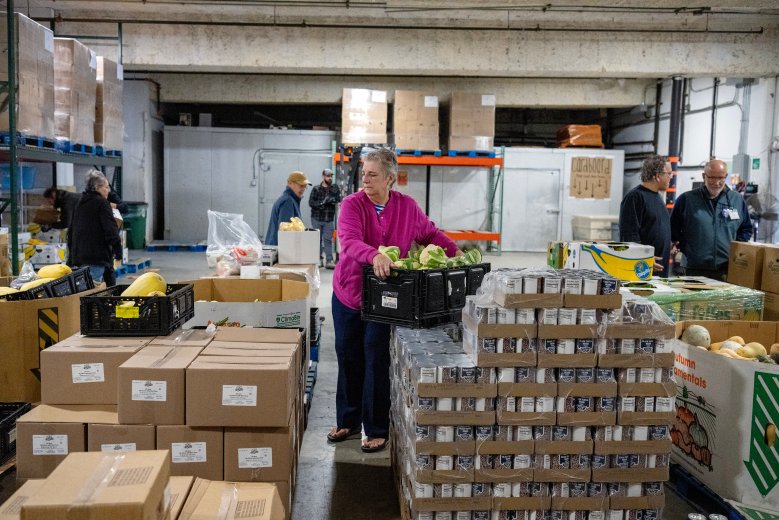
There’s a sense of urgency at the Wayside Food Program loading dock on a recent morning. Volunteer workers use forklifts to pull pallets of boxes—1,661 pounds of food in all—from a Wayside van that’s just made its routine Thursday morning rounds, picking up “food rescue” donations from area markets like Hannaford and Target.
A small crew of volunteers scurry around the 8,000-square-foot warehouse, adding the newly delivered boxes to designated sections for produce, baked goods, and meats. About eight representatives from four area food pantries look on, waiting for the morning shopping session to officially begin.
At 9:30 a.m. sharp, Marcus blows the ritual forklift horn. It’s not unlike the 9:30 a.m. bell that marks the start of the trading day at the New York Stock Exchange. But instead of traders shouting and waving their arms, the shoppers hustle boxes of food to their pantries’ reserved pallets. They’ll be done shopping in under 15 minutes, their vehicles loaded up within an hour.
Kim Munro, resident service coordinator for the senior residents at 100 State Street, a Portland Housing Authority property, loads her pallet with crates of cauliflower, fresh fennel, and baby ginger root, with an eye toward the new immigrants she serves.
“My new Mainers are going to be thrilled by these,” she said.
The shoppers can choose from about 15,000 pounds of free food this day, but only about 400 pounds of meat. Deb Alonzo, director of the Vineyard Church of Greater Portland Food Pantry in Westbrook, considered herself lucky to score a box of frozen sausages, chicken breasts, and Steak-umms.
“A year ago, we used to give the clients six packages of meat a week. Now we’re lucky if we give them two,” said Alonzo, who will take about 2,000 pounds of food back to the 70 families the Vineyard serves.
Still, the shoppers gladly take what they can get. They recognize that with Supplemental Nutritional Assistance Program (SNAP) benefits being slashed and grocery prices on the rise, a growing number of Mainers will turn to food pantries for help this fall and winter.
—
### Generous Donations Help Meet Growing Demand
People running Maine’s food pantries feel confident they’ll be able to meet the increased demand, thanks in large part to the sizable regular food donations they receive from Maine markets, bakeries, farms, and fishermen.
“The farmers and the markets are so generous. They’re really aware of the need,” said Marion Nielsen of North Windham, a volunteer and former board member of Wayside. “This program would not be able to continue as it does if we didn’t have all these places giving to us.”
“We wouldn’t exist without the food rescue,” said Wayside operations manager Don Morrison.
—
### Dependent on Markets
As a distribution hub for more than 60 Maine food pantries and soup kitchens, Wayside depends on the kindness of retailers and wholesalers, whose donations usually account for about half the food they receive each month.
In September, Wayside took in 115,579 pounds of food from regional supermarkets like Hannaford and Shaw’s; national chains like BJ’s Wholesale Club, Costco, Target, Walmart, and Whole Foods; and the restaurant wholesaler Sysco.
“We understand the responsibility we have in supporting our communities, which is why we have a very robust food donation program,” said Caitlin Cortelyou, external communications manager for Hannaford supermarkets. Last year, Hannaford donated 13 million pounds of food to Maine food programs.
Wayside has also received more than 40,000 pounds of surplus produce from Farms for Food Equity in Cape Elizabeth and counts on thousands of pounds of frozen fish each week from the Maine Coast Fishermen’s Association.
—
### What is Food Rescue?
Wayside’s food rescue program collects donated food that is unsellable but completely safe and nutritious to eat and would otherwise go to waste. The program directed about 1.7 million pounds of food to Mainers in need last year, according to Wayside’s 2024 impact report.
The rescued food includes:
– Past-peak or misshapen produce
– Dairy and packaged foods nearing their expiration dates
– Canned or boxed products that are damaged but still sealed
– Cartons of eggs with one or two broken shells
– Day-old breads
– Meats that have reached their use-or-freeze-by dates and are frozen before donation
Bruce Willson, co-director of the Hope House Network in Lewiston, said a little more than half of the food his pantry distributes comes from retailers like Target and Shaw’s. If his pantry lines grow longer in the coming months, he still expects to be able to serve everyone.
“The supply is good right now,” he said. “If we didn’t have Target to get a big variety of food items, especially the meat they donate, it’d be a lot tougher.”
—
### Meat Supply Challenges
Meat is in shortest supply for food pantries these days. Morrison believes the rising cost has led supermarkets to stock less of it to avoid waste.
Pantries don’t tend to look to restaurants for donations because, as Morrison points out, savvy chefs repurpose their leftovers.
“Saturday’s stir-fry special was Friday night’s prime rib,” he said. “Any restaurant that is throwing away enough food for me to come pick it up, they’re probably not going to be in business long.”
—
### Private Donations Augment Meat Supply
Private donations help augment the meat supply. Sandy Swett, executive director of the Harrison Food Bank, which serves about 1,000 rural Maine families a week, said an anonymous donor buys livestock every year at auction, has them butchered in Windham, and donates all the meat.
This year, the donor bought two cows, six pigs, and six lambs.
“That’s a lot of meat,” Swett said.
Market anomalies sometimes prove to be a boon.
“During the egg shortage last winter, we were flush with eggs,” said Harrison Otterbein, president at St. Vincent de Paul Soup Kitchen, the state’s largest soup kitchen. “Stores were buying as much as they could, they were way too expensive, and they were expiring.”
—
### Benefits from Supermarket Display Practices
Pantries and soup kitchens can also benefit from supermarket display strategies.
“Grocery stores pre-slicing deli meats was the best thing that ever happened to us,” Otterbein said. “They have a mandate to keep the shelves flush with product because it’s visually appealing,” he added. “But at the same time, the food needs to be safe. So they cycle out a lot of it, which helps us make thousands of sandwiches every week.”
Otterbein’s kitchen serves more than 200 people a day, up about 25% in the last 18 months. When they first opened in 1972, they fed just 16 people daily.
Still, Otterbein says St. Vincent’s will be able to meet any increased need, thanks to “tremendously helpful” retail donations, substantial reserves, and a growing volunteer base.
“We are able to weather any storm for the next two or three years.”
—
### “Nobody Should Go Hungry”
Local markets also offer substantial support for Maine food pantries. Rosemont Market & Bakery last year donated more than 13,000 pounds of produce, prepared foods, and baked goods to the Good Shepherd Food Bank network, for instance.
Rosemont Marketing Director Finn Naylor said that each night, the six Rosemont locations around Greater Portland sort through their inventory for edible but unattractive produce, prepared food that’s reached its sell-by date, and day-old bread. They deliver the food to Rosemont’s headquarters on Stevens Avenue, where it’s picked up throughout the week by the Locker Project, the South Portland Food Pantry, and The Root Cellar.
Around the holidays, Rosemont also donates surplus fresh turkeys to Wayside.
“It feels like quality food should go to everyone, no matter what they’re experiencing in their lives,” Naylor said. “This way we can share what we’re making here.”
—
### Support from Local Bakeries
Peter McNamara, director of operations at the South Portland Food Cupboard, said about 20% of his food donations come from local bakeries like The Cookie Jar in Cape Elizabeth, Night Moves Bread in South Portland, and Scratch Baking Co.
Morrison said artisanal bread doesn’t always work well for donations because it doesn’t contain preservatives and molds quicker than mass-produced loaves. But Night Moves baker-owner Kerry Hanney said her dough undergoes a slow-fermentation process that keeps the bread fresh longer.
“I know it will still be good for many days if we’re able to get it to people as soon as possible, so we really try to prioritize that,” Hanney said.
Pantries can only accept baked goods that are packaged or wrapped, so Hanney covers her donated loaves in plastic wrap or paper. She said the packaging requirement can be a barrier for some smaller businesses that would like to donate but can’t spare the added time or expense.
“It’s easier for a larger business like Hannaford to send packaged foods,” she said. “Money adds up in this industry, we’re always fighting time and costs. But overall, it’s a pretty small cost to make sure the food gets to somebody, in my opinion.
“I can’t imagine wasting this good food,” she said. “Knowing it can have another life to sustain others in our community feels like it’s a necessary part of our process. We have enough food in Maine—nobody should be going hungry. If there’s anything we can do to contribute, I think we have to.”
https://www.pressherald.com/2025/10/18/maine-food-pantries-weathering-funding-cuts-with-help-from-retailers/