Tag Archives: supplemental

The timeline for SNAP benefits remains uncertain, even after Congress agrees to end the shutdown

**Congress Moves to Reopen Government, But SNAP Benefit Timing Remains Uncertain**

*By Geoff Mulvihill, Associated Press*

Congress has taken a major step toward reopening the government, but there’s still uncertainty about when one of the most far-reaching impacts of the closure will be resolved: when all 42 million Americans who receive SNAP food aid will have access to their full November benefits.

On Wednesday, the House adopted a plan to reopen and sent it to President Donald Trump to sign. One provision calls for restarting the Supplemental Nutrition Assistance Program (SNAP), but it does not clarify exactly when benefits will be loaded onto the debit cards beneficiaries use to buy groceries.

A spokesperson for the U.S. Department of Agriculture (USDA), which runs SNAP, said in an email Wednesday that funds could be available “upon the government reopening, within 24 hours for most states.” The department did not immediately answer questions about which states might face delays or whether the 24-hour timeline applies to states or directly to the cards used by recipients.

There has been a series of court battles over the fate of the nation’s largest government food program, which serves about 1 in 8 Americans. Here are some key points about the situation:

### When SNAP Funds Become Available Could Vary by State

Seesawing court rulings and changing guidance from the USDA have led to unequal distribution of benefits across states. Some beneficiaries have already received their full monthly allocations, while others have received nothing. A few states have issued only partial payments.

States report it’s faster to provide full benefits than to do the calculations and computer programming required for partial payments. At least 19 states plus the District of Columbia issued full benefits to at least some recipients last week, according to an Associated Press tally. Many did so within a day, during the narrow window between a Nov. 6 court ruling requiring full payments and a Nov. 7 U.S. Supreme Court decision halting them.

Jessica Garon, spokesperson for the American Public Human Services Association, anticipates most states will be able to issue full benefits within three days after receiving the go-ahead, while others may take up to a week. States that have sent no November benefits yet, such as South Carolina and West Virginia, will likely be the quickest to disburse funds. However, sixteen states have already loaded EBT cards with partial benefits, and some may face technical hurdles issuing the remaining amount, according to Carolyn Vega, a policy analyst at advocacy group Share Our Strength.

### Delays in Benefits Are a Problem for Recipients

For millions of Americans, even knowing benefits are on the way is not enough—when they arrive matters. About 42 million lower-income Americans receive SNAP benefits, averaging around $190 monthly per person. Many say the benefits do not—and are not intended to—cover the full cost of groceries in a normal month, even with careful budgeting. Delays make matters worse.

Doretha Washington, 41, of St. Louis, has a husband and six children, but not enough money to cover all their food needs. Even though her husband works servicing heating and cooling systems, the family relies on SNAP. They had received nothing in November, although Missouri announced Tuesday that partial benefits would be issued.

“Now it’s making things difficult because we can’t pay our bills in full and keep food in here,” Washington said this week. “I’m down to three days of food and trying to figure out what to do.” She has been rationing what they have. Others have turned to food charities, but report long lines and low supplies.

### Cutting Off Funds Left State Governments Scrambling

The USDA told states on Oct. 24 that it would not fund SNAP for November if the shutdown continued, leaving states scrambling. Most Democratic-led states sued to have the funding restored. Both Democratic and Republican-led states also launched emergency efforts, including using state funds to pay for benefits, boosting food banks, and deploying the National Guard to help with food distribution.

Other states used their allotted SNAP money only after a judge ordered the Trump administration to cover the full cost for the month. The legislation to reopen the government, passed by the Senate on Monday, calls for states to be reimbursed for funds spent running programs typically paid for by the federal government. However, it’s not immediately clear which situations will qualify in the case of SNAP.

In the meantime, the USDA told states Tuesday that it would reimburse them for paying out partial SNAP benefits, under a system where recipients get up to 65% of their regular allocations—and even states that paid the full amount can receive partial reimbursements. It also assured states it would not reduce amounts on cards for recipients in states that paid full benefits.

Democratic-led states that sued for benefits to be released said in a filing Wednesday that the late-breaking information “illustrates the chaos and confusion occasioned by USDA’s multiple, conflicting guidance documents.”

*Associated Press reporters Margery A. Beck and David A. Lieb contributed to this story.*
https://www.orlandosentinel.com/2025/11/12/timeline-for-snap-benefits/


Michael Che Calls SNAP Freeze ‘Really F–ed Up’: I Keep Seeing ‘Racist Videos Celebrating (Mostly Black) Families Not Being Able to Buy Groceries’

“Saturday Night Live” star Michael Che is speaking out against the suspension of the Supplemental Nutrition Assistance Program (SNAP), which began on Saturday as a result of the now month-long government shutdown.

“This SNAP freeze is really fucked up,” Che wrote in an Instagram post Saturday. “And I keep seeing a lotta racist videos celebrating (mostly black) families not being able to buy groceries. There’s this weird idea that since some people have taken advantage of welfare benefits in the hood, NOBODY should receive help, at all? This country is built on greedy motherfuckers taking shortcuts and gaming the system to their benefit, but for some reason, when poor people find a way to turn a nickel into a dime, they’re judged more severely, especially Blacks.”

He continued, “I [know] the hustle is to hate each other here so we can fight in the comments and up our engagements, but let’s draw the line at feeding the poor. I grew up on free cheese and powdered milk and waiting for your friends to leave the store so they won’t see me pay with stamps. That shit ain’t as glamorous as it sounds. I promise.”

The government shut down on Oct. 1 after Republicans and Democrats failed to pass a funding bill for government services as the previous federal budget expired. In the Senate, Republicans are short 60 votes to pass the proposed bill, which gives Democrats a chance to fight back on key issues.
https://variety.com/2025/tv/news/michael-che-snap-freeze-racist-government-shutdown-1236567724/

Mayor Woodfin: Birmingham Has ‘Moral Obligation’ to Assist Those Who Lose SNAP Benefits

By Sym Posey | The Birmingham Times

As part of an extensive plan to assist elders, children, and families, Birmingham Mayor Randall L. Woodfin on Thursday asked the City Council to commit $1 million to support households at risk of losing November SNAP benefits due to the federal government shutdown.

Woodfin spoke during a City Hall press conference, flanked by City Councilors including President Wardine Alexander; Drew Langloh, President of the United Way of Central Alabama; faith leaders; non-profit executives; and others.

“We are taking immediate action because we have a moral obligation to take care of the general welfare of our residents,” Woodfin said. “Our focus is on getting help directly to the people who need it most—whatever it takes to keep folks fed and families whole.”

Nearly 23,000 Birmingham households—one in four—rely on SNAP to keep food on the table, Woodfin noted. “On Nov. 1, those families could wake up with nothing because Washington shut the government down.”

Unless the federal government shutdown is ended, benefits under the Supplemental Nutrition Assistance Program will cease. SNAP is the nation’s largest anti-hunger program, serving nearly 42 million people nationwide.

The mayor’s comprehensive three-part plan to help families that could lose benefits includes:

1. **Securing Funding:** Mayor Woodfin will ask the council on Tuesday to commit $1 million to provide supplemental nutrition assistance for the month of November, aiming to replace at least a portion of lost benefits for Birmingham households affected by the shutdown.

2. **Community Food Drive:** Launching a food drive from Monday, Nov. 3, through Thursday, Nov. 6, at Christian Service Mission, 3600 3rd Ave. South. Drop-off hours will be 7:30 a.m. to 4 p.m.

3. **Connecting Residents to Services:** Coordinating with local partners to serve as an information hub, helping residents access additional wraparound services and assistance programs during this period.

Residents can monitor updates at [birminghamal.gov/bhamready](https://www.birminghamal.gov/bhamready).

“At its core, we all believe the role of the government is simple: to protect and care for its people,” said Council President Wardine Alexander. “When federal leadership cannot ensure these programs are fully funded, it falls on us at the local level to take up that responsibility.”

Tracy Hipps, Executive Director of Christian Service Mission, emphasized community involvement. “The greatest commandment that we can live out is to love our neighbor,” he said. “If you have a neighbor in need, help them. Don’t wait on the city, don’t wait on anybody else—you help them. That’s our responsibility. Live out the gospel every day.”

Individuals and organizations interested in supporting the response effort are encouraged to email **BHAMready@birminghamal.gov**. Messages should include the sender’s name, organization, phone number, and any commitments or questions. City staff will respond promptly.

For more information and updates regarding this initiative, visit [www.birminghamal.gov/bhamready](https://www.birminghamal.gov/bhamready). For up-to-the-minute non-emergency updates, text **BHAMREADY** to **38276**.
https://www.birminghamtimes.com/2025/10/woodfin-birmingham-has-moral-obligation-to-assist-those-who-lose-snap-benefits/

Fact Check: Did Democrats Vote Against Funding SNAP Benefits?

**Senate Democrats Vote 12 Times Against Funding the Supplemental Nutrition Assistance Program**

*By Andrew Stanton | Newsweek | October 28, 2025*

Senate Democrats have now voted 12 times to not fund the food stamp program, officially known as the Supplemental Nutrition Assistance Program (SNAP).

**Community Reactions**

A user named DallasBiff commented on the situation, highlighting the ongoing political debates surrounding SNAP funding.

Another commenter, SaveFerris, referenced a biblical passage, Luke 17:28:
*”As it was in the days of Lot; They did eat, they drank, they bought, they sold…”* — drawing parallels to current socio-political circumstances.

**Disclaimer:**
Opinions expressed on Free Republic are those of individual posters and do not necessarily represent the views of Free Republic or its management. All materials posted are protected accordingly.
https://freerepublic.com/focus/f-news/4349444/posts

Maine food pantries weathering funding cuts with help from retailers

There’s a sense of urgency at the Wayside Food Program loading dock on a recent morning. Volunteer workers use forklifts to pull pallets of boxes—1,661 pounds of food in all—from a Wayside van that’s just made its routine Thursday morning rounds, picking up “food rescue” donations from area markets like Hannaford and Target.

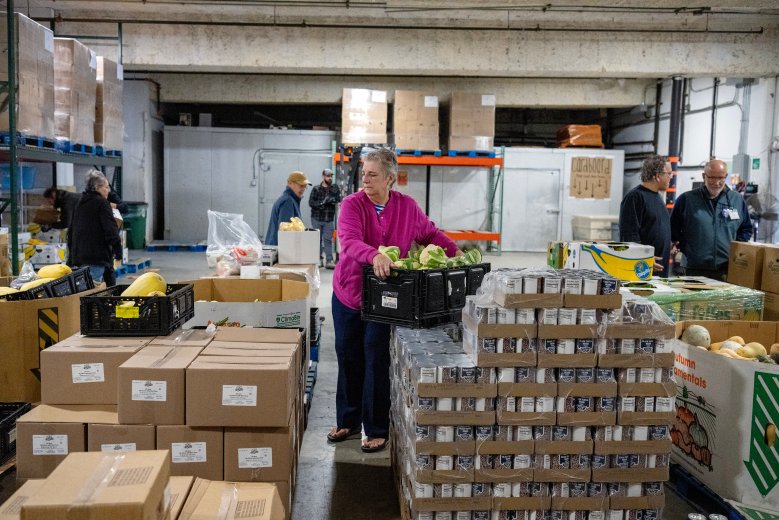
A small crew of volunteers scurry around the 8,000-square-foot warehouse, adding the newly delivered boxes to designated sections for produce, baked goods, and meats. About eight representatives from four area food pantries look on, waiting for the morning shopping session to officially begin.

At 9:30 a.m. sharp, Marcus blows the ritual forklift horn. It’s not unlike the 9:30 a.m. bell that marks the start of the trading day at the New York Stock Exchange. But instead of traders shouting and waving their arms, the shoppers hustle boxes of food to their pantries’ reserved pallets. They’ll be done shopping in under 15 minutes, their vehicles loaded up within an hour.

Kim Munro, resident service coordinator for the senior residents at 100 State Street, a Portland Housing Authority property, loads her pallet with crates of cauliflower, fresh fennel, and baby ginger root, with an eye toward the new immigrants she serves.

“My new Mainers are going to be thrilled by these,” she said.

The shoppers can choose from about 15,000 pounds of free food this day, but only about 400 pounds of meat. Deb Alonzo, director of the Vineyard Church of Greater Portland Food Pantry in Westbrook, considered herself lucky to score a box of frozen sausages, chicken breasts, and Steak-umms.

“A year ago, we used to give the clients six packages of meat a week. Now we’re lucky if we give them two,” said Alonzo, who will take about 2,000 pounds of food back to the 70 families the Vineyard serves.

Still, the shoppers gladly take what they can get. They recognize that with Supplemental Nutritional Assistance Program (SNAP) benefits being slashed and grocery prices on the rise, a growing number of Mainers will turn to food pantries for help this fall and winter.

### Generous Donations Help Meet Growing Demand

People running Maine’s food pantries feel confident they’ll be able to meet the increased demand, thanks in large part to the sizable regular food donations they receive from Maine markets, bakeries, farms, and fishermen.

“The farmers and the markets are so generous. They’re really aware of the need,” said Marion Nielsen of North Windham, a volunteer and former board member of Wayside. “This program would not be able to continue as it does if we didn’t have all these places giving to us.”

“We wouldn’t exist without the food rescue,” said Wayside operations manager Don Morrison.

### Dependent on Markets

As a distribution hub for more than 60 Maine food pantries and soup kitchens, Wayside depends on the kindness of retailers and wholesalers, whose donations usually account for about half the food they receive each month.

In September, Wayside took in 115,579 pounds of food from regional supermarkets like Hannaford and Shaw’s; national chains like BJ’s Wholesale Club, Costco, Target, Walmart, and Whole Foods; and the restaurant wholesaler Sysco.

“We understand the responsibility we have in supporting our communities, which is why we have a very robust food donation program,” said Caitlin Cortelyou, external communications manager for Hannaford supermarkets. Last year, Hannaford donated 13 million pounds of food to Maine food programs.

Wayside has also received more than 40,000 pounds of surplus produce from Farms for Food Equity in Cape Elizabeth and counts on thousands of pounds of frozen fish each week from the Maine Coast Fishermen’s Association.

### What is Food Rescue?

Wayside’s food rescue program collects donated food that is unsellable but completely safe and nutritious to eat and would otherwise go to waste. The program directed about 1.7 million pounds of food to Mainers in need last year, according to Wayside’s 2024 impact report.

The rescued food includes:

– Past-peak or misshapen produce
– Dairy and packaged foods nearing their expiration dates
– Canned or boxed products that are damaged but still sealed
– Cartons of eggs with one or two broken shells
– Day-old breads
– Meats that have reached their use-or-freeze-by dates and are frozen before donation

Bruce Willson, co-director of the Hope House Network in Lewiston, said a little more than half of the food his pantry distributes comes from retailers like Target and Shaw’s. If his pantry lines grow longer in the coming months, he still expects to be able to serve everyone.

“The supply is good right now,” he said. “If we didn’t have Target to get a big variety of food items, especially the meat they donate, it’d be a lot tougher.”

### Meat Supply Challenges

Meat is in shortest supply for food pantries these days. Morrison believes the rising cost has led supermarkets to stock less of it to avoid waste.

Pantries don’t tend to look to restaurants for donations because, as Morrison points out, savvy chefs repurpose their leftovers.

“Saturday’s stir-fry special was Friday night’s prime rib,” he said. “Any restaurant that is throwing away enough food for me to come pick it up, they’re probably not going to be in business long.”

### Private Donations Augment Meat Supply

Private donations help augment the meat supply. Sandy Swett, executive director of the Harrison Food Bank, which serves about 1,000 rural Maine families a week, said an anonymous donor buys livestock every year at auction, has them butchered in Windham, and donates all the meat.

This year, the donor bought two cows, six pigs, and six lambs.

“That’s a lot of meat,” Swett said.

Market anomalies sometimes prove to be a boon.

“During the egg shortage last winter, we were flush with eggs,” said Harrison Otterbein, president at St. Vincent de Paul Soup Kitchen, the state’s largest soup kitchen. “Stores were buying as much as they could, they were way too expensive, and they were expiring.”

### Benefits from Supermarket Display Practices

Pantries and soup kitchens can also benefit from supermarket display strategies.

“Grocery stores pre-slicing deli meats was the best thing that ever happened to us,” Otterbein said. “They have a mandate to keep the shelves flush with product because it’s visually appealing,” he added. “But at the same time, the food needs to be safe. So they cycle out a lot of it, which helps us make thousands of sandwiches every week.”

Otterbein’s kitchen serves more than 200 people a day, up about 25% in the last 18 months. When they first opened in 1972, they fed just 16 people daily.

Still, Otterbein says St. Vincent’s will be able to meet any increased need, thanks to “tremendously helpful” retail donations, substantial reserves, and a growing volunteer base.

“We are able to weather any storm for the next two or three years.”

### “Nobody Should Go Hungry”

Local markets also offer substantial support for Maine food pantries. Rosemont Market & Bakery last year donated more than 13,000 pounds of produce, prepared foods, and baked goods to the Good Shepherd Food Bank network, for instance.

Rosemont Marketing Director Finn Naylor said that each night, the six Rosemont locations around Greater Portland sort through their inventory for edible but unattractive produce, prepared food that’s reached its sell-by date, and day-old bread. They deliver the food to Rosemont’s headquarters on Stevens Avenue, where it’s picked up throughout the week by the Locker Project, the South Portland Food Pantry, and The Root Cellar.

Around the holidays, Rosemont also donates surplus fresh turkeys to Wayside.

“It feels like quality food should go to everyone, no matter what they’re experiencing in their lives,” Naylor said. “This way we can share what we’re making here.”

### Support from Local Bakeries

Peter McNamara, director of operations at the South Portland Food Cupboard, said about 20% of his food donations come from local bakeries like The Cookie Jar in Cape Elizabeth, Night Moves Bread in South Portland, and Scratch Baking Co.

Morrison said artisanal bread doesn’t always work well for donations because it doesn’t contain preservatives and molds quicker than mass-produced loaves. But Night Moves baker-owner Kerry Hanney said her dough undergoes a slow-fermentation process that keeps the bread fresh longer.

“I know it will still be good for many days if we’re able to get it to people as soon as possible, so we really try to prioritize that,” Hanney said.

Pantries can only accept baked goods that are packaged or wrapped, so Hanney covers her donated loaves in plastic wrap or paper. She said the packaging requirement can be a barrier for some smaller businesses that would like to donate but can’t spare the added time or expense.

“It’s easier for a larger business like Hannaford to send packaged foods,” she said. “Money adds up in this industry, we’re always fighting time and costs. But overall, it’s a pretty small cost to make sure the food gets to somebody, in my opinion.

“I can’t imagine wasting this good food,” she said. “Knowing it can have another life to sustain others in our community feels like it’s a necessary part of our process. We have enough food in Maine—nobody should be going hungry. If there’s anything we can do to contribute, I think we have to.”
https://www.pressherald.com/2025/10/18/maine-food-pantries-weathering-funding-cuts-with-help-from-retailers/