
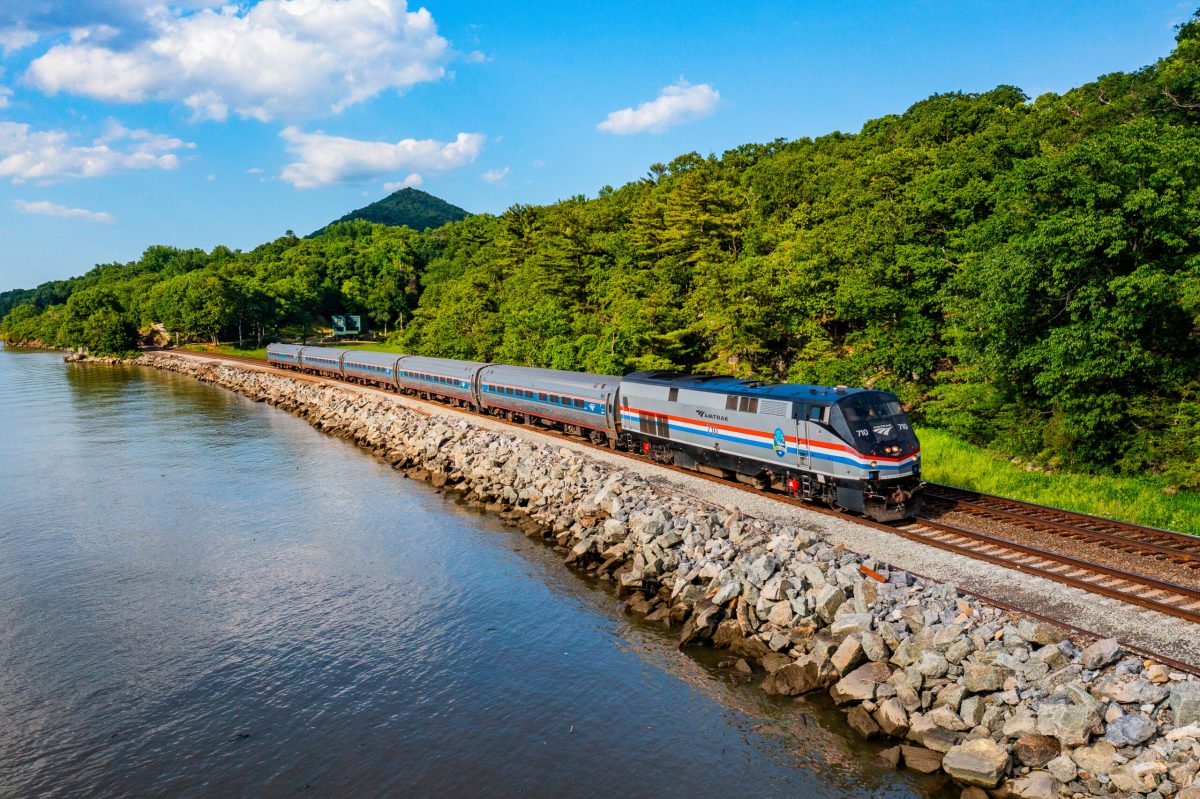
As millions of Americans crowd highways and airports this Thanksgiving week, Amtrak is enjoying an unexpected surge: a record 36. 2 million passengers in fiscal year 2025, up a remarkable 10 percent from the year prior. The company calls it a “historic milestone” for U. S. public transportation. “These results show what’s possible when we lead with purpose,” Amtrak President Roger Harris said in a statement shared with Newsweek. But while ridership is surging, the country’s aging rail infrastructure remains far from ready to meet the demand. Amtrak’s popularity spike comes as the broader travel industry cools. According to the 2025 Deloitte Holiday Travel Survey, more than half of Americans plan to travel between Thanksgiving and early January, the highest intent in five years, but they’re spending less overall. Average trip budgets are down 18 percent, and many travelers are choosing to drive or take the train instead of flying to save money. That shift is benefiting Amtrak, whose fares are typically lower than airfare on short routes and appeal to cost-conscious travelers tired of packed airports and rising ticket prices. “These numbers show that Americans want more train travel, not less,” Amtrak CEO Stephen Gardner said. Yet as more travelers rediscover rail, experts warn the U. S. lacks the infrastructure needed to sustain that momentum, to say nothing of the political will. John Robert Smith, former chairman of Amtrak’s board and longtime chair of Transportation for America, said the country’s failure to modernize its rail network stems from decades of policy neglect. “National leaders often ask why we can’t have passenger rail service like Europe or Asia,” Smith told Newsweek. “The simple answer is that those governments chose to invest in passenger rail as a vital form of connectivity. In this country, we haven’t done that.” Smith, who also served as mayor of Meridian, Mississippi, recalled that when he joined the Amtrak board in 2002, “the U. S. was spending more money collecting roadkill from highways than on the entire national passenger rail system.” The result, he said, is a “highway-centric nation” that never matched that investment with comparable support for rail. America’s Rail Gap Is Widening That imbalance has left the U. S. far behind its global peers. China has built more than 25, 000 miles of high-speed rail since 2008, while France’s TGV network regularly runs trains above 180 mph. By contrast, no Amtrak line meets international high-speed standards. A May 2025 Bechtel Group report said the U. S. has struggled to advance high-speed rail because of inconsistent funding, slow and fragmented permitting, complex land acquisition, and delivery systems that have not kept pace with the scale of the projects. “We’ve been trying to develop high-speed rail in the U. S. for a long time. We have not really succeeded,” said Eric Goldwyn, a transportation and land-use professor at NYU’s Marron Institute, in comments to the outlet SmartCitiesDive. “The biggest barrier has been funding.” Funding has long defined the modern Amtrak era. Joe Biden’s 2021 Bipartisan Infrastructure Law allocated $66 billion for rail the largest federal investment since Amtrak’s founding in 1971. But four years later, much of the money remains tied up in planning, permitting and negotiations with states and private freight owners. According to the Federal Railroad Administration, fewer than a dozen major rail projects have moved beyond preliminary design, and only a small number, such as the Gateway Tunnel between New York and New Jersey and parts of the Chicago Hub Improvement Program, have broken ground. (The Trump administration said it was shutting down Gateway because it was a “Democrat project,” despite the infrastructure improvements being critical for the nation’s biggest economy.) Smith said the uneven progress illustrates a larger issue. “We made a historic promise with the infrastructure bill, but we haven’t matched it with the urgency or coordination it demands,” he said. “The money is there, but the willpower to execute at scale is not. Until we treat rail as essential infrastructure like highways or airports we will keep falling behind our global peers.” Meanwhile, expectations are shifting. The Deloitte survey found that Generation Z and millennials now make up half of all U. S. holiday travelers, a generational change that is reshaping not only where Americans go but how they get there. Younger travelers are gravitating toward more affordable, lower-carbon options and increasingly see rail as a convenient, environmentally friendly alternative. Momentum Is Growing Last year, 1. 2 million people traveled by train for Thanksgiving, far fewer than the roughly 18 million who flew, but experts say the trend line is changing. Amtrak’s bookings for the 2025 holiday season are already up by double digits compared with last year, with Northeast Corridor routes selling out days ahead. “People are rediscovering something that should never have been forgotten,” Smith said. “Rail connects people in a way that air travel never will. It ties communities together.” For Amtrak and rail advocates, the ridership boom is both a warning and an opportunity. Air travel continues to deteriorate, and federal data shows consumer complaints against U. S. airlines hit a record high in 2024. Rail is becoming increasingly attractive as a result. “If Amtrak’s success this year shows anything, it’s that demand is not the issue,” Smith said. “We’ve reached a point where people want the train, but the infrastructure to support them is not there yet.” Amtrak officials say the gap is starting to narrow. The company has committed more than $22 billion in federal infrastructure funds to replace aging bridges, tunnels and trainsets as part of a sweeping modernization plan focused on long-distance service and its busiest corridors. One early win has emerged along the Gulf Coast, where Amtrak’s restored service between New Orleans and Mobile has exceeded expectations, doubling and in some cases tripling early ridership and revenue projections. Smith called the route “a bellwether for what passenger rail can become nationwide, not just for mobility but for economic development in every town it serves.” What Comes Next for Amtrak Although previous administrations have faced criticism for slow progress on rail modernization, there is growing agreement that Amtrak’s survival and its recent growth rest on a rare source of political unity. Earlier this year, the Trump administration’s fiscal 2026 transportation budget proposed flat funding for Amtrak at about $2. 4 billion. Rail advocates described it as a continued commitment to the national network. The plan increases support for long-distance routes while reducing federal assistance for the critical Northeast Corridor, a shift officials say reflects stronger revenue on that corridor after record ticket sales. “After decades of cuts and uncertainty, even flat funding is a sign of bipartisan recognition that rail matters,” said Jim Mathews, president and CEO of the Rail Passengers Association. “With predictable investment, trains can give Americans a safer and more efficient travel alternative to congested roads and highways.” Transportation advocates see that as evidence of momentum increasingly crossing party lines. “We’re seeing a growing bipartisan recognition that rail is an important piece of the U. S. transportation network,” Mathews said. For Smith, the lesson is straightforward: Americans have decided they want passenger rail. The question now is whether Washington will meet that demand. “We’re finally at a point where people want the train,” he said. “The next question is whether we will build the country to match that demand.”.
https://www.newsweek.com/america-is-finally-falling-in-love-with-amtrak-the-tracks-cant-keep-up-11110010