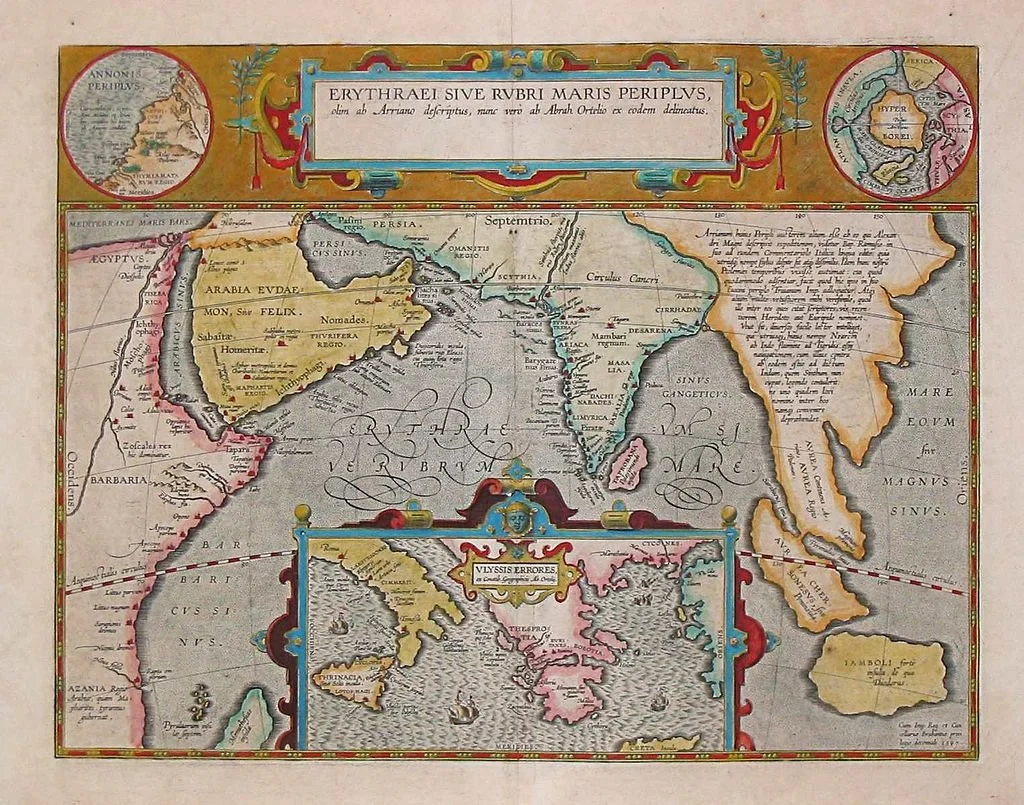
A map said to date from 1597 by Abraham Ortelius. It depicts the locations of the Periplus of the Erythraean Sea. From Egyptian Red Sea entrepôt (a transshipment port) such as Berenice and Myos Hormos Roman merchants operating under the political umbrella of imperial Egypt but largely as private entrepreneurs and syndicates, loaded cargoes when the seasonal winds turned, thereby crossing directly to the ports of the Malabar Coast. The result was not a brief flirtation but sustained, documented commerce that reshaped consumption in both regions and left a clear archaeological footprint centuries later. Knowledge of the monsoon pattern is central to this maritime revolution. Ancient writers attribute the practical discovery of the direct wind route across the open Arabian Sea to the mariner Hippalus, whose name is attached in later sources to the seafarer who realized that the monsoon could be used to make a rapid crossing. The most vivid contemporary guide to the mechanics of those voyages and the ports they serviced is the Periplus of the Erythraean Sea, a pragmatic merchant’s handbook written in Greek in the first century CE. The Periplus instructed captains on seasons for departure, sailing distances, and the goods exchanged, and it explicitly links Egyptian Red Sea harbors with Indian anchorages such as Muziris on the Malabar Coast and farther east and north to ports like Nelkunda and Barygaza. Other Greco-Roman authors, notably Strabo, Ptolemy and Pliny the Elder repeated and amplified these observations: Pliny famously lamented the enormous outflow of Roman bullion to the East and thereby provides contemporary testimony to the scale and significance of the trade, even if his tone is moralizing. The logistics of these missions were anchored in Egypt. Following Augustus’ secure control of Egypt, Roman commerce could reach the Red Sea ports under relatively reliable conditions. Berenice and Myos Hormos (the latter likely corresponding to the later Quseir region) functioned as staging points where cargoes from the Mediterranean wine, olive oil, glassware, fine metalwork, and coins were trans-shipped into Red Sea craft. Roman captains timed departures to the monsoon: ships would ride the southwest monsoon out of the Red Sea, cross the Arabian Sea in weeks rather than months, and then use the returning northeast monsoon for the homeward voyage. This seasonal rhythm structured an annual trading circuit and made repeated, large-scale exchanges possible rather than one-off ventures. On the Indian side, the principal destinations were the sheltered estuaries and backwaters of the Malabar Coast. Muziris, long considered the primary Roman-era entrepôt in southern India appears repeatedly in the Periplus as a hub for pepper, pearls, timber and other highly prized products. Other nodes, including the entrepôts at Arikamedu near modern Pondicherry and the trading emporia around the mouth of the Periyar River, provided additional access to inland producers. The distribution network within India routed commodities from interior markets and coastal fisheries toward these harbors, where foreign merchants met local brokers, guilds and rulers willing to trade access for customs and gifts. This commodity mix explains why Romans were willing to sail such long distances. Southern India supplied pepper, spices, pearls, ivory, aromatic woods, and precious gems, items that could command fortunes in Roman urban markets. In return, Roman consumers sent gold and silver, wine and olive oil, fine tablewares, glassware, and coins; Roman manufactures and Mediterranean foods had status and practical demand. The Periplus and other texts catalogue these categories with a trader’s eye, and the economic consequences are visible in Roman commentary: Pliny’s remarks that gold poured out of the Empire into the East reflecting a structured trade imbalance that contemporary Romans noticed and debated. Archaeology has provided the most persuasive confirmation that the Periplus and classical authors were not merely repeating traders’ tall tales. Excavations at sites on the Indian coast have turned up unequivocal Roman material, amphorae sherds of Mediterranean types, terra sigillata and other fine wares, intaglios, glass fragments and Roman coins, demonstrating repeated contacts over centuries. The site long identified as Arikamedu produced large quantities of Roman ware and Mediterranean glass and has been dated by stratigraphy and finds to the early centuries of the Common Era; its imported assemblage fits neatly with Periplus descriptions of northeastern Indian trade. On the Malabar side, substantial finds at several Kerala sites, most controversially at Pattanam, where archaeologists have reported Roman amphorae, Mediterranean ceramics, beads, and other imported items point toward a busy port landscape that traded directly with Roman ships. Although the precise identification of Pattanam with ancient Muziris remains debated among specialists, the material evidence from the region shows a dense, long-term network of maritime exchange during the first three centuries CE. Beyond ceramics and coins, the movement of organic and botanical goods is reflected with indirect but telling finds. Roman settlements and villas around the Mediterranean display evidence of Indian spices and resins, while excavations at Pompeii and other Roman towns have yielded peppercorns and traces of eastern spices in kitchens and storehouses, showing that Indian condiments were incorporated into Mediterranean culinary life. Conversely, Indian coastal deposits include Mediterranean amphora fragments whose shapes and stamps can be typologically dated to the early imperial period; these amphorae once contained wine and oil that were desirable enough to import across thousands of kilometers of sea. Numismatic and epigraphic evidence further corroborates the intensity of contact. Roman coins denarii and aurei appear in southern Indian hoards and contexts, sometimes in significant quantities, indicating monetary exchanges rather than mere occasional barter. Likewise, Indian inscriptions and later classical sources mention the presence of foreign merchants and sometimes tax arrangements. A handful of Roman goods, including high-status glass and metal objects, have been found in local elite contexts, suggesting the circulation of prestige items and diplomatic gifts alongside market trade. Material connections were matched by cultural interactions. Roman motifs appear in local art, and Indian goods circulated through Roman markets and households. The trade brought wealth and exotic goods to coastal polities, and it also produced a network of agents, interpreters and middlemen whose livelihoods depended on interregional exchange. The pattern was not one of wholesale colonization but of sustained commercial entanglement: caravan routes, riverine feeders and local markets in southern India integrated the region into a broader Indian Ocean economy in which Roman demand played a strong role. Scholars continue to refine the picture. New excavations, improved typologies for dateable Mediterranean sherds, residue analysis of amphora contents, and better numismatic chronologies have all tightened the temporal contours of the trade and exposed its fluctuations: periods of intense activity, phases when political instability or piracy depressed traffic, and the later attenuation of direct Roman-Indian commerce as intervening powers and new maritime networks reconfigured the Indian Ocean. Yet across those shifts, the archaeological record and the contemporary written sources together make a coherent case that in the first and third centuries CE, Roman merchants used the monsoon winds in predictable seasonal circuits from Egyptian Red Sea ports to Indian anchorages, where those voyages established a long-running exchange that left tangible traces in the ground and in the literature. Viewed together, text and trowel give complementary insight. The Periplus and Greco-Roman authors supply the practical vocabulary of sailing seasons, cargo types and port names; the archaeological record supplies the tangible residues amphora fragments, coins, glass and exotic botanical remains that prove sustained contact. The Roman-Indian trade of the early imperial centuries is therefore not an abstract line on a map but a lived, seasonal choreography of sailors, brokers and coastal communities whose exchange of goods transformed taste, wealth and connectivity across two very different maritime worlds. In conclusion, the maritime trade between Rome and southern India during the first through third centuries CE stands as one of antiquity’s most remarkable examples of long-distance commercial integration. What began as an experiment in harnessing the monsoon winds became a sustained and organized exchange that compressed the vast distances between the Mediterranean and the Indian Ocean into a manageable, predictable circuit of travel. This trade was not merely the movement of goods across seas but the development of a cross-cultural ecosystem in which Roman and Indian societies profoundly influenced one another economically, materially, and even symbolically. The combination of literary testimony and archaeological discovery has transformed what might once have seemed a romantic episode of ancient seafaring into a well-documented reality. The Periplus of the Erythraean Sea and the observations of classical geographers provided the framework, while the excavation of Red Sea ports such as Berenice and Indian coastal sites like Arikamedu and Pattanam filled in the empirical detail. Together, they reveal a world in motion: Roman merchants timing their departures with the monsoon’s turn, Indian traders and rulers orchestrating the flow of inland produce to meet foreign demand, and both sides adapting to a rhythm of seasonal winds that dictated the tempo of a globalized economy centuries before the modern age. The economic consequences of this transoceanic connection were immense. Roman markets developed a lasting appetite for Indian luxuries pepper, pearls, spices, ivory and gems while Indian elites gained access to Roman coin, glass, and fine wares that signified wealth and prestige. The imbalance lamented by Pliny the Elder, in which gold drained eastward, is not merely a rhetorical flourish but an early reflection on international trade deficits and the complex dependencies that arise from them. Yet this exchange was not exploitative conquest but negotiated interdependence: each side held what the other desired, and through mutual adaptation, both prospered. Culturally, the trade’s influence rippled far beyond the harbors. Artistic motifs, technologies, and tastes circulated with the goods, while evidence of Indian spices in Roman kitchens and Roman coins in Indian hoards testifies to a two-way diffusion of material culture. These exchanges subtly redefined notions of luxury, identity, and worldliness across both regions. The merchants, translators, and sailors who navigated this network became agents of connectivity, knitting the Mediterranean and Indian Ocean basins into one of the earliest examples of a truly intercontinental economy. Ultimately, the Roman-Indian maritime trade illuminates a broader human story of curiosity, enterprise, and the pursuit of opportunity across the natural boundaries of geography. The monsoon winds, once a barrier, became a bridge linking two great civilizations. Through their shared engagement with the sea, Rome and India participated in a dynamic, centuries-long dialogue of commerce and culture whose traces still gleam in amphora shards, peppercorns, and ancient coins unearthed on opposite sides of the ocean. It remains a vivid testament to how ingenuity and exchange can reshape entire worlds, and how the tides of history often flow along the same routes as the winds that once filled ancient sails. The site has been offering a wide variety of high-quality, free history content since 2012. If you’d like to say ‘thank you’ and help us with site running costs, please consider donating here. Notes: Periplus of the Erythraean Sea The Periplus, (περίπλους and transliterated as períplous), of the Erythraean Sea is one of the most remarkable maritime documents to survive from the ancient world. Written in Greek during the mid-first century CE, it serves as both a navigational guide and a commercial handbook for sailors and traders navigating the waters of the Red Sea, Arabian Sea, and the western Indian Ocean. The term periplus itself means “sailing around” in Greek, and the work provides a detailed account of coastal landmarks, ports, trade goods, and peoples encountered along the maritime routes linking the Roman Empire with Arabia, East Africa, and India. Though the author remains anonymous, internal evidence suggests he was a Greek-speaking Egyptian merchant or shipmaster operating out of one of the Red Sea ports, such as Berenice or Myos Hormos, which were vital links in Rome’s eastern trade network. As indicated in the main text the Periplus offers a vivid picture of the bustling trade that flourished across these routes, describing ports such as Adulis on the African coast, the Arabian markets of Cana and Muza, and the Indian port of Muziris on the Malabar Coast, which received Roman ships bearing gold, silver, and wine in exchange for pepper, pearls, ivory, and fine textiles. It details the monsoon wind patterns that made such voyages possible the southwest monsoon carrying ships eastward in summer and the northeast monsoon returning them westward in winter. The document’s precision in describing distances, directions, and local products makes it not only an invaluable historical source but also evidence of the sophistication of ancient navigation and trade logistics. Beyond its practical guidance, the Periplus reveals the extent of cultural and economic interconnection between the Mediterranean world and the civilizations of the Indian Ocean. It portrays a globalized system of exchange long before modern notions of globalization, in which Roman luxury markets depended on Indian spices and Arabian incense, while African ports exported exotic goods to the farthest corners of the empire. For historians and archaeologists, the Periplus remains a crucial key to understanding the maritime Silk Road of antiquity. A world bound together by the rhythm of the monsoon winds and the universal language of commerce. Hippalus Hippalus was an ancient Greek mariner whose name became synonymous with one of the most significant maritime discoveries of the ancient world-the monsoon wind system of the Indian Ocean. Although little is known about his life and career, Hippalus is credited in Greco-Roman sources, notably the Periplus of the Erythraean Sea and writings of Pliny the Elder, with identifying the regular seasonal winds that blow across the Arabian Sea. This discovery, made around the 1st century BCE, revolutionized sea travel between the Red Sea and the Indian subcontinent, allowing for direct voyages across open water rather than the slower, more perilous coastal routes that had been used for centuries. Before Hippalus’s time, trade between the Mediterranean world and India was largely dependent on hugging coastlines, which required multiple stopovers and was at the mercy of unpredictable weather patterns. Hippalus’s recognition that the southwest monsoon could carry ships swiftly eastward from Arabia to India, and the northeast monsoon could bring them safely back, drastically shortened travel time and increased the volume and regularity of trade. This discovery effectively opened the maritime “highway” that linked Roman Egypt to the rich markets of the Malabar Coast, facilitating the exchange of goods such as spices, silk, ivory, and precious stones in return for gold and silver from the Roman Empire as detailed in the main text. Although some modern historians question whether Hippalus was the first to understand or use the monsoon winds-since Arab, Indian, and earlier sailors likely had practical experience with them-his name became immortalized in Western accounts as the figure who brought systematic knowledge of these winds into the Greco-Roman world. In fact, the southwest monsoon itself was long referred to as the “Hippalus wind.” Whether historical or partly legendary, the story of Hippalus symbolizes the spirit of maritime innovation and the cross-cultural exchanges that defined the early Indian Ocean trade network. His legacy lies not only in the mastery of the winds but in the profound expansion of human connection across continents that his discovery enabled.
http://www.historyisnowmagazine.com/blog/2025/11/11/roman-trade-missions-to-india-1st-to-3rd-century