

Amid the war in Iran, the nationwide average price for a gallon of regular is now $4. 10. Soaring gas prices are also fueling new questions about the cost of the vehicles we drive. Ali Bauman has.
https://www.cbsnews.com/video/beyond-rising-gas-prices-car-prices-soar-us/
Category Archives: economy


WATCH: Gender pay gap widens for 2nd year in a row
Gender pay gap widens for 2nd year in a row Data from the U. S. Census Bureau shows that women working full-time, year-round jobs still earn less than men.
https://abcnews.com/video/131447606/
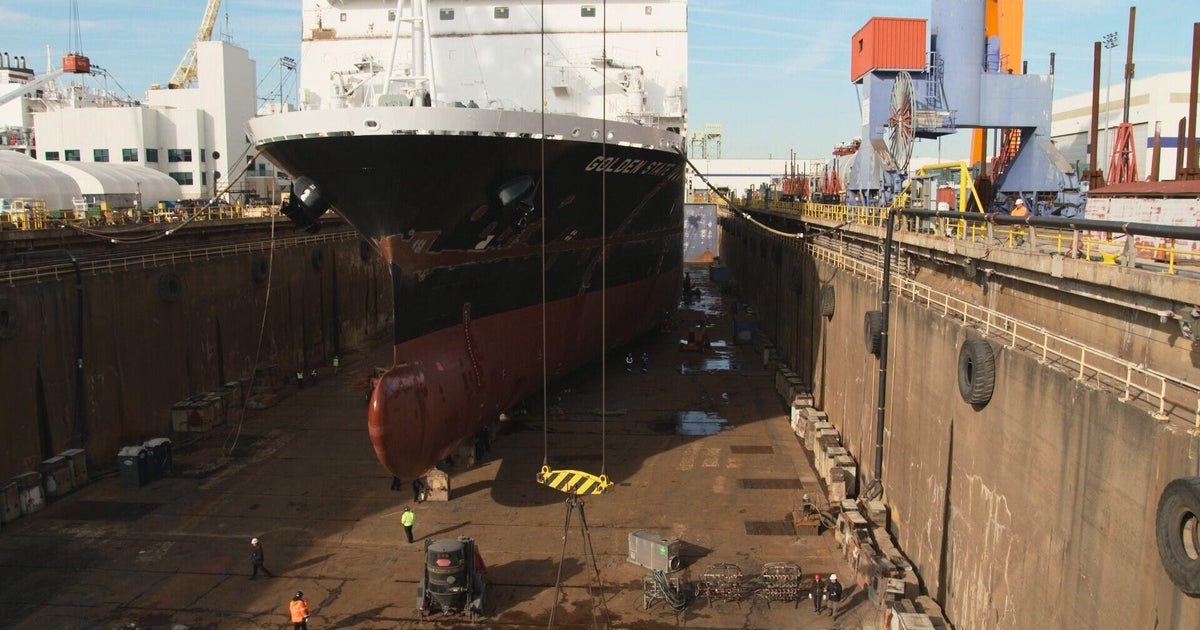
Trump says U.S. shipbuilding is in a crisis as it lags far behind China
The war in Iran is highlighting the importance of ships not just warships but cargo vessels like those carrying oil or gas trapped near the Strait of Hormuz. But American shipbuilding is in shambles, due to decades of shortsighted policies and neglect. Our submarine building program is sluggish. And our commercial shipbuilding is nearly extinct. China makes roughly 1, 000 cargo ships a year. The U. S.? Maybe three. The Trump administration has called this a national security crisis. But can this ship be turned around? This is the Philadelphia shipyard, one of only two left in the U. S. building large commercial cargo ships. Once a symbol of American might and innovation, ships built here helped win our independence in the 18th century, and World War II in the 20th. This shipyard has become a symbol of American industrial decline, a money loser falling decades behind our global rivals. And it still uses a crane from 1942! Lesley Stahl: Now, talk about a metaphor of how far behind we are. David Kim: Lotta times people’ll call it a dinosaur. Lesley Stahl: What else is a dinosaur? David Kim: Almost everything that you’ve seen out there. David Kim, the new head of the Philly shipyard, showed us around. He works for Hanwha, a giant shipmaker from South Korea, the country making most ships after China. Hanwha bought the yard in 2024 for $100 million, then poured in another $100 million and tasked Kim, a Korean-American born and bred in Texas, to bring it into the 21st century. Lesley Stahl: How many ships do you actually make here? David Kim: Here at the Hanwha Philly Shipyard we deliver one to one-and-a-half ships a year versus our yard in Korea where they deliver basically one a week. Lesley Stahl: What? One a year for delivery versus one a week? David Kim: That’s correct. Not building ships in the U. S. is considered a national security threat because if there’s a conflict with China, for instance, Beijing could weaponize its substantial merchant fleet and cut us off from global goods. Hanwha plans to spend $5 billion in Philly and has already sent 50 trainers from Korea to teach American workers. David Kim: Our aspiration is to get to up to 20 ships a year here at the shipyard. Lesley Stahl: So we come back in two years. How different will it look? David Kim: You’ll see robots. You will see automation equipment. And we’re looking to grow the workforce by, call it, 7, 000 to 10, 000 people. Sounds great, only there’s a huge shortage in the U. S. of skilled labor in ship-building, including welders and pipe-fitters. This work is grueling: freezing in winter, scorching in summer, and it’s dangerous. And while the yard has a training program, it can only train 20 or so new hires at a time and it takes three years! Still, apprentices Justin, Jeff, and Meg, told us this beats their old jobs. Justin: I worked at Amazon as a grocery picker. Meg: Before this job I was a cake decorator at a bakery. Lesley Stahl: And a nanny. Meg: And a nanny as well. Yes. I worked many jobs. Lesley Stahl: If you were to pitch this job and this place to a friend, what would you say? Meg: I would tell my friend that instead of paying out of pocket to go to a trade school, you’re getting paid while you learn here the entire time. Lesley Stahl: They pay you? Meg: Yes. Lesley Stahl: And health care? Meg: And health care, which is amazing. Lesley Stahl: But aren’t the conditions really harsh? Jeff: Not the easiest work. Like, I go home, granted, I’m more tired but it’s more fulfillin’ to me. Makes you feel like you’re somethin’, part of somethin’ bigger. But not only are workers scarce and the yard outdated, the Philly shipyard has to bring key components to the U. S., such as propellers, and even the engine. So ships that take six months to build in Korea or China can take twice as long here, and cost five times as much! And who will buy them? Michael Coulter: There’s no doubt that we have challenges and headwinds, but I also think we have a unique moment in time. Michael Coulter, who’s Hanwha’s top executive in charge of U. S. operations, says the way to lower prices is scale up production. Lesley Stahl: So you’re saying if we build more ships, then the cost per ship will come down. Michael Coulter: Significantly. Lesley Stahl: It’s so busy here! Michael Coulter: It is busy. He took us to Hanwha’s shipyard in Korea, where nine ships are being built at once, four in a row, like Lego sets the size of football fields. Steel chunks bigger than buildings hover over the ground. They’re lifted above the water, or they just glide by. He showed us how far ahead they are technologically: rows and rows of robots! But even with all the automation, the human workforce keeps growing. There are over 26, 000 workers on site, many getting around on low tech because this place is so vast. And the yard keeps hiring, training 400 workers at once way more than the 20 in Philly! And they’re taught using cutting-edge virtual reality! He’s learning to paint. It’s a dance of tech, cranes, trucks, and bikes. And this yard also builds military vessels, including submarines, which the U. S. desperately needs, since our fleet is aging and we can barely make new ones. Michael Coulter: From a Hanwha perspective, we build great submarines. Lesley Stahl: Here, in Korea. Michael Coulter: Here, in Korea, yes. We have told the U. S. government that if they so wish, we will build submarines for them in the United States, and in Philadelphia, just like we do in Korea. Send a secure tip to 60 Minutes: Here’s how to confidentially share information with our journalists Lesley Stahl: Is the ultimate goal for your company to build nuclear submarines for the U. S. Navy? Michael Coulter: The submarine program in the United States is heading in the wrong direction, and we think we can help. Another way Hanwha says it wants to help the U. S. is with transporting liquified natural gas, or LNG, hoping to build these giant LNG tankers in Philly. Lesley Stahl: The United States is the largest producer of natural gas. And yet, we don’t have any LNG ships that we make ourselves. Is that correct? Michael Coulter: That’s correct. Not a single one. This leads to an absurd situation: while we export LNG on foreign carriers to over 30 countries Colin Grabow: One country we don’t send it to is other parts of the United States. Colin Grabow, a trade expert at the libertarian CATO Institute, explains that a century-old law called the Jones Act requires that any cargo shipped between U. S. ports say from Baltimore to Boston, or Seattle to Juneau that cargo has to be on an American-made ship. So if the cargo is LNG, it has to be on an American made LNG ship. Lesley Stahl: But we don’t build any. Colin Grabow: That’s right. There aren’t any. Lesley Stahl: Oh, my god. Colin Grabow: And you might think, “Well, seems like an easy problem to solve. Go build the ship, transport the gas,” except the math doesn’t work. If you want to build one of those ships in Asia, the cost is around $260 million; here in the United States? About $1 billion! Lesley Stahl: Well, wait. Are there parts of this country that cannot get natural gas because of this law? Colin Grabow: That’s right, New England. In winters, New England has to import pricier natural gas from abroad, even though it’s extracted only a few states away. Colin Grabow: In fact, Puerto Rico imported Russian natural gas the same month as Russia invaded Ukraine. Lesley Stahl: No. (GASP) Colin Grabow: So we take a stance against Russia. On the other hand, we’re importing their energy, something that we have in abundance. You can’t make this stuff up. Last year, President Trump made solving our ship crisis a national priority, signing an executive order creating a multi-agency action plan and a White House office of shipbuilding. President Trump (4/9/25, signing executive order).: “We’re way, way, way behind. We used to build a ship a day and now we don’t do a ship a year, practically.” But the White House has conflicting priorities. Lesley Stahl: So here’s the administration. It wants to build ships and they’re putting huge tariffs– 50% on steel, which is the main component in a ship. What’s wrong with that picture? Colin Grabow: Yes. This is one of the paradoxes of the Trump administration. We’re artificially increasing the cost of building ships in this country! Lesley Stahl: So why can’t shipbuilders just use American made steel? There’s no tariffs on those. Colin Grabow: That’s true. But when we put heavy tariffs on imported steel, we drive those costs up, that’s a great opportunity for Americans to raise their own price. What we know is today, American steel is roughly twice as expensive as steel in, say, China. Lesley Stahl: What you’re saying is when the price of steel goes up because of tariffs, then the American steel manufacturer hikes the price of steel? Colin Grabow: These are profit oriented enterprises. He actually thinks we should be able to just buy and use ships from our ally, South Korea, not build them. And he points to another conflicting White House priority: making it harder to grant skilled immigrants work visas. Colin Grabow: Traditionally, a lot of immigrants have been willing to do this kind of work. And yet, we are turning our back on immigration and adopting a more hostile stance. Lesley Stahl: The administration seems to be fighting its own policy. Colin Grabow: Yes. It didn’t help when last September, ICE raided a Korean battery plant in Georgia, alleging visa violations. Agents dragged off 300 Korean technicians and engineers in cuffs and chains, despite their coming here to train American workers. Hanwha’s Michael Coulter says this caused a backlash in Korea. Lesley Stahl: Have you been assured that what happened in Georgia will not happen in Philadelphia? Michael Coulter: We’ve been assured that our visas are the right visas and our team is not going to be impacted. The White House is committed to making ships here. So last year, when President Trump threatened to put tariffs on Korean imports, Korea’s president offered instead to invest $150 billion to revive the U. S. shipbuilding industry, promising Philly is just the start. Michael Coulter: There’s a recognition that the United States has a problem that Korea may be uniquely positioned to help. Lesley Stahl: That’s like aid for the United States. Wow. Wouldn’t it be more profitable and wiser if the United States just bought the ships from Korea? Michael Coulter: That doesn’t solve the problem. At the end of the day, shipbuilding is a national security necessity. The U. S. needs to be able to secure our own commerce. We need to be able to export our own energy. Lesley Stahl: The idea that we now rely on Korean expertise to help us build an industry that we need for national security reasons. Should we be ashamed of ourselves? Should we feel weak? Michael Coulter: I don’t think we should be fearful or feel weak. We are in a shipbuilding crisis in the United States, and every American should be aware of that. But that doesn’t mean that it’s not solvable. We once deployed ships to save South Korea. Now we’ve been forced to turn to South Korea to save us. In a statement to 60 Minutes, the White House said, quote: “no president has done more to bolster American maritime power.” This past week, with gas prices soaring, the president suspended the Jones Act for 60 days, to ease the transport of oil and gas within the U. S.. Produced by Shachar Bar-On and Jinsol Jung. Broadcast associate, Aria Een. Edited by Matthew Lev.
https://www.cbsnews.com/news/us-ship-building-lags-behind-china-south-korea-trump-makes-it-priority-60-minutes-transcript/

Ross Gerber Warns Inflation’s Persistence Diminishes Market Optimism For Stocks And Bonds
In a recent post on X, Ross Gerber expressed a cautious view on the current market environment, stating that he sees sellers stepping in and describing the setup as “hard to be bullish at the moment.” He directly tied this perspective to ongoing inflation concerns, emphasizing, “Inflation is real and not going away soon.”
Gerber highlighted a notable shift in market dynamics, framing it as a change in who is controlling the tape. With downside activity becoming more visible, he believes this makes it tougher for risk assets to find sustained support. Pushing back against the notion that inflation risks have faded, Gerber stressed that the problem is persistent. This stance implies investors may need to continue factoring higher-for-longer pricing pressures into their portfolio decisions.
### Is Inflation the Ultimate Market Spoiler?
In his post, Gerber argued that inflation is not just a macroeconomic talking point but an active constraint on markets. He remarked that inflation “is neither good for stocks or bonds,” pointing to a scenario where both major asset classes struggle simultaneously rather than offsetting each other. For diversified investors, this complicates the usual strategy of balancing equity risk with bond exposure.
### Impact of Rising Fuel Prices on Investment Strategies
Gerber’s perspective on inflation aligns with his recent comments urging consumers to switch to electric vehicles amid soaring fuel prices and escalating tensions in the Middle East. He noted that driving a gas-powered car has become “4-5 times more expensive” compared to electric vehicles. With the national average gasoline price reaching $3.842 per gallon and Brent crude oil prices surging past $108 per barrel, many could save “thousands of dollars a year” by making the switch.
This emphasis on cost-effective alternatives reflects broader economic pressures that complicate investment strategies. It reinforces the idea that inflation is impacting both equities and bonds, underscoring the need to reevaluate portfolio decisions in light of a persistent inflationary environment that could undermine traditional asset class performance.
### How Rising Prices Squeeze Investment Valuations
Higher inflation can pressure stock valuations by raising the bar for earnings growth while keeping discount rates elevated. At the same time, bonds are affected as inflation erodes real returns and pushes yields higher when the market reprices inflation expectations.
Gerber’s message centers on the near-term challenge for bullish positioning when inflation shows no signs of easing. While he did not reference specific companies or provide forecast numbers, his commentary clearly links the current market tone to the ongoing inflation backdrop.
https://www.benzinga.com/markets/emerging-markets/26/03/51395923/ross-gerber-warns-inflations-persistence-diminishes-market-optimism-for-stocks-and-bonds?utm_content=taxonomy_rss

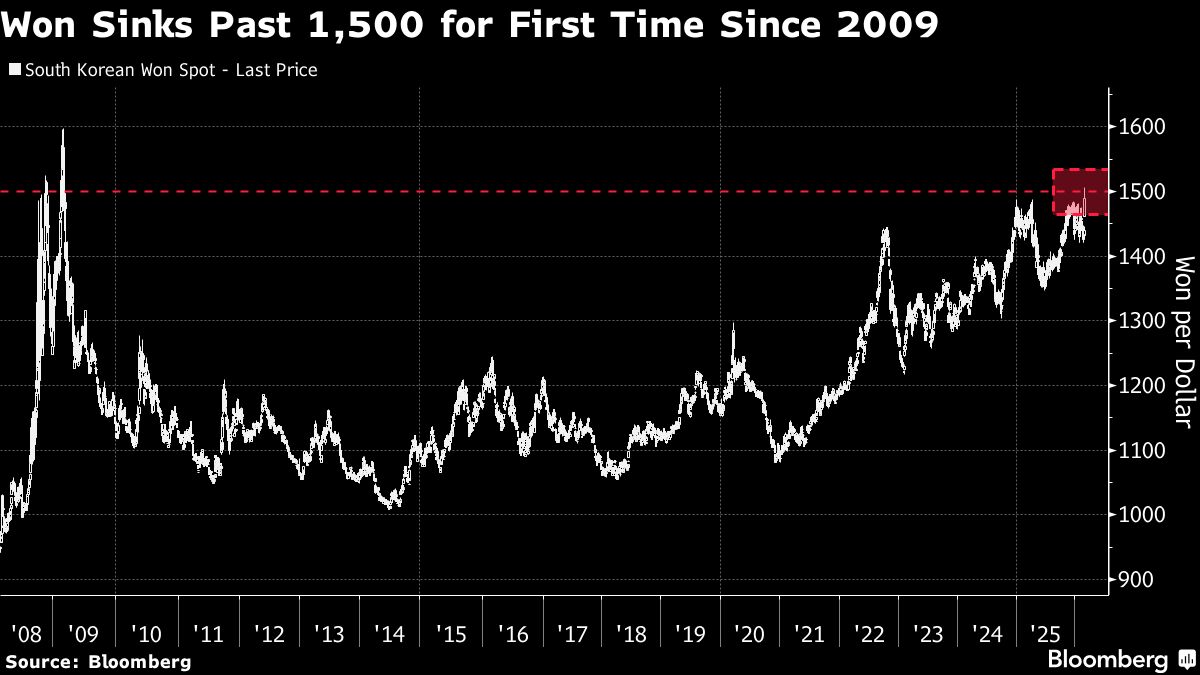
Won’s Plunge May Just Be Start of Bigger Losses, Analysts Say
Connecting decision makers to a dynamic network of information, people, and ideas, Bloomberg quickly and accurately delivers business and financial information, news, and insight around the world.
South Korea’s tumbling won looks set for further declines as higher energy prices threaten growth in the world’s eighth-largest oil consumer, according to forecasters at some of the biggest global banks.
The won slumped more than 4% at one stage on Tuesday, marking its biggest drop since 2010, as concerns about the Iran war dented sentiment toward risk assets. The currency slid beyond the closely watched 1,500 per dollar level, reaching its weakest point since the global financial crisis.
It retraced part of its losses at the Wednesday open.
https://www.bloomberg.com/news/articles/2026-03-04/won-s-epic-plunge-may-just-be-start-of-bigger-losses-banks-say


China Seeks to Slow Yuan Gains by Cutting Cost to Short Currency
China has intensified efforts to moderate the yuan’s recent appreciation by eliminating the additional charge imposed on betting against the currency in the derivatives market.
In a statement, the People’s Bank of China (PBOC) announced that it will remove the reserve requirement of 20% on foreign-currency forward contracts starting from March 2.
This move aims to ease pressure on the yuan and stabilize the currency market amid ongoing fluctuations.
https://www.bloomberg.com/news/articles/2026-02-27/china-seeks-to-slow-yuan-gains-by-cutting-cost-to-short-currency
Trump announces new retirement plan with federal match of up to $1,000
President Trump addressed what he described as the “gross disparity” within the U.S. retirement system during Tuesday night’s State of the Union address.
To tackle this issue, he announced plans to create a new retirement plan aimed at Americans who do not have access to a 401(k) or any employee-sponsored savings plan.
To provide further insight on this topic, Teresa Ghilarducci, a professor of economics and policy analysis at the New School, joined “The Daily Report” to discuss the proposed changes.
https://www.cbsnews.com/video/trump-announces-new-retirement-plan-federal-match-up-to-1000/
What the Supreme Court’s decision to strike down tariffs means for L.A.’s trade-dependent economy
The Supreme Court’s decision Friday to strike down the majority of tariffs imposed by President Trump could provide some relief to L. A.’s trade-reliant economy but only if they are not reimposed again through other means. The court’s 6-3 ruling that Trump didn’t have the authority to impose tariffs under the International Emergency Economic Powers Act rolled back levies that have upended international trade. “We’ve seen that the tariffs have a significant impact on our supply chain, on our manufacturers and especially on our port logistics and trade sector,” said Stephen Cheung, chief executive of the nonprofit Los Angeles County Economic Development Corp. “I think this decision will have a significant impact on the Los Angeles economy. However, it’s going to take a long time to unravel, so we’ll see specifically how everything is going to pan out,” he said. The tariffs dealt a blow to a large swath of businesses in Southern California and across the state, including farmers, automakers, home builders, tech companies and apparel retailers. MGA Entertainment, the Chatsworth maker of Bratz dolls, said a little more than half of its products are made in China, while hardware and lumber seller Anawalt in Malibu said the majority of its lumber comes from Canada and nearly all of its steel products are made in China. During a news conference Friday following the decision, Trump said that under other legal authorities he will impose a 10% global tariff and pursue additional levies, including a possible 30% tariff on foreign cars. “The Supreme Court’s ruling on tariffs is deeply disappointing, and I’m ashamed of certain members of the court absolutely ashamed,” Trump said. “They’re very unpatriotic and disloyal to our Constitution.” Friday’s high-court decision affects up to $170 billion in tariffs collected under the International Emergency Economic Powers Act of 1977, including 10% to 50% duties and penalties on China, Canada and Mexico. Whether importers who paid the tax can seek refunds was left to a lower court to decide. It’s estimated some $100 billion in tariffs were not affected by the decision. The ports of Los Angeles and Long Beach which handle nearly a third of the nation’s containerized cargo and are the primary trade gateway to Asia saw a surge of traffic the first half of last year as importers sought to get ahead of the tariffs, largely imposed in April. However, traffic tailed off the second half of the year, with the L. A. port expecting a single-digit decline in volume this year before Friday’s decision. The twin facilities form the largest ports complex in North America, supporting more than 200, 000 jobs and contributing $28 billion to the regional economy in 2022, according to a California Center for Jobs & the Economy report. The uncertainty surrounding the tariffs derives from the complexity of the tariffs themselves as well as the other legal options Trump has to impose them again. Mike Jacob, president of the Pacific Merchant Shipping Assn., which represents ocean carriers, marine terminal operators and others in the industry, said the tendency is to think of the tariffs as uniform. “It was different rates for different countries. That was compounded by different rates for different commodities. And there’s a lot of changes that have occurred with specific commodities,” he said. “So it’s almost impossible to take a broad brush and say, here’s what we expect to happen except to say that it’s still a pretty unsettled space.” In seeking to impose a 10% global tariff, Trump would be relying on a provision of the Trade Act of 1974, while his ability to pursue additional levies would rely on other sections of that act and another law. Economist Jock O’Connell, international trade advisor at L. A.’s Beacon Economics, said that Trump may have authority to impose the 10% global tariffs, but additional levies would involve trade authorities. “That would be a cumbersome process. The tariffs have to be more specifically framed and the subject of an investigation,” he said. Also complicating the process are trade deals the U. S. has been negotiating with foreign countries based on the tariffs. O’Connell expects they will seek to renegotiate them. “They’re likely to come back to the table and say, ‘Well, you don’t have the authority to impose these,’” he said. Gene Seroka, executive director of the Port of Los Angeles, said importers are facing tough decisions right now, given that any ocean carrier leaving an Asian port today would not be subject to the tariffs that were struck down. “That executive is asking: ‘Are my commodities now exempt from this tariff?’ If the answer is yes, ‘Can I buy more of that product and get it shipped while there are no tariffs?’” he said. Those decisions would revolve around such factors as the availability of space on the vessel and local warehouses, as well as trucking services, he said. Mark Zandi, chief economist at Moody’s Analytics, said the decision should be good news for the larger U. S. economy and businesses on the “front line” of the trade wars, such as transportation, distribution, agriculture and retail. “If the president lets the Supreme Court decision stand and doesn’t try to replace the tariffs, that’s a plus for the economy but that’s not what’s going to happen,” he said.
https://www.latimes.com/business/story/2026-02-20/what-supreme-courts-decision-to-strike-down-tariffs-means-for-l-a-s-trade-dependent-economy


EIT Water prepares to call for projects in 2027
EIT Water, the EU’s new community for water-related innovation, is set to start work in 2026, with the first calls for projects and training launching in 2027.
This new knowledge and innovation community will be the tenth launched by the European Institute of Innovation and Technology (EIT). Like its predecessors, EIT Water will provide entrepreneurship training, as well as business and acceleration support to innovators across Europe.
In November, the EIT selected a group of 50 organisations from 24 countries to launch EIT Water, with Denmark’s Aarhus University taking the lead. The consortium will receive €5 million and one year to establish the organisation, recruit staff, and develop a comprehensive strategy.
“It’s like rapidly building and scaling a very fast start-up,” said Michelle Williams, project coordinator at Aarhus University, in an interview with Science|Business.
https://sciencebusiness.net/news/r-d-funding/european-institute-innovation-and-technology/eit-water-prepares-call-projects-2027


Trump issues Executive Order creating Genesis Mission AI Action Plan for America
Section 1. Purpose. From the founding of our Republic, scientific discovery and technological innovation have driven American progress and prosperity. Today, America is in a race for global technology dominance in the development of artificial intelligence (AI), an important frontier of scientific discovery and economic growth. To that end, my Administration has taken a number of actions to win that race, including issuing multiple Executive Orders and implementing America’s AI Action Plan, which recognizes the need to invest in AI-enabled science to accelerate scientific advancement. In this pivotal moment, the challenges we face require a historic national effort, comparable in urgency and ambition to the Manhattan Project that was instrumental to our victory in World War II and was a critical basis for the foundation of the Department of Energy (DOE) and its national laboratories. This order launches the “Genesis Mission” as a dedicated, coordinated national effort to unleash a new age of AI‑accelerated innovation and discovery that can solve the most challenging problems of this century. The Genesis Mission will build an integrated AI platform to harness Federal scientific datasets the world’s largest collection of such datasets, developed over decades of Federal investments to train scientific foundation models and create AI agents to test new hypotheses, automate research workflows, and accelerate scientific breakthroughs. The Genesis Mission will bring together our Nation’s research and development resources combining the efforts of brilliant American scientists, including those at our national laboratories, with pioneering American businesses; world-renowned universities; and existing research infrastructure, data repositories, production plants, and national security sites to achieve dramatic acceleration in AI development and utilization. We will harness for the benefit of our Nation the revolution underway in computing, and build on decades of innovation in semiconductors and high-performance computing. The Genesis Mission will dramatically accelerate scientific discovery, strengthen national security, secure energy dominance, enhance workforce productivity, and multiply the return on taxpayer investment into research and development, thereby furthering America’s technological dominance and global strategic leadership.
https://www.shacknews.com/article/146962/trump-ai-genesis-mission-executive-order