Tag Archives: stay

Analyst Suggests CFTC May Gain Broader Crypto Oversight Than SEC

**CFTC’s Growing Role in Crypto Regulation: Leading the Charge for Clarity and Growth**

The Commodity Futures Trading Commission (CFTC), with its deep expertise in derivatives, is increasingly positioned to lead cryptocurrency oversight, aligning U.S. regulations with global commodity standards. Bipartisan legislative proposals aim to clarify the CFTC’s jurisdiction over spot trading of digital commodities, reducing regulatory ambiguity that has long challenged the crypto market.

Industry analysts, including Jeff Park, Chief Investment Officer at ProCap BTC, predict that this regulatory evolution will foster the development of new financial products. According to recent surveys, about 70% of crypto market participants favor clearer regulatory guidelines. This article explores how CFTC crypto regulation could reshape the digital asset landscape, offering much-needed clarity and facilitating growth opportunities. Stay informed on the latest developments to make smarter investing decisions.

### What Is the Role of CFTC in Crypto Regulation?

The CFTC’s role in crypto regulation focuses on overseeing digital assets classified as commodities. This includes both spot trading and derivatives within the cryptocurrency ecosystem. Established originally to regulate futures and swaps markets, the CFTC is gaining prominence as legislation evolves to address the unique features of blockchain-based assets.

This regulatory approach aims to provide robust consumer protections while maintaining the flexibility needed to accommodate the innovative nature of crypto markets.

### How Does CFTC Crypto Regulation Differ from SEC Oversight?

The CFTC primarily regulates commodities and derivatives, making it a natural fit for cryptocurrencies like Bitcoin, which function as digital commodities traded on a global scale. Conversely, the Securities and Exchange Commission (SEC) focuses on securities, often classifying tokens as investment contracts subject to U.S. securities laws.

Jeff Park notes that the CFTC’s regulatory domain will likely expand beyond the SEC’s jurisdiction, especially in areas involving leverage and international settlement mechanisms. This expansion supports greater capital efficiency in blockchain projects.

Recent bipartisan legislative drafts underscore the CFTC’s evolving role in spot digital commodity trading. For example, Senator John Boozman (R-AR), Chair of the Agriculture Committee, emphasized the need for clear CFTC rules to ensure both consumer protection and industry expansion.

Data shows that over 80% of crypto derivatives volume occurs outside the traditional securities framework, highlighting the CFTC’s natural fit and expertise. This clear delineation reduces regulatory overlap and streamlines enforcement, as the agency already handles similar markets such as energy futures.

Experts—including voices from the Blockchain Association—argue this framework mitigates risks associated with decentralized finance (DeFi) by focusing on the functional characteristics of assets rather than the intent of issuers. This enables the CFTC to develop comprehensive guidelines incorporating anti-manipulation measures and margin requirements.

Park also points to international precedents, such as the European Union’s classification of major cryptocurrencies as commodities, allowing the U.S. to harmonize its regulatory approach without stifling innovation.

### Frequently Asked Questions

**What Proposed Legislation Supports Expanded CFTC Crypto Regulation?**
The proposed crypto market structure bill, backed by senators John Boozman and Cory Booker among others, outlines the CFTC’s authority over spot trading of digital commodities. The legislation aims to clearly define jurisdictional boundaries, protecting investors while fostering market growth. It builds on the CFTC’s powers under the Dodd-Frank Act to include digital assets within commodity oversight frameworks.

**Why Might the CFTC Lead Crypto Regulation Over the SEC?**
The CFTC’s leadership stems from its expertise in derivatives and global commodity markets—areas that closely mirror the trading dynamics of assets like Bitcoin and Ethereum. In discussions with crypto entrepreneur Anthony Pompliano, Jeff Park explained that the CFTC’s functional, rather than security-focused, approach offers a balanced path forward for regulating NFTs, DeFi, and other digital asset innovations.

### Key Takeaways

– **Regulatory Shift Toward CFTC:** Proposed bipartisan bills position the CFTC as the primary overseer for digital commodities, clarifying rules and reducing regulatory overlap with the SEC.
– **Innovation Boost:** Clearer guidelines could accelerate the development of DeFi and NFTs, attracting institutional investors according to industry reports.
– **Leadership Changes:** Potential appointments like Michael Selig signal a proactive regulatory stance, with upcoming hearings expected to address integration and enforcement challenges.

### Conclusion

As CFTC crypto regulation gains traction through bipartisan legislation, the digital asset landscape is set for a more structured and investor-friendly future. Experts like Jeff Park advocate for expanding the CFTC’s role over that of the SEC, emphasizing a balance between innovation and investor protection across DeFi and blockchain sectors.

These developments could usher in a new era of mainstream adoption, encouraging stakeholders to engage responsibly with emerging protocols. Staying informed about the evolving regulatory environment is critical, as clearer oversight creates opportunities for secure, efficient trading.

The CFTC’s focus on derivatives expertise addresses key challenges in crypto markets, such as leverage trading and settlement finality. Historical data from traditional commodity markets indicates that clear regulation often leads to a 25-30% increase in market participation within the first year of implementation.

Legislators like Senators Boozman and Booker have incorporated extensive industry feedback to ensure that new rules adapt to technological advances without imposing undue burdens. Meanwhile, acting leadership under Caroline Pham has initiated consultations with blockchain developers to foster collaborative rule-making.

This inclusive process aims to cover emerging areas including tokenized assets and cross-border transactions. By classifying cryptocurrencies as commodities, the U.S. regulatory framework aligns with global standards set by organizations like the International Organization of Securities Commissions, reducing fragmentation and promoting interoperability.

For consumer protection, the CFTC plans to extend its surveillance systems—successfully used in futures markets—to crypto exchanges, addressing the sector’s inherent volatility. This oversight is crucial given the history of market manipulation incidents.

Jeff Park’s predictions reflect broader analyst consensus. Industry reports from firms like Deloitte note that 65% of executives view CFTC-led regulation as a catalyst for increased institutional involvement.

Potential changes in CFTC leadership—such as appointing Michael Selig from the SEC’s crypto task force—could further cement this regulatory shift. Upcoming hearings will likely focus on integration strategies to ensure a seamless transition.

Overall, these efforts signal a maturing industry ready for scalable growth, where transparency and regulatory clarity empower market participants to innovate confidently.

Stay tuned for ongoing updates as the CFTC refines its approach to crypto regulation—your resource for navigating a rapidly evolving digital asset ecosystem.
https://bitcoinethereumnews.com/crypto/analyst-suggests-cftc-may-gain-broader-crypto-oversight-than-sec/

Trump Signs Bill to End Record 43-Day US Shutdown, Eyes Healthcare Collaboration

Shutdown’s Impact on Crypto: What the End of the US Government Shutdown Means for Regulation and Market Stability

The prolonged US government shutdown halted the Securities and Exchange Commission’s (SEC) reviews of cryptocurrency proposals, delaying important market structure reforms. With the recent resumption of government funding, bipartisan talks on healthcare and broader budgets are now underway, indirectly supporting a more stable regulatory environment for digital assets.

According to Federal Reserve data, economic uncertainty during shutdowns can increase crypto market volatility by up to 15%. This article explores how the end of the US government shutdown affects crypto regulation and market stability, with implications for SEC enforcement and investor confidence heading into 2025. Stay informed on the crucial role federal funding plays in shaping the digital asset landscape.

What Does the End of the US Government Shutdown Mean for Crypto Regulation?

The conclusion of the US government shutdown clears the path for the resumption of federal operations, including those of the SEC, the primary regulatory body overseeing cryptocurrency markets. The funding bill, signed by President Donald Trump, provides financial support until January 30, 2026. This timeframe allows for bipartisan negotiations on key policy issues.

This renewed stability is vital for crypto investors. Past shutdowns have caused delays in regulatory decisions and heightened market uncertainty, interrupting the steady progress of crypto market development.

How Has the Shutdown Affected SEC Enforcement on Crypto?

The 43-day shutdown—the longest in US history—suspended non-essential SEC activities. This included delays in reviewing crypto exchange applications and taking enforcement actions against fraudulent digital asset schemes. During the shutdown, the SEC processed fewer filings, resulting in a backlog of market structure proposals that could modernize crypto trading rules.

SEC Chair Gary Gensler has emphasized the agency’s commitment to maintaining rigorous enforcement standards post-shutdown. In official remarks, he stated, “We will not adopt lax enforcement on crypto under any new market structure.” This highlights the SEC’s focus on protecting investors in the rapidly evolving digital asset space.

While short-term delays may continue as staff work through the backlog, experts from the Blockchain Association anticipate a full resumption of operations within weeks. This could accelerate approvals for crypto spot exchange-traded funds (ETFs) and provide clearer regulatory guidelines on stablecoins.

Supporting this view, data from Chainalysis indicates that regulatory pauses during government disruptions have historically correlated with a 10-20% dip in institutional crypto investments, underscoring the importance of a swift regulatory recovery.

Frequently Asked Questions

What are the long-term implications of the government shutdown for cryptocurrency markets in the US?

The resolution of the shutdown funds federal agencies through early 2026, creating an opportunity for Congress to address crypto-specific legislation such as the Financial Innovation and Technology 2021 (FIT21) bill. This could lead to more predictable regulatory frameworks, boosting investor confidence and reducing volatility linked to political gridlock.

Fact-based analyses from the Congressional Budget Office suggest that stable funding environments support fintech innovation, including blockchain technologies, which could accelerate the maturation of the crypto industry.

Will the end of the shutdown speed up SEC decisions on crypto ETFs?

Yes. With federal operations back online, the SEC can prioritize pending crypto ETF applications, including products related to Bitcoin and Ethereum. This natural progression aligns with the agency’s mandate to carefully evaluate market risks, ensuring decisions are grounded in thorough reviews rather than delays caused by the shutdown. Recent SEC updates confirm this anticipated acceleration.

Key Takeaways

  • Restored Funding Stability: The new funding bill ends the 43-day shutdown, securing federal operations until 2026 and minimizing further disruptions to crypto oversight.
  • Bipartisan Opportunities: President Trump’s willingness to engage in cross-party talks on healthcare may extend to crypto policy, encouraging collaborative regulatory frameworks.
  • Investor Action Item: Monitor SEC announcements closely, as resumed activities may signal forthcoming approvals that could drive crypto market rallies.

Conclusion

The end of the US government shutdown marks a significant turning point for cryptocurrency regulation and market stability. The resumption of SEC operations and secured federal funding through 2026 provide a more predictable environment for both innovators and investors in the digital asset space.

As bipartisan talks continue and regulatory backlogs are cleared, the crypto industry can expect increased clarity and potentially faster approval processes for important market instruments like ETFs. Staying informed about regulatory developments will be key for those looking to navigate the evolving landscape in 2025.

https://bitcoinethereumnews.com/tech/trump-signs-bill-to-end-record-43-day-us-shutdown-eyes-healthcare-collaboration/

ICP’s Short-Term Bounce Hits $3.67 on Liquidations, But Long-Term Downtrend Persists

**ICP Price Bounce Fueled by Short Liquidations and Volume Surge**

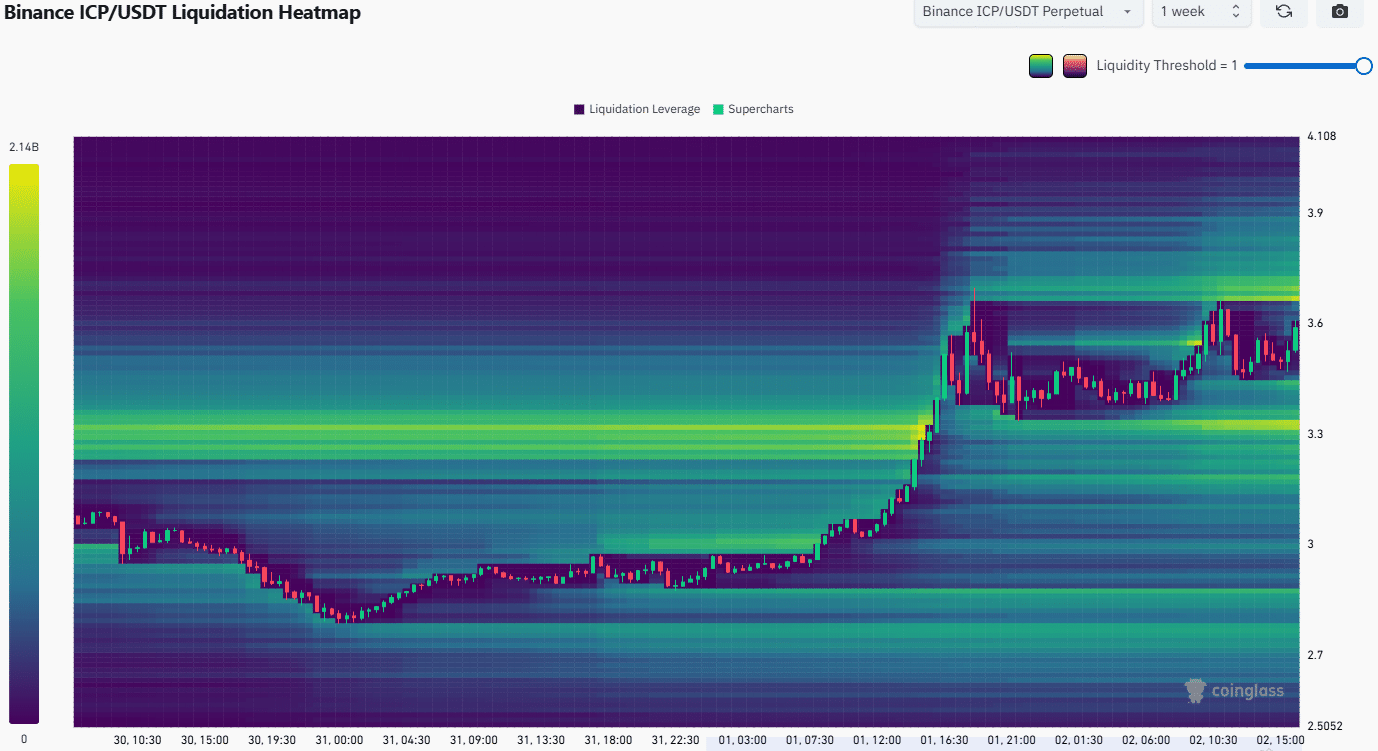
Short liquidations at the $3.55 level sparked a significant bounce in the price of Internet Computer (ICP), attracting buyers and driving a 6.5% increase. This upward move was supported by high trading volumes, propelling ICP to reach $3.67. However, the price later dipped after encountering resistance near $3.75—a level that has held firm since mid-October.

Over a 24-hour period, ICP experienced a liquidity build-up that contributed to the surge. Data shows that the $3.75 supply zone continues to act as a key resistance barrier for the token.

### What Fueled the ICP Price Bounce?

The ICP price bounce was primarily triggered by a cluster of short liquidations around the $3.55 level. These liquidations generated substantial buying pressure, lifting ICP’s value by 6.5% within 24 hours, rising from $3.33 on November 1st to a peak of $3.67.

Increased trading activity following the dip played a crucial role in amplifying this movement. Despite the rally, the price faced stiff resistance at the $3.75 supply zone, which has been well-established since mid-October.

### What Could Indicate ICP’s Next Moves?

Market data from CoinGlass highlights a notable liquidity cluster at $3.55 that attracted buyers on November 2nd, driving the price upward. Prior to this, prices dipped to $3.33 before stabilizing near $3.50 for almost a day. This consolidation phase built up short positions, whose liquidation fueled the subsequent surge.

Assets in similar scenarios often gravitate toward high-liquidity zones. For ICP, the next significant resistance lies between $3.70 and $3.75, where gains may be capped unless momentum shifts.

Trading volumes spiked during this upward movement; however, without a change in the broader trend, this bounce may be a temporary correction rather than a sustainable reversal. Analysts emphasize that liquidity-driven rallies require confirmation from higher timeframes to validate a sustained breakout.

Historical price action shows that ICP’s resilience is frequently tested by persistent supply pressures. Notably, on November 1st, the $3.33 level acted as a supportive floor before the rebound unfolded.

### Frequently Asked Questions

**Why did ICP experience a sudden 6.5% price increase on November 2nd?**
The rally was triggered by accumulated short liquidations near $3.55, sparking upward momentum amid rising trading volumes. This followed a consolidation period around $3.50 and culminated in a peak at $3.67 before a minor pullback.

**Is the ICP price bounce a sign of a broader recovery in the cryptocurrency market?**
While the bounce indicates short-term buying interest driven by liquidations, it does not confirm a broader market recovery. ICP’s weekly charts show a persistent downtrend dating back to March. This trend has remained intact despite earlier Bitcoin rallies in April and June. Traders should watch for sustained breaks above critical resistance levels before considering a trend reversal.

### Resistance Challenges and Long-Term Strategy

The $3.75 to $3.78 zone remains a key resistance barrier for ICP. Bearish technical indicators, such as negative readings on the Chaikin Money Flow (CMF) and the Awesome Oscillator, continue to exert downward pressure.

To confirm a bullish turnaround, investors should watch for a decisive break above $3.80 with a successful retest of that level as support. Until such confirmation, the downtrend that began in March remains the dominant market structure.

### Conclusion

The recent ICP price bounce illustrates how clusters of liquidity can trigger short-term rallies in volatile cryptocurrency markets. However, the token’s broader trajectory is still shaped by a bearish weekly pattern that has persisted since March.

As ICP tests supply zones near $3.75, investors are advised to rely on data from reliable analytics tools to make informed trading decisions. Monitoring shifts in momentum will be key to identifying strategic opportunities in the evolving landscape of Internet Computer.

*Disclaimer: The information presented in this article is for informational purposes only and does not constitute financial, investment, or trading advice.*
https://bitcoinethereumnews.com/tech/icps-short-term-bounce-hits-3-67-on-liquidations-but-long-term-downtrend-persists/?utm_source=rss&utm_medium=rss&utm_campaign=icps-short-term-bounce-hits-3-67-on-liquidations-but-long-term-downtrend-persists

Litecoin’s Record-Low Volatility Signals Potential Bullish Breakout Toward $140

**Litecoin’s Volatility Hits Record Lows, Signaling Imminent Bullish Breakout**

Litecoin’s volatility has dropped to its lowest levels ever, positioning the cryptocurrency above key support zones and setting the stage for a potential strong breakout. Technical analysis reveals a bullish setup, highlighted by consolidation within a triangle pattern on the weekly chart.

Historical data shows that similar low-volatility periods in Litecoin’s price action have often led to major rallies. Experts are forecasting gains of up to 190% from current price levels, signaling robust upside potential. Currently trading near $98, Litecoin’s breakout appears imminent as volatility compression tightens.

### What Is Causing Litecoin’s Imminent Breakout as Volatility Hits Record Lows?

The prospects for a Litecoin breakout are strengthening as the asset experiences unprecedented low volatility around the $98 mark. This compression is evident in technical indicators such as the Bollinger Bands, which suggest that an explosive price move could be on the horizon.

Sustained support above critical levels and historical precedents of sharp rallies following similar volatility contractions underpin this bullish outlook. Analysts — including certified market technicians — point to recent bullish candle formations that signal potential gains, aiming for significantly higher price thresholds.

### How Do Bollinger Bands Signal Litecoin’s Bullish Momentum?

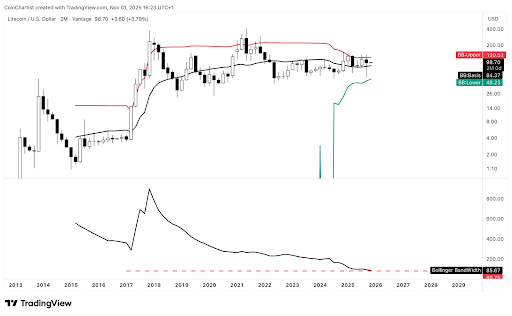
Litecoin’s Bollinger Bands currently show the following levels:

– Upper Band: $120.52
– Middle Band: $84.37
– Lower Band: $48.23

The price is positioned above the middle band, indicating short-term strength. Moreover, the Bollinger Band width reading is at 85.67 — the tightest in Litecoin’s trading history compared to past peaks exceeding 800. Such narrowed bands often suggest reduced market fluctuations that typically precede major breakouts.

Tony Severino, CMT, shared insights on social media, highlighting that the two-month Bollinger Band width has set record lows, reflecting the least volatile period in LTCUSD history. He observed that despite a recent downward wick, the two-month candle closed as a Hammer above the Bollinger Band basis, which is a bullish technical signal.

Severino emphasized that a close above $120 by the end of 2025 could trigger a definitive buy signal, consistent with patterns seen in earlier market cycles.

### Litecoin’s Historical Context and Current Stability

Since its inception in 2013, Litecoin has navigated multiple market phases, demonstrating resilience throughout. Particularly since 2022, the cryptocurrency has consolidated within a narrower range, gradually rebuilding momentum and gaining in stability.

This historical context supports the current narrative that Litecoin is poised for a breakout. Low volatility periods have repeatedly preceded upward price expansions, reinforcing the bullish technical setup.

Recent market data further validates this view. Litecoin gained 3.79% against the U.S. dollar in short-term charts, trading at approximately $98.70. The alignment of analyses across multiple timeframes strengthens the expectation of continuation, with Litecoin holding firm above critical support zones that have proven reliable during past recoveries.

### Analysts Predict Strong Price Targets Ahead

**Price Targets for a Litecoin Breakout:**

– Initial target: $140
– Subsequent targets: $180 and $285

These targets derive from the completion of bullish patterns, such as the ABCDE structure and triangle consolidation. They also take into account historical rally percentages and ongoing technical squeezes, indicating a potential upside exceeding 190% from current levels.

However, analysts emphasize the importance of volume confirmation to validate these breakout moves.

### Is Litecoin’s Low Volatility a Reliable Predictor of Future Gains?

Yes. Litecoin’s record-low volatility has historically preceded significant price movements. Past cycles where the Bollinger Bands tightened have led to rallies exceeding 300%.

Combined with the formation of bullish Hammer candles and sustained support above the middle Bollinger Band, this pattern suggests mounting pressure for an upward breakout. This makes volatility compression a crucial signal for traders monitoring Litecoin’s long-term trends.

### Key Takeaways

– **Record-Low Volatility:** Litecoin’s Bollinger Band width is at historic lows, signaling an impending major move similar to setups that preceded past bull runs.
– **Bullish Technical Indicators:** The Hammer candle close and price above the middle band provide strong upward momentum, with experts like Tony Severino forecasting clear buy signals above $120.
– **Analyst Consensus on Targets:** Industry analysts such as Jonathan Carter and The Penguin project price targets of $140, $180, and $285, urging traders to watch for breakout confirmations on higher timeframes.

### Conclusion

Litecoin’s current trading near $98 combined with record-low volatility primes it for a potential breakout. This is supported by Bollinger Band analysis and expert insights from seasoned analysts including Tony Severino, Jonathan Carter, and The Penguin.

As Litecoin consolidates above crucial support levels and mirrors historical bullish patterns, the outlook remains optimistic for substantial price gains. Investors and traders should closely monitor forthcoming candle closes for confirmation signals, preparing for what may become a transformative rally in the Litecoin market.

*Stay tuned for the latest updates as Litecoin nears a critical technical squeeze, potentially unlocking significant bullish momentum in the coming months.*
https://bitcoinethereumnews.com/tech/litecoins-record-low-volatility-signals-potential-bullish-breakout-toward-140/?utm_source=rss&utm_medium=rss&utm_campaign=litecoins-record-low-volatility-signals-potential-bullish-breakout-toward-140