Category Archives: law

Minnehaha County Rebel Republicans going to try hold meeting to censure chair over censure

It’s getting kind of hard to figure out who is being censured by the Minnehaha County Republican Party without a censure scorecard.

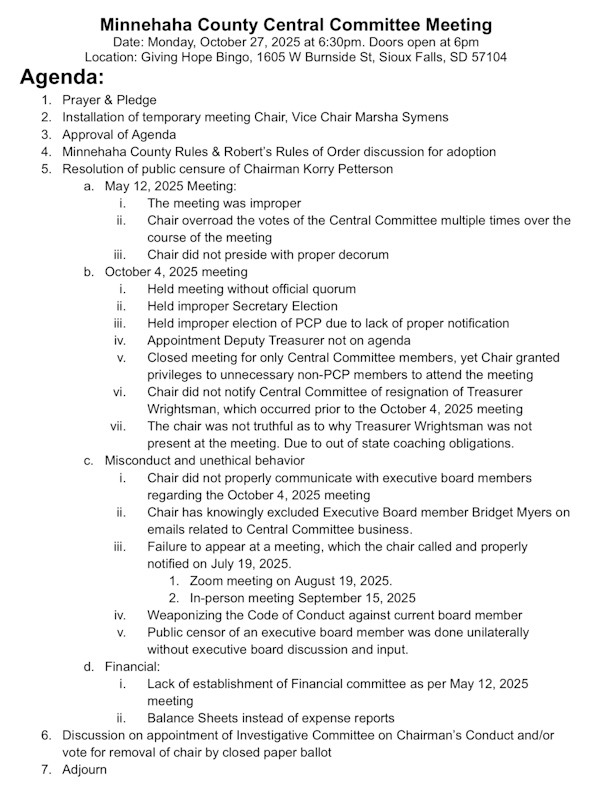
In the latest development, the vice chair and the committeewoman are trying to hold an unauthorized meeting to sanction the chair, Korry Petterson, over his sanctioning of Senator Tom Pischke for being a dirtbag to people on Facebook.

Here is the notice they sent out:

**From:** Minnehaha County GOP Executive Board
**Date:** October 20, 2025 at 5:22:41 PM CDT
**Subject:** Special Meeting Notice: Monday, October 27, 2025 at 6:30 pm

Dear Minnehaha County Central Committee Members,

We hope this email finds you well. We are writing to encourage your full participation in our upcoming Central Committee special meeting on Monday, October 27, 2025.

This special meeting, called by Bridget Myers and myself, Vice Chairwoman Marsha Symens, will include an important discussion regarding the proposed resolution to censure Chairman Korry Petterson, specifically concerning, but not limited to, the meetings held on May 12, 2025, and October 4, 2025. These meetings were conducted improperly.

Attached is the agenda and a copy of the county rules.

Sincerely,
Marsha Symens
Vice Chairwoman

Bridget Myers
Executive Committeewoman

I find it hard to believe that people don’t want to get involved in politics when they read about this kind of stuff. (That was sarcasm.)

Actually, this is a clown car. Except it’s South Dakota’s largest county, and there are more people—so they need a clown bus.

Stay tuned.
https://dakotawarcollege.com/minnehaha-county-rebel-republicans-going-to-try-hold-meeting-to-censure-chair-over-censure/?utm_source=rss&utm_medium=rss&utm_campaign=minnehaha-county-rebel-republicans-going-to-try-hold-meeting-to-censure-chair-over-censure

Former Troy Housing Authority IT worker charged with running private business on city time

The former information technology worker has been charged with public corruption and official misconduct.

These serious allegations highlight concerns about unethical behavior within public office. Further details regarding the case are expected to emerge as the investigation proceeds.
https://www.timesunion.com/news/article/troy-housing-authority-worker-grand-larceny-charge-21110144.php

Chaos and Disorder Prohibited by National Guard

The party of chaos and disorder is furious that the National Guard has been restoring peace to U.S. cities. Every metric has shown crime significantly plummeting in every area where the National Guard has been stationed.

American citizens are safe; the military is protecting those abiding by the law. Yet, figures like Obama continue to spin narratives that undermine these positive developments.
https://www.armstrongeconomics.com/international-news/politics/chaos-and-disorder-prohibited-by-national-guard/

ACLU asks judge to find that immigrants who are arrested have right to bond

When a Border Patrol agent arrested a 24-year-old Venezuelan man in Brunswick last month, the officer said he had to detain him under a law that immigration lawyers say has traditionally been used for people after they’ve just crossed the border. But the man has been in Maine for two years and was allowed to work while he seeks asylum, according to court records. Federal agents have been using the law to arrest more immigrants who they say are in the country illegally and seeking admission, which, according to the Department of Justice, means they are not entitled to a bond hearing or conditional release. In several cases recently considered by a federal judge in Maine, immigrants who have been detained say they have lived and worked in the United States for several years. Many have applied for asylum and some have children who are U. S. citizens. Their lawyers have argued that the federal government is ignoring decades of precedent, in which immigration authorities have used a different law to arrest people who have been in the country for years. That law allows detainees to request bond, as long as they’re not found to be dangerous to the community or a flight risk. The man arrested in Brunswick is one of many immigrants challenging their arrests in the U. S. District Court of Maine. The American Civil Liberties Union, including several of its New England chapters, has also filed a lawsuit asking a federal judge in Boston to deem the practice of “systematically misclassifying” immigrant detainees as unconstitutional. ACLU of Maine lawyer Max Brooks said the issue comes down to bond hearings. Brooks, whose clients have included asylum seekers, has filed a handful of petitions seeking the release of people who he says were detained under the wrong law. “It’s extremely difficult to prove your asylum case, to prove the persecution that you suffered, when you’re locked up in a detention facility with very minimal access to the outside world,” Brooks said in an interview Wednesday. Attorneys for the Department of Justice have said the law allows them to detain and deny bond to anyone in the country illegally and that it doesn’t matter if people “have successfully evaded U. S. Border Patrol and effected an unlawful entry into the interior of the United States,” according to their response to the ACLU case in Boston. “The crux of this dispute is one of statutory interpretation,” federal attorneys wrote. “And, under the plain text, the resolution of this case is neither close nor difficult.” The Board of Immigration Appeals, which is overseen by the Department of Justice, upheld the practice in a decision last month. ACLU lawyers say their argument is supported by “decades of settled immigration practice,” as well as several recent decisions from federal judges in Maine and Massachusetts. Last month, Maine U. S. District Judge Stacey Neumann ordered the release of three Ecuadorian men, who she agreed had been detained under the wrong law. During a hearing Tuesday, while considering the case of the Brunswick man arrested by Border Patrol, Neumann told two assistant U. S. attorneys that she was “frustrated” to see them raising the same defense, despite her previous rulings. “The government agency continues to act in a way that the court has said is illegal,” Neumann said during the Zoom hearing. She ordered on Thursday that the federal government give the man a bond hearing. ‘CREATES A LEGAL CONUNDRUM’ The Board of Immigration Appeals was recently asked to consider the case of a Venezuelan man, who was arrested in Washington by immigration officials as someone “seeking admission” and not entitled to bond. While the man admitted to crossing the southern border in 2022 without encountering Border Patrol, he also said he had been living in the United States for almost three years. He was granted temporary protected status in 2024, but that expired a year later. The board said this “creates a legal conundrum,” and that the man “provides no legal authority” to show why people accused of being in the country illegally are eligible for bond hearings “after some undefined period of time residing in the interior of the United States.” “If he is not admitted to the United States (as he admits) but he is not ‘seeking admission’ (as he contends), then what is his legal status?” the board stated. In a Sept. 5 decision, the board agreed that people arrested under the law in question are not entitled to a bond hearing. Brooks, with the ACLU of Maine, described the difficulties immigrants who have been arrested endure while locked up. He said facilities can record calls to friends and family, and can charge detainees for the calls. In Maine, where Border Patrol agents are carrying out many of these arrests, the agency recently has been holding people in small stations. In some petitions filed in Maine’s U. S. District Court, immigration lawyers have said their clients were sleeping on cots on the floor, surrounded by several other detainees while in Border Patrol facilities. “It’s inherently harder to prepare for your case if you’re locked up, can’t see people in person, are stressed out,” Brooks said. Because of a 1st U. S. Circuit Court of Appeals decision four years ago, it’s easier for immigrant detainees in New England to get approved for bond. Since President Donald Trump took office, immigration advocates say the administration has been transferring more ICE detainees to facilities in the south, to prisons in Texas and Louisiana, where they’re far away from their communities and it’s harder to request bond. CLASS ACTION CASE The ACLU lawyers in the Boston case have asked for class action status, so that anyone who a judge believes is being detained under the wrong law can be released or given a bond hearing. The federal government argued that this kind of process would be illegal and that federal judges can only weigh each case individually. U. S. District Judge Patti B. Saris in Massachusetts was still considering the ACLU’s request on Thursday, according to court records. The ACLU attorneys shared almost 30 petitions with Saris that have been filed this year in Massachusetts, Maine and New Hampshire. They all involve immigrants who were arrested by Border Patrol and ICE and who said they’re being held under the wrong law and should be eligible for bond. The cases include a 37-year-old Ecuadorian man who was arrested by Border Patrol in Maine on Sept. 10 after being involved in a car accident in Waterville. A police officer called Border Patrol because the man didn’t have identification and wasn’t fluent in English, according to court records. Neumann, the judge in Maine, ordered the federal government on Sept. 30 to release him and give him a bond hearing “for the same reasons as I have enumerated in detail in previous cases.” If the ACLU wins class action status for the lawsuit, Brooks said it could save Maine’s federal court from a surge in individual petitions. While all of the cases in Maine have varied slightly, based on each petitioner’s circumstances and the details of their arrest, Brooks said they all deal with legal misclassification and the denial of bond hearings. “That’s why it makes so much sense to do this as a class action,” Brooks said. “Basically, all of this stuff is flowing from . this broad policy decision to require illegal misclassification, and a court can address that in one fell swoop.”.
https://www.pressherald.com/2025/10/16/aclu-asks-judge-to-find-that-immigrants-who-are-arrested-have-right-to-bond/

Mitch McConnell, 83, Falls in Senate Office Hallway [WATCH]

Sen. Mitch McConnell (R-Ky.), the Senate’s longest-serving party leader, fell in a hallway of a Senate office building on Thursday as he was heading to the Capitol for votes. The incident was captured on footage by a left-wing activist group, the Sunrise Movement, and reported by the New York Post.

The 83-year-old senator was seen reaching toward an aide moments before losing his balance and falling to the ground. The aide and a security guard immediately helped him back to his feet. McConnell appeared to wave to bystanders before continuing down the hallway with assistance. The video showed the fall taking place just outside his office.

McConnell has previously suffered multiple falls and health-related incidents over the past few years, which have drawn attention to his mobility issues. Earlier this year, he announced that he will not seek re-election in 2024. Since early 2023, he has dealt with a series of injuries and hospitalizations. He briefly used a wheelchair following several falls and has experienced public freezing episodes during press appearances.

A spokesperson for the senator said earlier this year that the effects of childhood polio have occasionally affected McConnell’s balance. “Senator McConnell is fine,” the spokesperson stated. “The lingering effects of polio in his left leg will not disrupt his regular schedule of work.”

McConnell’s recent health incidents include a sprained wrist and facial cuts sustained in December 2024 after slipping during a Capitol lunch. Months earlier, in March 2023, he was hospitalized following a fall that resulted in a concussion and fractured rib. After that incident, he underwent rehabilitation before returning to his Senate duties.

Despite these challenges, McConnell has remained active in Senate proceedings, playing a key role in negotiating government funding measures and judicial confirmations.

The Kentucky senator was first elected in 1984. He has served seven terms and has been the Senate Republican leader since 2007, making him the longest-serving party leader in Senate history. He is set to step down from his leadership position at the end of his current term.

As of now, McConnell’s office has not commented on Thursday’s fall or indicated whether he required any medical evaluation following the incident.
https://www.lifezette.com/2025/10/mitch-mcconnell-83-falls-in-senate-office-hallway-watch/

For Mainers impacted by gun violence, red flag referendum is personal

James LaPlante remembers hearing how Robert Card was experiencing paranoia in the months before he killed 18 people and injured a dozen more in the Lewiston mass shooting. It sounded familiar. Three years earlier, LaPlante’s brother, Stephen, was worried his friends were spreading lies that he was a pedophile and that a grocery store clerk who giggled was in on the rumor. Card had made similar claims to friends and family. LaPlante contacted police after his brother started stockpiling guns, but police said there wasn’t enough evidence for them to intervene and LaPlante was unable to get his brother the help he needed to stop him from acting on his worst impulses. In 2020, Stephen died from a self-inflicted gunshot wound. His brother’s death is the reason LaPlante now supports a red flag law in Maine a proposal that would allow family members, in addition to police, to initiate a weapons removal process if a person poses a risk to themselves or others. The law also would eliminate the requirement in Maine’s existing yellow flag law that a person first be taken into custody for a mental health evaluation. “The big thing for the red flag law for me is it enables family members to take action,” said LaPlante, who lives in South Portland. “And family members are the ones who are going to know if someone is in a mental health crisis.” LaPlante is among dozens of Mainers who have pleaded with lawmakers over the last two years for stronger gun control. After the Legislature failed to take up a red flag proposal last year in the aftermath of the Lewiston mass shooting, gun safety advocates organized a signature gathering campaign to get a citizen’s initiative on the ballot. That measure will now go to voters statewide on Nov. 4 as Question 2. Many people directly impacted by gun violence support a red flag law family members, like LaPlante, and friends who have lost loved ones to gun suicides, as well as survivors of the Lewiston shooting and victims of other crimes involving firearms. Opponents, some of whom also survived the mass shooting, say it weakens due process for gun owners and have argued that a red flag law already in place in 21 other states would not have prevented what happened in Lewiston. “They could have used the yellow flag here in Maine and they never did,” Destiny Johnson, a Lewiston survivor, says in a campaign video released this week urging people to vote no on Question 2. ‘IT COULD HAVE ALLOWED ME TO GO TO THE COURTS’ LaPlante encouraged his brother to move in with their mother in Naples after he got caught up in drugs and was “hanging with the wrong crowd” in Massachusetts, where the brothers had grown up. At one point, he said, Stephen was voluntarily committed to a mental hospital after attempting suicide. The move to Maine was good for Stephen at first, LaPlante said, but he still struggled with bipolar disorder that prevented him from working. His mental health worsened when the pandemic hit. He stopped playing guitar and started focusing on collecting replica and BB guns, and eventually real firearms. “During COVID, his paranoid ideations very quickly went to, ‘Society is going to collapse and I have to be ready for it, and people are after my stuff,’” LaPlante said. “He started to just amass weapons.” LaPlante said he got particularly concerned after his brother woke their mother up in the middle of the night while he was on the roof with a rifle looking for people he thought were coming to take their belongings. Around the same time, he said Stephen became convinced friends of his from Massachusetts were spreading rumors that he was a pedophile. “Being in that scenario was really hard,” LaPlante said. “I felt stuck.” LaPlante said he contacted police but was told there wasn’t much they could do unless Stephen committed a crime. In his research on the yellow flag law, which had just taken effect in July 2020, he found that police were struggling to arrange the mental health assessments needed to confiscate firearms. Stephen died in September. LaPlante said he believes the outcome could have been different had a red flag law been in place. “It could have allowed me to go to the courts and say as a family member that I’m concerned he has been suicidal in the past,” he said. Supporters of the red flag law say it could be especially helpful in reducing firearm suicides, and research has shown that red flag laws in other states can be an effective part of suicide prevention. LEWISTON SURVIVORS’ VIEWS While police initially struggled to connect with medical practitioners to conduct the required mental health assessments in the early days of the yellow flag law, a telehealth contract with the Portland nonprofit behavioral health provider Spurwink has since helped streamline the process. Then, a state investigation into the Lewiston shooting which found it could have been used by law enforcement increased awareness and training among police, and its use has skyrocketed. State officials recently announced the law has been used more than 1, 000 times, all but 81 of those coming after the Oct. 25, 2023, mass shooting. But some survivors still say a red flag law would be beneficial. Among the most vocal is Arthur Barnard, whose son Artie Strout was killed at Schemengees Bar & Grille. Barnard has lobbied at the State House in favor of the law and last month appeared in an ad on behalf of the Yes on Question 2 campaign. “Nobody knows if a family member is off-kilter faster than a family member,” Barnard said in an interview. “I believe that. Who knows that person better than their family?” Jennifer Zanca of Auburn, who was shot in the left shoulder at Schemengees, is also in favor of a red flag law. Zanca said that while she generally favored gun safety laws prior to the shooting, it made her think harder about what can be done to prevent such violence. “I just feel like what we’re doing is not working,” she said. “It’s getting worse.” The red flag proposal offers a more streamlined alternative and gives families a way to remove weapons from a person in crisis, she said. “I feel safe knowing there are laws in place to take away guns from people who are having a mental health crisis, or who have gone psychotic and their family members see that,” Zanca said. She was part of a group of four friends who went to Schemengees for dinner following a golf outing the night of the shooting. Among them was Johnson, the woman who recently appeared in the video for Protect Maine − No Red Flag, a group opposing Question 2 that is led by the Sportsman’s Alliance of Maine with a powerful lobby. In testimony before the Legislature last spring, Johnson elaborated on her opposition to a red flag law, saying Mainers need to be able to defend themselves in public places. “Why would the state of Maine put a red flag law in place now, when they never enforced the yellow flag law to begin with?” she said in written testimony. IS MAINE’S CURRENT LAW ENOUGH? David Trahan, executive director of the Sportsman’s Alliance, who worked with Gov. Janet Mills to pass the yellow flag law, is a leading opponent of Question 2. He said he empathizes with anyone impacted by gun violence, including the many victims and survivors who have testified to lawmakers in support of a red flag law. “But I’d love to sit down and talk with some of them because I believe our (yellow flag) law is better than red flag, and so does the governor, and so do state police,” Trahan said, referring to Mills’ and Maine State Police’s opposition to the red flag proposal. State police have said that family members can already initiate weapons removal by contacting law enforcement, and have expressed concerns that it will be more dangerous for them to try and remove weapons because the changes could mean someone is not already in protective custody when police go to remove their guns. Supporters of the red flag law refute the idea that weapons removal would be more dangerous, saying law enforcement have inherently dangerous jobs and red flag laws are already working safely in several other states. Mills has said that the yellow flag law, which she helped draft with gun rights and safety groups, has already proven effective, while also protecting Second Amendment rights. She has argued it’s important for police to be involved in navigating what can be a confusing court process and that it’s the responsibility of law enforcement, not private citizens, to protect the public. LaPlante says he doesn’t see the option to use red flag as something that would be burdensome for family members, and said it is set up to work more quickly than the existing law. “You’re giving people the opportunity to seek help,” LaPlante said. “That’s not a burden.” He and other proponents acknowledge that it’s not a guarantee to prevent a loved one’s suicide or another mass shooting and point out that there are other steps Maine could also take to improve gun safety, such as closing background check loopholes and improving access to mental health care. But they said it’s a step in the right direction and that there’s no harm in giving families the choice of another tool. “This law is about preventing gun tragedies and saving lives,” said Judi Richardson, whose daughter, Darien Richardson, died after she was shot in a home invasion in Portland in 2010. Richardson and her husband, Wayne, are gun owners who didn’t think too much about whether Maine’s laws could be improved prior to their daughter being killed, she said. Then they started connecting with other families around the country who had been impacted by gun violence, and said it opened their eyes to the need for change. While the home invasion and homicide are still unsolved, Richardson said she can’t say if a red flag law would have helped in her daughter’s case. But she said it can generally improve safety. “It may not pertain in my situation, but if we can prevent other injuries and deaths, that’s what we’re advocating for,” Richardson said.
https://www.centralmaine.com/2025/10/16/for-mainers-impacted-by-gun-violence-red-flag-referendum-is-personal/

Why did Daddy Yankee sue his ex-wife? Relationship drama explored as rapper advices all artists to get a prenup

Puerto Rican rapper and singer Daddy Yankee has an important message for up-and-coming artists: always have a prenuptial agreement.

In the music industry, protecting your assets and intellectual property is crucial. Daddy Yankee emphasizes that a prenuptial agreement can provide financial security and clarity for artists as they navigate their careers.

For emerging talents, this advice serves as a reminder to plan ahead and safeguard their future, both personally and professionally.
https://www.sportskeeda.com/us/music/why-daddy-yankee-sue-ex-wife-relationship-drama-explored-rapper-advices-artists-get-prenup

‘The scandal is in the open now’: MSNBC guest blows up on new wave of Trump threats

Reacting to Donald Trump’s Wednesday press conference, where he made it clear he expects Attorney General Pam Bondi and FBI Director Kash Patel to focus their energies on pursuing his political foes, Politico’s Jonathan Martin couldn’t contain his incredulity and fury.

Appearing on MSNBC’s “Morning Joe,” Martin followed a rant on the same topic that morning show co-host Joe Scarborough opened with, raising his voice in anger.

“The scandal is in the open now. You don’t have to go to a, you know, garage in Rosslyn [Virginia] to meet Deep Throat to get the scoop on what Trump is doing,” Martin exclaimed, referencing Richard Nixon’s Watergate machinations that ultimately led to Nixon’s downfall.

“He’s literally doing it every day—calling some kind of press conference or signing an executive order in the Oval Office, going off script,” he added.

Martin continued, “Yesterday, for example, he demanded investigations into people whose names he can’t even recall. He says, ‘Lisa’ without her last name, ‘Weissmann,’ but not her first name. Yet, the folks standing behind him sure as heck know who that is.”

“And now they’re made to act,” he predicted. “It’s all in plain view. I think that reduces the shock value somewhat because it is out in the open every damn day!”

Watch the full segment on YouTube: youtu.be
https://www.rawstory.com/trump-enemies-2674204120/

[長崎県]偽電話詐欺関与の疑いで中国籍の男逮捕

長崎県で偽電話詐欺関与の疑い、中国籍の男逮捕

長崎県警は偽電話詐欺に関与した疑いで、中国籍の男を逮捕しました。本件の詳細は現在捜査中です。

なお、長崎県警本部によると、連続窃盗容疑で他の男が送検され、捜査は終結に向かっているとのことです。

この記事は有料会員限定の記事となっております。クリップ機能は有料会員の方のみご利用いただけます。

有料会員になると、7日間の無料トライアルや、1日あたり37円で記事を読み放題のサービスをご利用いただけます。年払いプランならさらにお得です。

https://www.nishinippon.co.jp/item/1411827/

福岡屋台にグッドデザイン 公募制度が文化継承と評価


title: 福岡屋台にグッドデザイン 公募制度が文化継承と評価
date: 2025-10-15 18:46
categories: くらし

福岡市は15日、全国で初めて制定した屋台基本条例による「屋台公募制度」が、日本デザイン振興会の2025年度グッドデザイン・ベスト100に選出されたと発表しました。

国内有数の100軒超が軒を連ねる福岡の屋台文化は、今回の制度によって文化継承の取り組みが高く評価されています。

本記事は有料会員限定となっております。詳細は会員登録のうえご覧ください。

*※クリップ機能は有料会員の方のみご利用いただけます。*
https://www.nishinippon.co.jp/item/1411662/