Tag Archives: donald trump

‘Their own voters are pissed’: Lawmaker says GOP left with ‘no choice’ but to attack Trump

A throughline is reportedly developing in the reaction of Republican lawmakers to the controversies piling up around President Donald Trump.

The president and his legal team have reportedly asked the Department of Justice for $230 million to settle damage claims related to his past federal prosecutions. However, House Speaker Mike Johnson responded firmly, saying, “Never happen again, and for that, there needs to be accountability.”

Senator Thom Tillis (R-NC) conceded that he had “optics concerns” about Trump’s move. Meanwhile, Senator Cynthia Lummis (R-WY) stated, “I decide based on what I hear from my constituents.” Lummis was among many GOP lawmakers who claimed they “never heard about” Trump’s demand for $230 million from their constituents.

Senator Ted Budd (R-NC) indicated that he and other Republicans “look through the lenses of our state” — in his case, focusing on hurricane recovery in western North Carolina — before criticizing the president. “I want to make sure that those he’s appointed to his cabinet are actually doing that,” Budd added.

On the other hand, Democrats told MSNBC that their Republican colleagues are primarily afraid of going against Trump. Representative Jared Huffman (D-CA) explained, “Trump’s wrath if they cross him badly, and their own voters who are rightfully pissed off right now over the Argentina bailout. That’s why they’re mostly silent, and when they do speak out, it’s on something like Argentina where their base is leaving them no choice, and where Trump probably won’t end their careers over just this one thing.”
https://www.rawstory.com/donald-trump-corruption-2674225593/

Trump plows past concerns over East Wing demolition — and envisions an even bigger ballroom than initially planned

(CNN) — President Donald Trump has proceeded with enormous latitude as he constructs his massive new ballroom, bypassing concerns raised by preservationists and so far stopping short of seeking approval from the commission overseeing construction on federal buildings to tear down the entirety of the White House East Wing.

The ballroom is now expected to be larger than initially planned, according to multiple sources familiar with the matter. The president has shown visitors two flat tabletop models, at times quizzing the room on which version they preferred: the smaller one or the larger one. Most answered that the bigger one was better, to which Trump agreed.

While it’s not clear how much larger, Trump said Wednesday that the ballroom is expected to cost a projected $300 million, seemingly in line with a larger structure. Previously, the administration had put the cost at $200 million.

The project has drawn outcry and led to questions about whether the president was within his legal authority to dismantle entire sections of the executive mansion. Not all of Trump’s own team was set on the project at the start, one source familiar with the internal conversations told CNN.

At the beginning, some aides and advisers thought it was too big of a task to undertake, and attempted to explain how difficult and lengthy the process was likely to be. But once it became clear the president wasn’t going to give up on the idea — which he’s been musing about for the better part of 15 years — everyone quickly got onboard.

The White House says it will submit plans for the ballroom construction to the National Capital Planning Commission, but insists the body doesn’t have purview over the decision to knock down the East Wing. Some former members of the panel have questioned that assessment. And one of the nation’s premier historic preservation organizations is calling for an immediate halt to the leveling of the East Wing.

But there appeared little standing in the way of the president’s decision to move ahead with the audacious, multi-year project. Now the demolition is well underway, making it seem unlikely the plans will be reversed.

“In order to do it properly, we had to take down the existing structure,” Trump said Wednesday in the Oval Office when questioned about the project. A scale model of the White House grounds with the ballroom prominently jutting out from the East Colonnade sat on the table in front of him.

He said after a “tremendous amount of study with some of the best architects in the world,” the determination was made that “really knocking it down” the East Wing would be necessary. “It was never thought of as being much,” he said. “It was a very small building.”

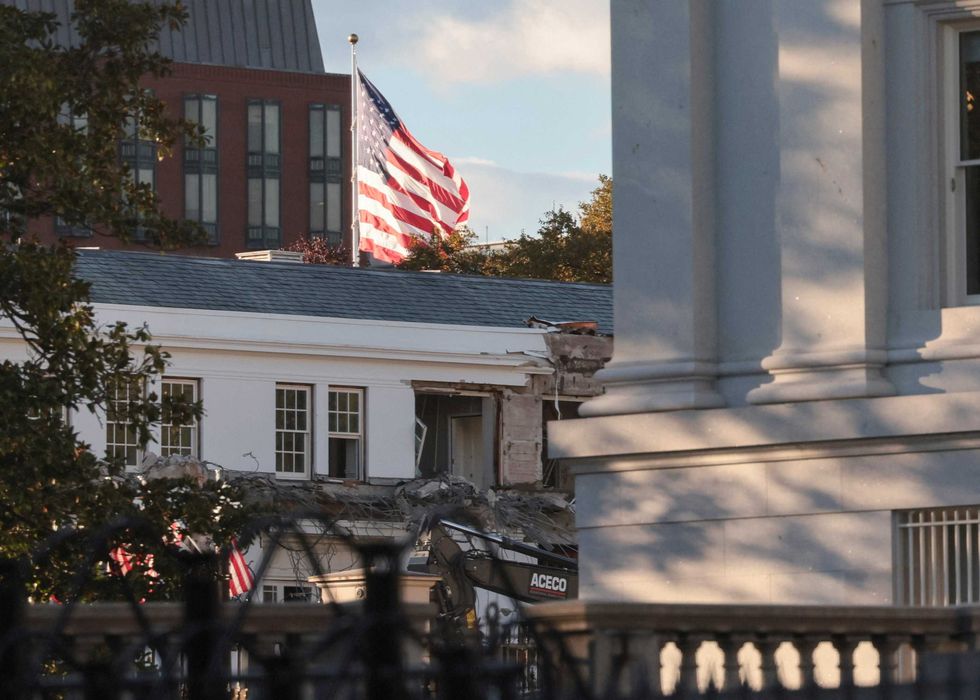
On Wednesday, track excavators continued their work ripping into the former home of the office of the first lady, the White House calligrapher, and some military aides. The demolition was proceeding quickly, with roughly half the structure now reduced to a grey pile of cement and twisted rebar. Staffers in those departments have been relocated to other areas on the complex.

The East Wing’s wood-paneled foyer has long been the main point of entry for visitors attending social events at the White House, as well as those going on tours of the building. The section emerged in its current form in 1942.

Officials said the rest of the East Wing is likely to be demolished by the end of the week.

In some ways, the cries of disapproval are coming too late. Renderings released by the White House in July showed the ballroom sitting atop where the East Wing used to sit, and an official press release at the time stated it would sit “where the small, heavily changed, and reconstructed East Wing currently sits.”

Trump said anyone outraged or concerned he was taking steps without being frank about his intentions were misplaced. “I haven’t been transparent? I’ve shown this to everybody that would listen,” he said in the Oval Office.

Still, images of the building torn to pieces this week have caused shock, particularly as Trump tests his authority in nearly all aspects of the presidency — not least of which is the building he lives and works in.

The project began ramping up over the summer, one source said, and weekly meetings to discuss the project began. The president himself has been involved in these meetings, which have also included Chief of Staff Susie Wiles, the White House Military Office, the Secret Service, an architecture team, and other staffers internally who have been tasked with helping move the project along quickly, the source said.

The White House said in late July that McCrery Architects and its CEO James McCrery would take the lead in the design of the addition. A few days later, McCrery was spotted alongside Trump on the White House roof surveying the area on the South Grounds where the ballroom will go.

Trump’s aides were prepared for pushback on the ballroom and sought to review what was legally required to complete the project, the source said.

Ultimately, administration officials determined the White House would only need approval from the National Capital Planning Commission, which oversees federal construction projects in Washington and its neighboring states, Virginia and Maryland.

However, officials said the commission has jurisdiction only when “vertical” construction begins and does not oversee demolition.

Trump recently appointed White House staff secretary and loyalist Will Scharf to chair the commission. White House deputy Chief of Staff James Blair and another Trump aide were also appointed to the commission at the same time.

Scharf said during a meeting of the commission last month the body would eventually be involved in the project, but not until after the East Wing was demolished.

“I know the president thinks very highly of this commission, and I’m excited for us to play a role in the ballroom project when the time is appropriate for us to do so,” he said.

The commission, which is closed amid the ongoing government shutdown, was created by Congress in 1924 and is comprised of 12 members. Three are appointed by the president, along with the chairman, with the rest of the seats reserved for federal agencies, such as the National Park Service, and representatives from the District of Columbia.

Projects reviewed by the NCPC in recent years include changing the perimeter fence around the White House grounds and a tennis pavilion Trump installed during his first term. The fence, in particular, took several years before it was ultimately approved; officials said it was a necessary change because people kept jumping over the previous one and running toward the North Portico.

L. Preston Bryant Jr., who served as chairman of the NCPC for nearly a decade, described a three-stage process that typically unfolds for federal projects, beginning with early consultations that he described as collaborative.

“The Commission staff very much wants a potential project to get started on the right foot. This early consultation stage is very important,” he told CNN.

The project goes through subsequent phases — conceptual, preliminary approval, and final approval — before the process is complete.

Bryant said he couldn’t remember a time when demolition was separated from the approval process in the way the Trump White House has done.

“That was not my experience during my time at NCPC,” Bryant said. “If there’s to be demolition, that’s part of the project. The demolition element is inherent in the overall project. Demo is not separated from construction. It’s part of it.”

Rebecca Miller, the executive director of the DC Preservation League, said demolishing the East Wing before a formal submission of the ballroom plans essentially starts the project before a formal review process.

“Most concerning is that they’re just tearing down the East Wing without any public submission as to what is going to be built in its place,” she said. “And that’s where the National Capital Planning Commission, or the Commission on Fine Arts, or the public, would have their input into the design of the property, its compatibility with the White House, and how to mitigate or minimize the impact on the current historic resource.”

“We’re in this kind of zone where there’s nothing that prevents the demolition, but we’ve also not seen what the submission is,” Miller added.

Other laws and rules also appear not to apply to the White House. President Lyndon B. Johnson signed the National Historic Preservation Act in 1966, which details the process by which stakeholders should be brought in for large public projects. But the law excludes the three pillars of US government — the Capitol, the Supreme Court, and the White House — from its provisions.

The Shipstead-Luce Act of 1930 also requires that alterations to buildings in the national capital area, including the White House, must be presented to the Commission of Fine Arts. The language, however, refers to buildings facing the White House and not the White House itself.

For Trump, the concerns about the new ballroom appear unconvincing.

Sitting in the newly gilded Oval Office as the machines were working away outside, he held up a pile of paper renderings showing the plans, including the Louis XIV-style interior that closely resembles the ballroom at Mar-a-Lago.

“You see it goes beautifully with the White House,” Trump proclaimed. “I mean, the mix is beautiful.”

© 2024 The-CNN-Wire™ & ©.
https://wsvn.com/news/politics/trump-plows-past-concerns-over-east-wing-demolition-and-envisions-an-even-bigger-ballroom-than-initially-planned/


Saving lives in Ukraine will require Trump to play the strong cards at his disposal

President Donald Trump’s mission to stop the killing in Ukraine has hit a wall. His strategy to let both Moscow and Kyiv “claim victory” and halt the fighting is missing the agreement of one man: Vladimir Putin, the last obstacle to peace.

Last week, Trump and Putin held yet another high-stakes phone call to end the war. Once more, they talked for two hours and appeared to make progress. A peace summit between all sides seemed possible—only for Russian Foreign Minister Sergey Lavrov to derail the process by repeating Putin’s maximalist demands.

Putin has not altered his original aim: “The whole of Ukraine is ours,” as he has asserted. The Kremlin is repeating a familiar pattern. Putin clearly does not want peace, even if he keeps talking about it with Trump endlessly.

As Putin filibusters, Russia’s military is ramping up efforts to replace its catastrophic losses, recruiting troops as if the war will never end. Here, Russia faces a major limitation in sustaining its invasion: it cannot conscript soldiers, but must buy them.

The fact is any traditional call-up of Russian soldiers for Ukraine would threaten the regime’s stability—a significant weakness for the Kremlin. Russian officials learned this lesson the hard way back in September 2022 when they attempted a “partial” call-up of young men. The move sparked widespread public opposition, causing the Kremlin to quickly back down.

This leaves the “golden handshake”—lucrative cash bonuses and incentive packages for volunteering—as Russia’s primary option for recruiting cannon fodder. But this cost is reaching new heights.

To meet recruitment targets, some of Russia’s regions have significantly increased pay for voluntary service in Ukraine. In Tyumen, Siberia, officials this month began offering a lump sum of $36,560—approximately three times the area’s average yearly salary—on top of Moscow’s $5,086 cash bonus for volunteering to fight in Ukraine.

Other regions have similarly made extravagant increases to their signing bonuses and are adding extra cash to recruits’ lavish monthly salaries. But few volunteers live long enough to collect their regular pay: one recent report estimated the average life expectancy of a Russian recruit to be just one month after signing a contract.

Worse still for the Kremlin, even as the payroll and golden handshake costs rise, Russia’s economic might is shrinking. This puts Putin in a tight financial corner—and Ukraine, the United States, and the Europeans hold all the cards.

To end the war, Trump must make Putin pay an exponentially higher price for it.

Ukraine has taken the first step, targeting Russia’s ability to refine oil. No military or society can function for very long without diesel and gasoline, and Ukraine’s planners have clearly identified this weak point in the Kremlin’s war economy.

In a series of spectacular drone attacks, they have struck Russian refining plants, doing significant damage to this key industry.

During his meeting with Trump on Friday, Zelensky stressed his country’s need to sustain this “oil war” with US-made weapons that can strike even deeper inside Russia.

So far, the White House has waffled on delivering this hardware—but Trump has told Putin that he was considering it. The US foot-dragging must end. Ukraine should have the ability to take out Russia’s major military-industrial targets.

Next, the United States and Europe must be more aggressive in eliminating Russia’s “shadow fleet” of oil tankers. This fleet consists of older, poorly insured vessels that operate outside of Western-imposed price caps on oil and regulatory oversight, effectively allowing Russia to sell its oil and fund its war while circumventing sanctions.

NATO’s navies can and must play a more aggressive role in seizing Russian tankers that violate international law and sanctions.

Finally, and perhaps most important, the United States must drop the hammer of secondary sanctions on countries that continue to buy Russian oil.

Trump has repeatedly called on Europeans to stop funding both sides of the Ukraine war, noting that while the European Union sends military aid to Ukraine with one hand, members like Hungary, Slovakia, and Austria have funneled billions to Russia through energy payments.

They need to halt this back-door support for the Kremlin—or pay a price for their stubbornness.

On October 6, Ukraine’s helpline for Russian servicemembers, “I Want To Live,” released what it claimed were internal Russian documents showing that 86,744 Russian soldiers were killed in Ukraine during the first eight months of 2025—an average of 10,842 per month.

In addition, 33,966 soldiers are missing, 158,529 were wounded, and 2,311 captured.

Saving lives in Ukraine will require Trump to play the strong cards at his disposal just as he did this month in the Middle East. But to make that move, he must first make it clear that he views Russia as the aggressor.

*Peter Doran is an adjunct senior fellow at the Foundation for Defense of Democracies, where Dmitriy Shapiro is a research analyst.*
https://nypost.com/2025/10/21/opinion/saving-lives-in-ukraine-will-require-trump-to-play-the-strong-cards-at-his-disposal/

Depending on China for rare-earths is one of our dumbest mistakes — and must be corrected PRONTO

In the 1960s, conservative intellectual James Burnham wrote a book arguing that the decline of Western civilization was a self-imposed choice. His volume, famously titled *The Suicide of the West*, desperately needs an update—one that includes an epilogue about the United States’ growing dependence on China for the mining and processing of rare earth elements. This vulnerability ranks as one of the most fantastically self-damaging strategic missteps of our time.

China is exploiting its advantage in trade negotiations with the United States by restricting the supply of rare earths to gain leverage. A key focus of President Donald Trump’s recent meeting with Australian Prime Minister Anthony Albanese was forging an agreement to jointly invest in critical-minerals projects. There has to be more where that came from. The United States must push on all fronts to address this truly dangerous strategic vulnerability.

Rare earth materials are crucial for manufacturing cars, smartphones, drones, medical devices, and, most importantly, high-tech weapons. For example, approximately 800 pounds of rare earths go into making a single F-35 fighter jet. Between 2019 and 2022, the Government Accountability Office reports, the United States imported more than 95% of the rare earths it consumed—and overwhelmingly from China.

It would be one thing if we relied on Norway or Canada—both allied nations with whom we have no prospect of military conflict (despite the occasional presidential joking about annexation). Instead, China, an adversary bent on surpassing the United States as a global power, is the country we are most likely to confront in a potentially ruinous war.

This scenario echoes the 1930s, when Imperial Japan imported 80% of its oil from the United States, even as it hurtled toward collision with American forces. Today, we are repeating that dynamic, except without a good reason, and playing the role of resource-starved Japan.

It’s a little like King Harold needing Norman goodwill to supply his men with shields in 1066 or Lord Nelson requiring French materials to build his ships of the line in 1798.

Not so long ago—in 1991—the United States was the biggest supplier of rare earths. Then, China undertook a concerted and highly successful effort to wrest the mining and processing of rare earths out from under us. It handed out tax rebates to boost production, bought a key U.S. rare-earths business, and shipped its equipment to China. Over time, it squeezed out the U.S. rare-earths industry and has maneuvered to maintain its dominance ever since.

This is industrial policy as highly consequential geopolitics.

There is no alternative but to respond in kind, which the Trump administration, to its credit, is now undertaking. According to Treasury Secretary Scott Bessent, the administration will establish a price floor for the domestic rare-earths industry. The Defense Department has taken an equity stake in our largest rare-earths miner, with more such moves anticipated.

Public-private cooperation, akin to what characterized Trump’s Operation Warp Speed, is necessary, along with the relaxation of permitting and environmental restrictions. It will take years to make up lost ground, but with enough resources and staying power, this problem is solvable.

Friendly countries have ample supplies of rare earths. The bigger challenge is processing—the sector where China holds an almost complete monopoly. Processing requires specialized know-how and considerable time to build facilities. Still, this is not a technical or logistical challenge on the scale of, say, the Manhattan Project.

Of all the elements of our post–Cold War vacation from history—when defense spending, geography, and supply chains were no longer considered paramount—the outsourcing of the rare-earths industry to China was the most improvident.

If nothing else, China’s recent use of rare earths as a weapon in trade disputes is a cautionary signal of what could come during a more momentous conflict. We can’t say we weren’t warned.

X: @RichLowry
https://nypost.com/2025/10/20/opinion/depending-on-china-for-rare-earths-is-one-a-dumb-mistake-we-must-correct-pronto/

Jesus Cast Down the Mighty from Their Thrones. So Should We

In the past week, the Trump administration brokered a deal that secured the release of Israeli hostages and Palestinian prisoners. While the terms of the long overdue ceasefire are being contested, this is a groundbreaking accomplishment for which I’m deeply thankful.

However, this short-term peacemaking victory abroad was quickly undermined by the administration’s bellicose rhetoric and actions at home. President Donald Trump has repeatedly abused his ability to declare emergencies and seize power under the pretense of maintaining law and order.

For example, he declared immigration emergencies to further militarize the U.S.-Mexico border and label drug cartels as terrorists. He also declared a “trade emergency” to justify and impose costly tariffs, and an energy emergency to greenlight new drilling projects and bypass regulations.

Most alarmingly, he has falsely declared a “crime” emergency to federalize and deploy National Guard troops to additional cities.
https://www.realclearreligion.org/2025/10/20/jesus_cast_down_the_mighty_from_their_thrones_so_should_we_1141997.html

Blowing Up the Drug-Laden Sub in the Caribbean

President Donald Trump announced that the two survivors from a U.S. strike on a vessel in the Caribbean Sea, suspected of carrying drugs, are being sent back to their home countries for prosecution.

“The two surviving terrorists are being returned to their countries of origin, Ecuador and Colombia, for detention and prosecution,” Trump posted on his social media platform Saturday afternoon.

Trump clarified that the vessel targeted was a submarine, noting that U.S. intelligence indicated it was carrying fentanyl and other illegal narcotics.

Repatriating the alleged drug traffickers avoids what could have been a messy legal battle for the administration and a potential challenge to Trump’s ongoing “war” against the cartels. Under U.S. law, unarmed combatants held in military custody are allowed to contest their detention in court, which could complicate the situation.

The OSINT Report added further details: “The U.S. Department of Defense has posted footage showing a drone strike carried out Thursday against a cartel drug semi-submersible, not a submarine as claimed by some officials, in the Southern Caribbean off the coast of Venezuela.” However, such vessels are commonly referred to as subs.

According to U.S. intelligence, the vessel was loaded with illegal drugs, including fentanyl, and was traveling along a known narcotrafficking transit route toward the United States.

The strike resulted in the deaths of two narco-terrorists, while two others survived and were later rescued by the U.S. Navy. These survivors are set to be returned to their home countries of Colombia and Ecuador for further legal action.
https://www.independentsentinel.com/blowing-up-the-drug-laden-sub-in-the-caribbean/

Top 10 Quant rated U.S.-listed Chinese stocks as trade war escalates

Trade tensions between the world’s two largest economies have been reignited after U.S. President Donald Trump and his administration imposed additional tariffs on Chinese goods.

This move comes as a retaliation against China’s strict export controls on rare earth elements, a critical component in many high-tech industries.

On October 10, President Trump further escalated the situation by issuing new threats, signaling a continued standoff between the two nations.
https://seekingalpha.com/news/4505443-top-10-quant-rated-us-listed-chinese-stocks-as-trade-war-escalates?utm_source=feed_news_all&utm_medium=referral&feed_item_type=news

How Trump Can Better Deal With New Delhi

As he demonstrated in the Knesset this week, Donald Trump is making a serious bid to become a historically consequential figure. His influence extends beyond upending American politics; he is also positioning himself as a key player in furthering world peace.

A recent trip to India highlighted how this peace campaign presents both challenges and opportunities for Trump in the region. While some issues have arisen, the visit also opened doors for important diplomatic advancements.

Read Full Article »
https://www.realclearworld.com/2025/10/18/how_trump_can_better_deal_with_new_delhi_1141774.html

Democrats say Trump needs to be involved in shutdown talks. He’s shown little interest in doing so

President Donald Trump is showing little urgency to broker a compromise that would end the government shutdown, even as Democrats insist no breakthrough is possible without his direct involvement.

Three weeks in, Congress remains at a standstill. The House hasn’t been in session for a month, and senators left Washington on Thursday frustrated by the lack of progress. Republican leaders are refusing to negotiate until a short-term funding bill to reopen the government is passed, while Democrats say they won’t agree without guarantees on extending health insurance subsidies. For now, Trump appears content to stay on the sidelines.

He spent the week celebrating an Israel-Hamas ceasefire deal he led, hosted a remembrance event for conservative activist Charlie Kirk, and refocused attention on the Russia-Ukraine war. Meanwhile, his administration has been managing the shutdown in unconventional ways, continuing to pay the troops while laying off other federal employees.

Asked Thursday whether he was willing to deploy his dealmaking background on the shutdown, Trump seemed uninterested. “Well, look, I mean, all we want to do is just extend. We don’t want anything, we just want to extend, live with the deal they had,” he said in an exchange with reporters in the Oval Office. Later Thursday, he criticized Democratic health care demands as “crazy,” adding, “We’re just not going to do it.”

Senate Majority Leader John Thune echoed that approach before leaving for the weekend, saying Trump is “ready to weigh in and sit down with the Democrats or whomever, once the government opens up.” Still, frustration is starting to surface even within Trump’s own party, where lawmakers acknowledge little happens in Congress without his direction.

Leaving the Capitol on Thursday, GOP Sen. Lisa Murkowski said, “We’re not making much headway this week.” For things to progress, Murkowski acknowledged Trump may need to get more involved: “I think he’s an important part of it. I think there are some folks in his administration that are kind of liking the fact that Congress really has no role right now,” she added. “I don’t like that. I don’t like that at all.”

### Trump Has Not Been Slowed by the Shutdown

While Congress has been paralyzed by the shutdown, Trump has moved rapidly to enact his vision of the federal government. He has called budget chief Russ Vought the “grim reaper,” and Vought has taken the opportunity to withhold billions of dollars for infrastructure projects and lay off thousands of federal workers, signaling that workforce reductions could become even more drastic.

At the same time, the administration has acted unilaterally to fund Trump’s priorities, including paying the military this week, easing pressure on what could have been one of the main deadlines to end the shutdown. Some of these moves, particularly the layoffs and funding shifts, have been criticized as illegal and are facing court challenges.

A federal judge on Wednesday temporarily blocked the administration from firing workers during the shutdown, ruling that the cuts appeared politically motivated and were carried out without sufficient justification.

### Congressional Gridlock Continues

With Congress focused on the funding fight, lawmakers have had little time to debate other issues. In the House, Speaker Mike Johnson has said the House won’t return until Democrats approve the funding bill and has refused to swear in Rep.-elect Adelita Grijalva.

Democrats say this move is to prevent her from becoming the 218th signature on a discharge petition aimed at forcing a vote on releasing documents related to the sex trafficking investigation into Jeffrey Epstein.

### Public Opinion Remains Steady Amid Shutdown

So far, the shutdown has shown little impact on public opinion. An AP-NORC poll released Thursday found that 3 in 10 U.S. adults have a “somewhat” or “very” favorable view of the Democratic Party, similar to an AP-NORC poll from September. Four in 10 have a “somewhat” or “very” favorable view of the Republican Party, largely unchanged from last month.

### Democrats Want Trump at the Table; Republicans Prefer He Stay Out

Senate Minority Leader Chuck Schumer and House Democratic Leader Hakeem Jeffries have said Republicans have shown little seriousness in negotiating an end to the shutdown. “Leader Thune has not come to me with any proposal at this point,” Schumer said Thursday.

Frustrated with congressional leaders, Democrats are increasingly looking to Trump. At a CNN town hall Wednesday night featuring Rep. Alexandria Ocasio-Cortez and Sen. Bernie Sanders, both repeatedly called for the president’s involvement when asked why negotiations had stalled.

“President Trump is not talking. That is the problem,” Sanders said. Ocasio-Cortez added that Trump should more regularly “be having congressional leaders in the White House.”

Democrats’ focus on Trump reflects both his leadership style, which allows little to happen in Congress without his approval, and the reality that any funding bill needs the president’s signature to become law.

This time, however, Republican leaders who control the House and Senate are resisting any push for Trump to intervene.

“You can’t negotiate when somebody’s got a hostage,” said South Dakota Sen. Mike Rounds, who added that Trump getting involved would allow Democrats to try the same tactic in future legislative fights.

### Trump’s Reluctance to Intervene

Trump has largely followed that guidance. After previously saying he would be open to negotiating with Democrats on health insurance subsidies, he walked it back after Republican leaders suggested he misspoke. And that’s unlikely to change for now.

Trump has no plans to personally intervene to broker a deal with Democrats, according to a senior White House official granted anonymity to discuss private conversations. The official added that the only stopgap funding bill that Democrats can expect is the one already on the table.

“The President is happy to have a conversation about health care policy, but he will not do so while the Democrats are holding the American people hostage,” White House spokesperson Abigail Jackson said Thursday.

### A Product of the Congress Trump Has Molded

In his second term, Trump has taken a top-down approach, leaving little in Congress to move without his approval.

“What’s obvious to me is that Mike Johnson and John Thune don’t do much without Donald Trump telling them what to do,” said Democratic Sen. Mark Kelly of Arizona.

His hold is particularly strong in the GOP-led House, where Speaker Mike Johnson effectively owes his job to Trump and relies on his influence to power through difficult legislative fights.

When Republicans have withheld votes on Trump’s priorities in Congress, he’s called them on the phone or summoned them to his office to directly sway them. When that doesn’t work, he has vowed to unseat them in the next election.

It’s led many Democrats to believe the only path to an agreement runs through the White House and not through the speaker’s office.

### Democrats Seek Binding Assurances

Democrats also want assurances from the White House that they won’t backtrack on an agreement. The White House earlier this year cut out the legislative branch entirely with a $4.9 billion cut to foreign aid in August through a legally dubious process known as a “pocket rescission.”

And before he even took office late last year, Trump and ally Elon Musk blew up a bipartisan funding agreement that both parties had negotiated.

“I think we need to see ink on paper. I think we need to see legislation. I think we need to see votes,” said Ocasio-Cortez. “I don’t accept pinky promises. That’s not the business that I’m in.”

### Both Parties Confident Amid Shutdown

Both parties also see little reason to fold under public pressure, believing they are winning the messaging battle.

“Everybody thinks they’re winning,” Murkowski said. “Nobody is winning when everybody’s losing. And that’s what’s happening right now. The American public is losing.”
https://abc7.com/post/government-shutdown-democrats-say-trump-needs-involved-hes-shown-little-interest-doing/18024978/

Samsung Is Now On The Cusp Of Revealing Its Galaxy Z TriFold

**Samsung to Unveil Its All-New Triple-Folding Smartphone: Galaxy Z TriFold**

South Korea is set to host the APEC Summit at the end of October in the historic city of Gyeongju. The event will attract world leaders, including US President Donald Trump, making it a significant gathering on the global stage. Alongside the summit, the APEC CEO Summit Korea 2025 will take place from October 28 to October 31, focusing on important topics such as energy transition, digital and AI transformation, trade, and biotechnology.

Amidst this global highlight, Samsung plans to capture attention by unveiling its latest innovation: the Galaxy Z TriFold. This all-new triple-folding smartphone is expected to generate significant media buzz as it makes its debut at the summit.

### A First Look at the Samsung Galaxy Z TriFold

The Galaxy Z TriFold introduces a pioneering design featuring three display sections connected by two hinges. This design allows the device to transform seamlessly into a full-sized tablet when fully unfolded. The phone will boast a 10-inch OLED inner display alongside a 6.5-inch outer display.

Unlike Huawei’s Mate XT, which combines both inward and outward folds, Samsung’s new foldable adopts a U-shaped folding mechanism. This design choice emphasizes screen protection, ensuring that the outer display does not merge with the inner display when the device is opened.

### Key Features and Specifications

– **Display:** A sizeable 10-inch OLED inner screen coupled with a 6.5-inch outer display.
– **Folding Mechanism:** U-shaped with two hinges for durable, user-friendly folding.
– **Build:** A titanium shell enhances durability and premium feel.
– **Battery:** Equipped with three batteries, delivering a combined capacity exceeding 5,000mAh for extended usage.
– **Processor:** Powered by the Snapdragon 8 Elite Gen 5 SoC for top-tier performance.

### Availability and Event Details

While attendees at the APEC Summit will get a first look at the Galaxy Z TriFold, Samsung will showcase the device behind glass panels, meaning the phone will not be available for hands-on use during the event.

The Galaxy Z TriFold is expected to launch in multiple countries, including the United States, the United Arab Emirates, and Vietnam, soon after its official unveiling.

Stay tuned for more updates on Samsung’s groundbreaking foldable smartphone as the APEC Summit approaches!
https://wccftech.com/samsung-is-now-on-the-cusp-of-revealing-its-galaxy-z-trifold/