
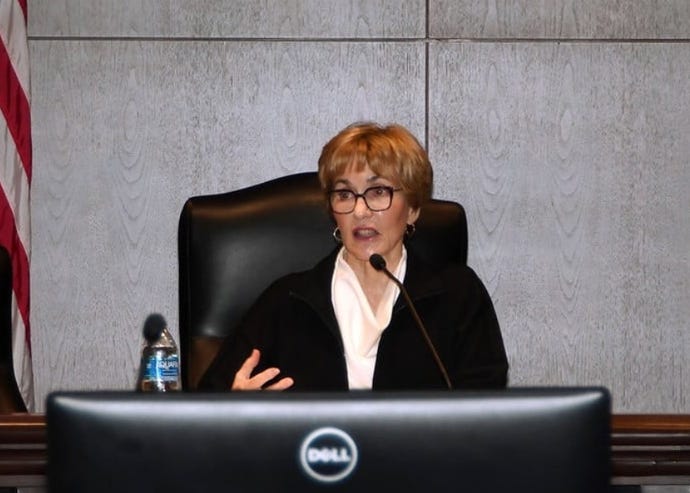
Declassified with Julie Kelly ^ | 24 Nov, 2025 | Julie Kelly Posted on by MtnClimber A pair of hasty, snarky opinions by Judge Cameron Currie once again illustrate an out-of-control judiciary increasingly seizing executive authority to sabotage the will of the people. Judge Cameron McGowan Currie in what is probably an old photo Describing acting U. S. Attorney Lindsey Halligan as “a former White House aide with no prior prosecutorial experience,” Judge Cameron McGowan Currie today dropped the criminal cases against New York Attorney General Leticia James and former FBI Director James Comey pending in the Eastern District of Virginia. “I agree with Ms. James that the Attorney General’s attempt to install Ms. Halligan as Interim U. S. Attorney for the Eastern District of Virginia was invalid,” Currie wrote. “And because Ms. Halligan had no lawful authority to present the indictment, I will grant Ms. James’s motion and dismiss the indictment without prejudice.” Currie wrote the same passage in her order dismissing the charges against Comey. Currie, 77, was appointed to the federal bench by Bill Clinton in 1994. Last month, the chief judge of the Fourth Circuit tasked Currie, who is based in South Carolina, with handling Comey’s disqualification motion. Chief Judge Albert Diaz said in an October 21 order that the transfer was necessary for the “limited purposes in the interest of maintaining public confidence in the impartial administration of justice.” A similar motion by Leticia James also landed on Currie’s docket. Both orders are here and here. In stark contrast to Judge Aileen Cannon’s five-month deliberations as to the lawfulness of Special Counsel Jack Smith’s appointment-Donald Trump’s lawyer filed a motion to dismiss the documents case based on Smith’s unconstitutional appointment in February 2024 and Cannon agreed with Trump in the matter and dismissed the documents indictment in July 2024-Currie took less than a month to kick Halligan off both cases. He thanked his defense attorneys and DOJ prosecutors who had refused to bring any charges against him, resulting in a purge of the office. Comey forgot to mention that the father of Erik Siebert, the ex-interim U. S. Attorney removed for refusing to indict the former FBI director for making false statements and obstructing Congress, is godfather to one of Comey’s children. Hopefully his preening won’t last long. Even if he skates on these charges, Comey appears to be a target of the DOJ’s “grand conspiracy” investigation into the perpetrators of Russiagate and decade-long lawfare against the president. TOPICS: Society KEYWORDS: clintoncrimefamily; democratcorruption; democratcrime; lawfare; leftism Click here: to donate by Credit Card Or here: to donate by PayPal Or by mail to: Free Republic, LLC PO Box 9771 Fresno, CA 93794 Thank you very much and God bless you. 1 posted on by MtnClimber To: MtnClimber The Judicial Lawfare battalion of the color revolution conspiracy against President Trump. 2 posted on by MtnClimber (For photos of scenery, wildlife and climbing, click on my screen name for my FR home page.) To: MtnClimber Yet another AWFL. 3 posted on by brownsfan (We are already on the slippery slope.) Disclaimer: Opinions posted on Free Republic are those of the individual posters and do not necessarily represent the opinion of Free Republic or its management. All materials posted herein are protected by.
https://freerepublic.com/focus/f-chat/4354492/posts
Tag Archives: unconstitutional

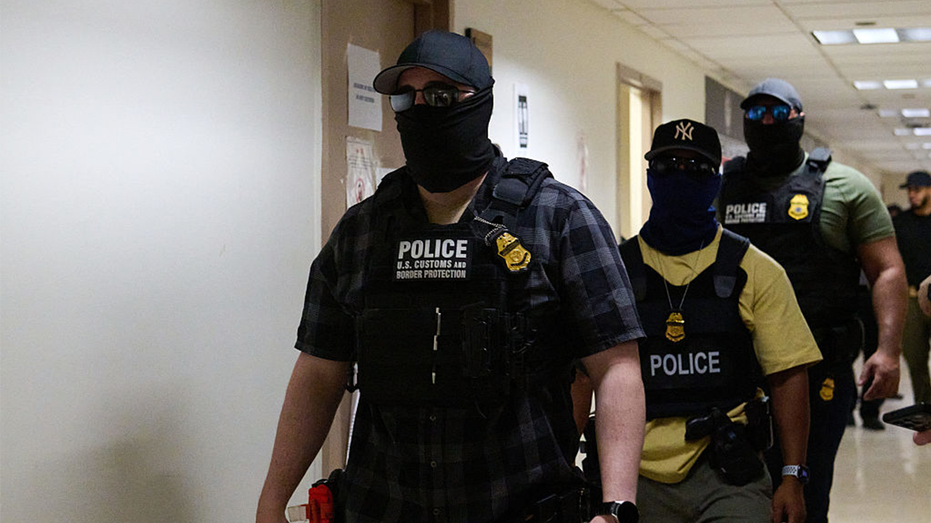
Trump admin sues over California law banning ICE from wearing face masks to shield identities
The Trump administration filed a lawsuit on Monday challenging California’s law banning federal immigration agents from wearing face masks to hide their identities, arguing that the measure is unconstitutional. The lawsuit claims that the state does not have the authority to restrict federal agents. California Gov. Gavin Newsom signed the No Secret Police Act and the No Vigilantes Act into law in September. Under the bills, most law enforcement, including federal agents, would be barred from wearing masks on the job and non-uniformed officers would be required to visibly display identification during their duties. Exceptions to the mask ban would be permitted for undercover agents, for those using medical masks like N95 respirators or as part of tactical gear. NEWSOM BANS LAW ENFORCEMENT FROM WEARING MASKS, TAUNTS ICE AGENTS: ‘WHAT ARE YOU AFRAID OF?’ Newsom said that federal immigration officers would no longer be “hidden from accountability” while performing operations in California. “That’s not the America we’ve grown up in. And so we are pushing back,” he said ahead of the bill signings. Federal agents have conducted immigration raids in Southern California since June, targeting migrant workers at local businesses that sparked protests and the subsequent federal deployment of the National Guard and Marines. During the raids, some federal agents wore masks and hid their identities. The administration urged the court to deem the laws a violation of the Supremacy Clause of the U. S. Constitution and issue a preliminary injunction blocking California from enforcing the laws. The Supremacy Clause establishes that federal law is the “supreme Law of the Land,” overriding state law. CALIFORNIA LEGISLATURE PASSES BILL PROHIBITING LAW ENFORCEMENT FROM WEARING FACE MASKS TO SHIELD IDENTITIES The lawsuit also argues that the California laws violate Article 5, Section 301 of the U. S. Code, which says agency heads “may prescribe regulations for the government of his department [and] the conduct of its employees.” Attorney General Pam Bondi said on Monday that the California laws “discriminate against the federal government and are designed to create risk for our agents.” After Newsom signed the measures, administration officials directed ICE agents to ignore the California laws. The Department of Homeland Security said on Sept. 22 that it will “NOT comply with Gavin Newsom’s unconstitutional mask ban,” pointing to an increase in threats towards ICE officers. The lawsuit also argues that the California laws “would recklessly endanger the lives of federal agents and their family members and compromise the operational effectiveness of federal law enforcement activities.” CLICK HERE TO DOWNLOAD THE.
https://www.foxnews.com/politics/trump-admin-sues-over-california-law-banning-ice-from-wearing-face-masks-shield-identities


A lawsuit challenges an Alaska program that allows killing bears as a way to rebuild a caribou herd
JUNEAU, Alaska (AP) — Conservation groups have filed a lawsuit challenging a state program in Alaska that authorizes the killing of brown bears and black bears. The program aims to increase the size of a once-significant caribou herd in the southwest part of the state.
The lawsuit, filed Monday in state court, claims the program lacks a scientific basis and is unconstitutional. It alleges that the program, adopted by the Alaska Board of Game in July, does not require the Department of Fish and Game to monitor bear populations to ensure their numbers remain sustainable. Furthermore, the program allows department employees to shoot bears from helicopters without setting limits on how many bears can be killed within an area roughly the size of Indiana.
Filed by Trustees for Alaska on behalf of the Alaska Wildlife Alliance and the Center for Biological Diversity, the lawsuit names as defendants the state, the Board of Game, the Department of Fish and Game, and the department’s commissioner. A message seeking comment was sent to the Alaska Department of Law, which typically represents state agencies in litigation.
This lawsuit is the latest chapter in an ongoing legal battle over what Fish and Game describes as an effort to restore the Mulchatna caribou herd. Named for its traditional calving grounds, the herd peaked at around 190,000 animals in the late 1990s and served as an important food source for subsistence hunters across dozens of communities.
However, the herd’s population began declining sharply, dropping to about 13,000 caribou by 2019. Hunting has been prohibited since 2021, according to Fish and Game. The department has cited several factors affecting caribou survival, including disease, hunting, food availability and quality, and predation. In this case, the Board of Game determined that predation could be addressed directly.
The board stated it was responding to requests to help rebuild the herd and restore caribou as a regional food source. In a fall newsletter, the department identified bears and wolves as “significant calf predators.” An aerial survey conducted last fall reported the highest recorded ratio of calves to cows in the herd’s western subgroup since 1999, suggesting a “positive response” to the 2023 and 2024 predator control program targeting bears and wolves on calving grounds.
According to the lawsuit, in May 2023, the agency killed “every single brown and black bear it found” within a 1,200-square-mile (3,108-square-kilometer) focus area encompassing the western Mulchatna caribou herd calving grounds. Altogether, in 2023 and 2024, 180 bears—most of them brown bears—were killed.
The Alaska Wildlife Alliance had previously sued to end the program. In March, a judge criticized the adoption process and ruled that the state lacked sufficient data on bear sustainability in the region before implementing the program. Despite this, the board and department moved forward, implementing emergency regulations under which 11 bears were killed before those regulations were struck down by another judge.
Following this, the department announced a public comment process regarding plans to reauthorize the program. Monday’s lawsuit claims the reauthorization plan adopted by the board in July includes elements previously struck down by the courts. The program is authorized to continue through 2028.
Doug Vincent-Lang, commissioner of the Department of Fish and Game, stated after the board’s action, “We were trying to rebuild the caribou herd, but we’re not going to jeopardize long-term sustainability of bears in so doing.” He added there is “strong evidence that neither disease nor nutrition are preventing this herd from recovering,” and that predation “has been isolated as the limiting factor preventing the herd from growing.”
Nicole Schmitt, executive director of the Alaska Wildlife Alliance, voiced concerns about the program, saying it “threatens bears who move across vast stretches of public lands.” Schmitt noted that parts of the area where bears can be killed are near Lake Clark National Park and Preserve, about 30 miles (48 kilometers) from Katmai National Park and Preserve, and near wildlife refuges.
Michelle Sinnott, staff attorney with Trustees for Alaska, characterized the program as unconstitutional. She criticized it for giving Fish and Game “a blank check to destroy bears across an entire region with impunity.” Sinnott added, “The Board of Game has once again shirked its constitutional obligations and ignored prior court decisions in its unscientific and relentless war on predator animals.”
https://ktar.com/national-news/a-lawsuit-challenges-an-alaska-program-that-allows-killing-bears-as-a-way-to-rebuild-a-caribou-herd/5774048/
Proposition 50 could disenfranchise Republican California voters. Will it survive a legal challenge?
Six years ago, when the U.S. Supreme Court upheld highly partisan state election maps in North Carolina and Maryland, it ruled that federal courts cannot block states from drawing maps that favor one party over the other. One of the court’s liberal justices issued a warning.
“If left unchecked, gerrymanders like the ones here may irreparably damage our system of government,” Associate Justice Elena Kagan wrote in a dissent. Kagan argued that Republicans in North Carolina and Democrats in Maryland — the two examples before the court — had rigged elections in a way that “deprived citizens of the most fundamental of their constitutional rights,” “debased and dishonored our democracy,” and turned “upside-down the core American idea that all governmental power derives from the people.”
“Ask yourself,” Kagan said as she recounted what had happened in each state, “Is this how American democracy is supposed to work?”
—
### Californians Face a Similar Question with Proposition 50
That’s the question Californians are now weighing as they decide how, or whether, to vote on Proposition 50, Governor Gavin Newsom’s plan to scrap congressional maps drawn by the state’s independent redistricting commission and replace them with maps drawn by legislators to favor Democrats through 2030.
Democrats don’t deny that the measure is a deliberate attempt to dilute GOP voting power. From the start, they’ve argued that the point of redistricting is to weaken Republicans’ voting power in California — a move they justify as a temporary fix to offset similar partisan gerrymandering by Texas Republicans.
This summer, President Trump increased the stakes by pressing Texas to rejigger maps to shore up the GOP’s narrow House majority ahead of the 2026 election.
—
### No Federal Court Road to Challenge Partisan Gerrymandering
Since the 2019 U.S. Supreme Court decision *Rucho vs. Common Cause*, complaints of partisan gerrymandering have no path in federal court.
Already, Proposition 50 has survived challenges in state court and is unlikely to be successfully challenged if passed, said Richard L. Hasen, professor of law and director of the Safeguarding Democracy Project at UCLA School of Law.
“If you’re a Republican in California, or you’re a Democrat in Texas, you’re about to get a lot less representation in Congress,” Hasen said. “I don’t think there’s anything you can do about that.”
If Californians vote in favor of the measure on Tuesday, the number of Republicans in the state’s House — nine of 52 total members — would likely be reduced by five. That could mean Republicans have less than 10% of California’s congressional representation even though Trump won 38% of the 2024 vote.
“All of this is unconstitutional, but the federal courts aren’t available to help,” said Justin Levitt, a law professor at Loyola Law School. “Every time you redraw a district specifically to protect some candidates and punish others,” Levitt said, “what you’re basically saying is it shouldn’t be up to the voters to weigh in on whether they think the candidates are doing a good job or not.”
—
### Possible Legal Avenues for Challenge
Even if partisan gerrymandering cases are blocked in federal courts, there are other potential legal avenues to challenge California’s new legislative maps.
One route would be to claim that Proposition 50 violates the California Constitution. David A. Carrillo, executive director of the California Constitution Center at Berkeley Law, said that if Proposition 50 passes, he expects a barrage of “see what sticks” lawsuits raising California constitutional claims.
They stand little chance of success, he said. “Voters created the redistricting commission,” he explained. “What the voters created they can change or abolish.”
—
### Racial Discrimination Claims Could Arise
Attorneys might also bring racial discrimination claims in federal court alleging California lawmakers used partisan affiliation as a pretext for race in drawing the maps to disenfranchise one racial group or another, Carrillo said. Under current law, such claims are very fact-dependent.
Attorneys are already poised to file complaints if the referendum passes. Mark Meuser, a conservative attorney who filed a state complaint this summer seeking to block Proposition 50, said he is ready to file a federal lawsuit on the grounds that the new maps violate the Equal Protection Clause in the 14th Amendment of the U.S. Constitution.
“We’re saying that race was a predominant factor in drawing the lines,” Meuser said. “When race is a predominant factor in drawing the lines without a compelling interest, strict scrutiny will mandate the maps be stricken.”
—
### Difficulty Proving Racial Discrimination
Some legal experts believe that would be a tricky case to prove.
“It sure seems like the new map was oriented predominantly around politics, not race,” Levitt argued. “And though they’d be saying that race was a predominant factor in drawing the lines, that’s very, very, very different from proving it. That’s an uphill mountain to climb on these facts.”
Some experts think the new maps are unlikely to raise strong Voting Rights Act challenges. Eric McGhee, a senior fellow at the Public Policy Institute of California who specializes in elections, said the new districts appeared to have been carefully carved to preserve Latino- or Black-majority districts.
A successful challenge is possible, McGhee said, noting there are always novel legal arguments. “It’s just the big ones that you would think about that are the most obvious and the most traditional are pretty closed,” he said.
—
### Supreme Court Ruling Looms Large
Ultimately, legal experts agree the fate of California maps and others in Texas and across the nation will depend on the Supreme Court’s upcoming ruling on a redistricting case from Louisiana.
Last month, conservative Supreme Court justices suggested in a hearing that they were considering reining in a key part of the landmark 1965 Voting Rights Act that prohibits voting practices or procedures that discriminate on the basis of race, color, or membership in a language minority group.
“Whatever happens with Proposition 50 — pass or fail — almost doesn’t matter in the grand scheme of things,” Carrillo said, noting that the Supreme Court could use the Louisiana case to strike Section 2 of the Voting Rights Act. “There’s a big litigation storm coming in almost any scenario.”
Levitt agreed that the Supreme Court ruling on the Voting Rights Act, which could come any time between now and June, could change current law. But he stressed it is impossible to predict how broad the ruling could be.
“Whether that leaves any of California’s districts vulnerable — either in the current map or in the map if Prop. 50 passes — depends entirely on what SCOTUS says,” Levitt argued. “There are only nine people who know what they’ll actually say, and there are a lot of possibilities, some of which might affect California’s map pretty substantially, and some of which are unlikely to affect California’s map at all.”
—
### Will Congress Intervene?
As the redistricting battle spreads across the country and Democratic and Republican states look to follow Texas and California, Democrats could ultimately end up at a disadvantage. If the overall tilt favors Republicans, Democrats would have to win more than 50% of the vote to get a majority of seats.
Congress has the power to block partisan gerrymandering in congressional map drawing. But attempts so far to pass redistricting reform have been unsuccessful.
In 2022, the House passed the Freedom to Vote Act, which would have prohibited mid-decade redistricting and blocked partisan gerrymandering of congressional maps. But Republicans were able to block the bill in the Senate — despite its majority support — due to the chamber’s filibuster rules.
—
### Proposed Legislation to Ban Mid-Decade Redistricting
Another option is a narrower bill proposed this summer by Republican Rep. Kevin Kiley, who represents parts of the Sacramento suburbs and Lake Tahoe and could lose his seat if Proposition 50 passes. Kiley’s bill, along with similar legislation introduced by California Democratic representatives, would ban mid-decade redistricting.
“That would be the cleanest way of addressing this particular scenario we’re in right now, because all of these new plans that have been drawn would become null and void,” McGhee said.
But in a heavily deadlocked Congress, Kiley’s bill has little prospect of moving.
“It may have to get worse before it gets better,” Hasen said.
—
### The Future of Redistricting Battles
If the redistricting war doesn’t get resolved, Hasen said there will be a continued race to the bottom — particularly if the Supreme Court weakens or strikes down Section 2 of the Voting Rights Act.
Another scenario, Hasen added, is that Democrats regain control of Congress and the presidency, overcome the filibuster rule, and pass redistricting reform.
If that doesn’t happen, Levitt said, the ultimate power rests with the people.
“If we want to tell our representatives that we’re sick of this, we can,” Levitt said. “There’s a lot that’s competing for voters’ attention. But that doesn’t mean that we don’t have agency here.”
https://www.latimes.com/california/story/2025-11-01/why-prop-50-likely-to-survive-legal-challenge-despite-disenfranchising-some-california-voters


ACLU asks judge to find that immigrants who are arrested have right to bond
When a Border Patrol agent arrested a 24-year-old Venezuelan man in Brunswick last month, the officer said he had to detain him under a law that immigration lawyers say has traditionally been used for people after they’ve just crossed the border. But the man has been in Maine for two years and was allowed to work while he seeks asylum, according to court records. Federal agents have been using the law to arrest more immigrants who they say are in the country illegally and seeking admission, which, according to the Department of Justice, means they are not entitled to a bond hearing or conditional release. In several cases recently considered by a federal judge in Maine, immigrants who have been detained say they have lived and worked in the United States for several years. Many have applied for asylum and some have children who are U. S. citizens. Their lawyers have argued that the federal government is ignoring decades of precedent, in which immigration authorities have used a different law to arrest people who have been in the country for years. That law allows detainees to request bond, as long as they’re not found to be dangerous to the community or a flight risk. The man arrested in Brunswick is one of many immigrants challenging their arrests in the U. S. District Court of Maine. The American Civil Liberties Union, including several of its New England chapters, has also filed a lawsuit asking a federal judge in Boston to deem the practice of “systematically misclassifying” immigrant detainees as unconstitutional. ACLU of Maine lawyer Max Brooks said the issue comes down to bond hearings. Brooks, whose clients have included asylum seekers, has filed a handful of petitions seeking the release of people who he says were detained under the wrong law. “It’s extremely difficult to prove your asylum case, to prove the persecution that you suffered, when you’re locked up in a detention facility with very minimal access to the outside world,” Brooks said in an interview Wednesday. Attorneys for the Department of Justice have said the law allows them to detain and deny bond to anyone in the country illegally and that it doesn’t matter if people “have successfully evaded U. S. Border Patrol and effected an unlawful entry into the interior of the United States,” according to their response to the ACLU case in Boston. “The crux of this dispute is one of statutory interpretation,” federal attorneys wrote. “And, under the plain text, the resolution of this case is neither close nor difficult.” The Board of Immigration Appeals, which is overseen by the Department of Justice, upheld the practice in a decision last month. ACLU lawyers say their argument is supported by “decades of settled immigration practice,” as well as several recent decisions from federal judges in Maine and Massachusetts. Last month, Maine U. S. District Judge Stacey Neumann ordered the release of three Ecuadorian men, who she agreed had been detained under the wrong law. During a hearing Tuesday, while considering the case of the Brunswick man arrested by Border Patrol, Neumann told two assistant U. S. attorneys that she was “frustrated” to see them raising the same defense, despite her previous rulings. “The government agency continues to act in a way that the court has said is illegal,” Neumann said during the Zoom hearing. She ordered on Thursday that the federal government give the man a bond hearing. ‘CREATES A LEGAL CONUNDRUM’ The Board of Immigration Appeals was recently asked to consider the case of a Venezuelan man, who was arrested in Washington by immigration officials as someone “seeking admission” and not entitled to bond. While the man admitted to crossing the southern border in 2022 without encountering Border Patrol, he also said he had been living in the United States for almost three years. He was granted temporary protected status in 2024, but that expired a year later. The board said this “creates a legal conundrum,” and that the man “provides no legal authority” to show why people accused of being in the country illegally are eligible for bond hearings “after some undefined period of time residing in the interior of the United States.” “If he is not admitted to the United States (as he admits) but he is not ‘seeking admission’ (as he contends), then what is his legal status?” the board stated. In a Sept. 5 decision, the board agreed that people arrested under the law in question are not entitled to a bond hearing. Brooks, with the ACLU of Maine, described the difficulties immigrants who have been arrested endure while locked up. He said facilities can record calls to friends and family, and can charge detainees for the calls. In Maine, where Border Patrol agents are carrying out many of these arrests, the agency recently has been holding people in small stations. In some petitions filed in Maine’s U. S. District Court, immigration lawyers have said their clients were sleeping on cots on the floor, surrounded by several other detainees while in Border Patrol facilities. “It’s inherently harder to prepare for your case if you’re locked up, can’t see people in person, are stressed out,” Brooks said. Because of a 1st U. S. Circuit Court of Appeals decision four years ago, it’s easier for immigrant detainees in New England to get approved for bond. Since President Donald Trump took office, immigration advocates say the administration has been transferring more ICE detainees to facilities in the south, to prisons in Texas and Louisiana, where they’re far away from their communities and it’s harder to request bond. CLASS ACTION CASE The ACLU lawyers in the Boston case have asked for class action status, so that anyone who a judge believes is being detained under the wrong law can be released or given a bond hearing. The federal government argued that this kind of process would be illegal and that federal judges can only weigh each case individually. U. S. District Judge Patti B. Saris in Massachusetts was still considering the ACLU’s request on Thursday, according to court records. The ACLU attorneys shared almost 30 petitions with Saris that have been filed this year in Massachusetts, Maine and New Hampshire. They all involve immigrants who were arrested by Border Patrol and ICE and who said they’re being held under the wrong law and should be eligible for bond. The cases include a 37-year-old Ecuadorian man who was arrested by Border Patrol in Maine on Sept. 10 after being involved in a car accident in Waterville. A police officer called Border Patrol because the man didn’t have identification and wasn’t fluent in English, according to court records. Neumann, the judge in Maine, ordered the federal government on Sept. 30 to release him and give him a bond hearing “for the same reasons as I have enumerated in detail in previous cases.” If the ACLU wins class action status for the lawsuit, Brooks said it could save Maine’s federal court from a surge in individual petitions. While all of the cases in Maine have varied slightly, based on each petitioner’s circumstances and the details of their arrest, Brooks said they all deal with legal misclassification and the denial of bond hearings. “That’s why it makes so much sense to do this as a class action,” Brooks said. “Basically, all of this stuff is flowing from . this broad policy decision to require illegal misclassification, and a court can address that in one fell swoop.”.
https://www.pressherald.com/2025/10/16/aclu-asks-judge-to-find-that-immigrants-who-are-arrested-have-right-to-bond/