
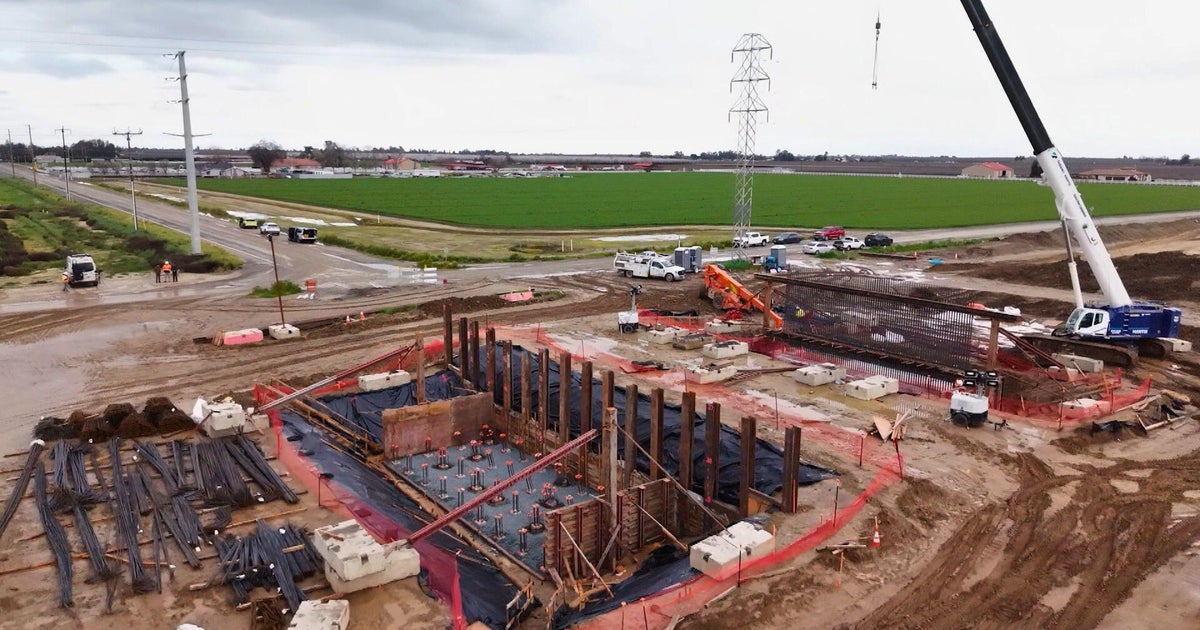
With high-speed rail ambitions in California delayed by years and coming in at a higher-than-expected cost, Lou Thompson, who sat on the state’s high-speed rail peer review group, said “failure is always an option.” He doesn’t think failure is what will necessarily happen in California, but earlier ambitions have been scaled back. When California voters approved a bullet train between Los Angeles and San Francisco in 2008, the estimated price tag was $33 billion, with a target completion date of 2020. Nearly two decades later, the California High-Speed Rail Authority is preparing to lay its first tracks to connect Bakersfield and Merced a portion of the original route with a target completion of 2033. “When you have a project like this, and when the budget no longer permits you to finish it the way you wanted to, you start cutting off your arms and legs,” Thompson said. What happened to California’s plans Rep. Vince Fong, a Republican representing California’s Central Valley, sits on the House Transportation and Infrastructure Committee. He says that when California voters first approved high-speed rail, the promise and price tag were more of a marketing campaign than a realistic projection. “We’re now in 2026. There are no trains. There’s no track laid,” he said. “It was a complete bait and switch.” It became clear after voters approved the plan in 2008 that the specifics hadn’t been worked out, Fong said. California Secretary of Transportation Toks Omishakin, who’s relatively new to the job agrees with that point. He’s been left to answer for his predecessors. “I don’t think the voters fully understood and neither did we in the public sector what it was going to take to actually get this project delivered,” Omishakin said. To get the necessary political buy-in from the whole state, the plan called for the train to run inland, threading the farmland of the Central Valley. But at the time, the California High-Speed Rail Authority hadn’t answered basic questions, like precisely where it could lay down its tracks, the public and private property the route would traverse what’s known as right of way So far, the state has had to negotiate roughly 3, 000 parcels of land to run its train through the Central Valley leg, Omishakin said. California’s environmental regulations have also slowed the process. Those regulations have triggered years-long reviews, lawsuits and delays which, combined with the relatively high cost of labor and construction in the U. S., have also added to the price tag. While the federal government made modest contributions to the project under the Obama and Biden administrations, the financial burden fell chiefly on California, and when construction started, the state didn’t have the financing to complete the full route. In 2019, with costs ballooning and the timeline years off schedule, bipartisan political pressure mounted. “Right now, there simply isn’t a path to get from Sacramento to San Diego, let alone from San Francisco to L. A.,” Gov. Gavin Newsom, who inherited the project, said at the time. Under Newsom, who didn’t respond to repeated interview requests, California decided to focus on completing that initial Central Valley segment. It’s a route few are likely to ride, according to the Rail Authority’s own projections. The ultimate goal remains connecting northern and southern California. More than 20 countries have high-speed rail. Why doesn’t the U. S.? The American rail system was once envied around the world. In the 1800s, the U. S. government oversaw the birth of the transcontinental railroad, stitching the country together as it expanded westward. In the 1950s, the Eisenhower administration decided to create and, critically, continuously fund the interstate highway system, fueling a car culture that still dominates today. Meanwhile, Japan’s bullet train opened in 1964. Today, more than 20 countries largely in Europe and Asia have high-speed rail, generally defined as cruising at 150 miles per hour or more. In Africa, Morocco has a train traveling at a top speed of nearly 200 miles an hour. And Egypt has broken ground on a high-speed rail line. “The simple answer is they’ve decided they want to do it and pay for it, and we haven’t,” Thompson said. Thompson, who is in his 80s said he’s dubious about the prospect of seeing high-speed rail completed in the U. S. in his lifetime. “But maybe yours, I don’t know,” he said. Can a private company make high-speed rail work in the U. S.? Brightline, a private company, believes it can achieve what California hasn’t. In 2018, it opened a train between Miami and Orlando that hits top speeds of around 125 miles an hour. While it’s not a high-speed rail, it’s akin to a beta test for Brightline’s next project: a bullet train connecting L. A. and Las Vegas in just two hours. It’s a trip that can take five hours by car. “Brightline West will be true high-speed rail, first time in the country,” Mike Reininger, managing director of Brightline West, said. “And we’ll operate at speeds of about 200 miles an hour maximum.” Brightline is avoiding complicated right-of-way issues out west by running on the median of the I-15 highway. Construction has already begun on some of the station structures. The plan is to start service in late 2029. The company says building out west will also avoid the tragedy that has plagued the south Florida route, where trains run at street level, through crowded neighborhoods. In the near-decade since operations began, more than 200 people have been hit and killed by Brightline trains, according to numbers compiled by The Miami Herald and local public radio station WLRN. It will be safer out west, the company says, where train crossings won’t be at street level. But there are also the finances. In Florida, stratospheric costs of building and running the rail line vastly outstrip revenues. Analysts have downgraded Brightline’s debt to junk, raising questions about private rail as a business. “The business has built slower than we originally expected it to build. We thought we would be carrying more passengers today than we are,” Reininger said. “The business is in fact growing month over month, year over year. That’s a great thing.” Brightline West has already received some federal funding and is hoping for a $6 billion loan from the Trump administration. Can California get the high-speed rail project back on track? In California, there’s not much hope for federal funding at the moment. In 2025, The Trump administration canceled $4 billion in grants previous administrations had committed to the state’s bullet train project, calling it the “worst cost overrun I’ve ever seen.” In a statement to 60 Minutes, Secretary of Transportation Sean Duffy said the administration is in favor of high-speed rail, but this project has “wasted billions in taxpayer dollars yet delivered nothing.” Omishakin said the California High-Speed Rail Authority believes it can complete the Central Valley segment without money from the federal government, but that the full route from L. A. to San Francisco would be challenging without it. Lou Thompson says large infrastructure projects like these require consistent, stable funding that only the federal government can provide, much like it did for the interstate highway system 70 years ago. Plus, he says, “a lot of the benefits of the project, the reason why you build a project, is public pollution reduction, congestion reduction, improved safety, comfort all of those things are public benefits.”.
https://www.cbsnews.com/news/us-high-speed-rail-60-minutes/
Category Archives: transportation

TSA pay may be coming, but airport delays could persist and ICE agents may not leave soon
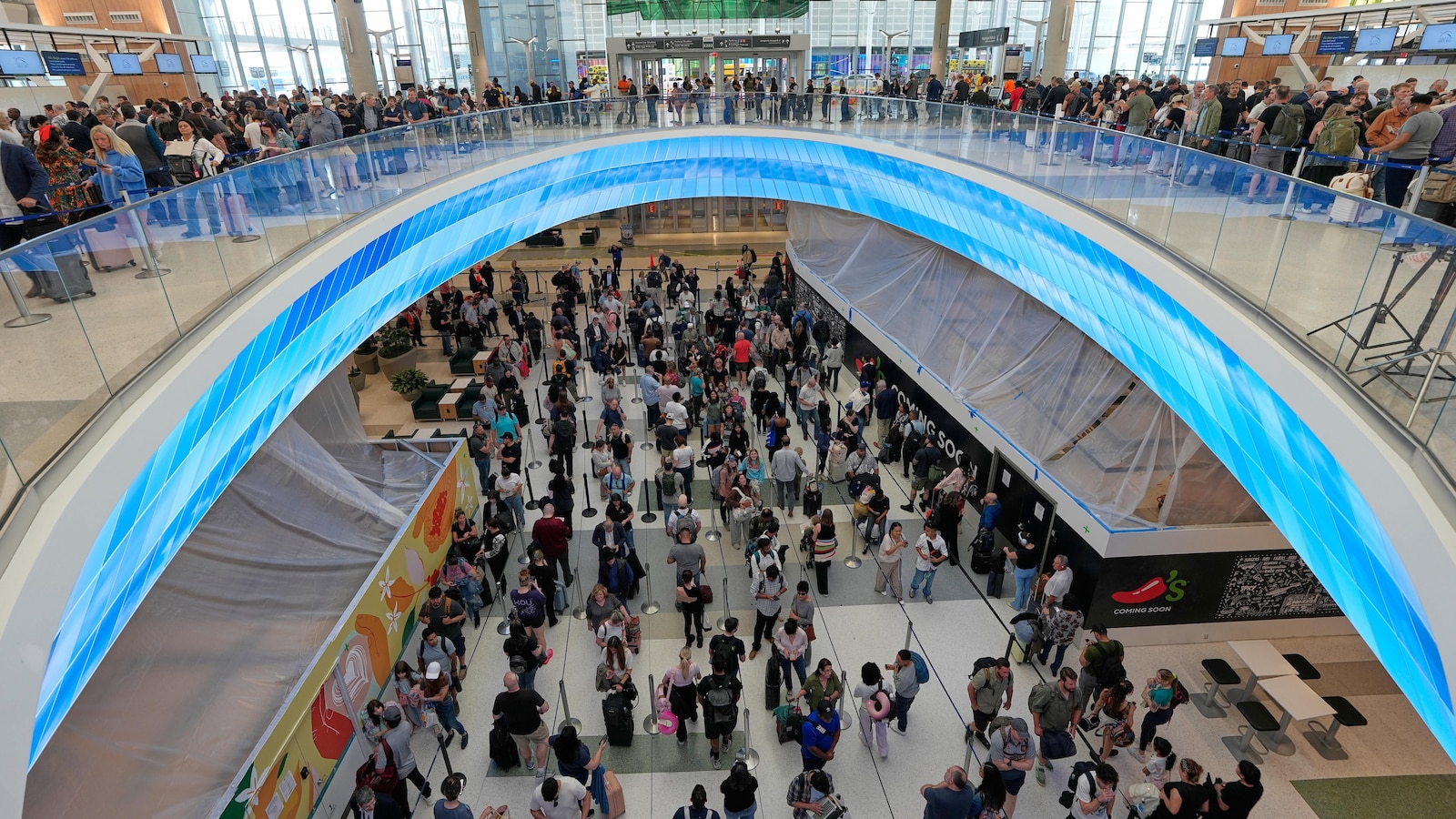
Even after President Donald Trump ordered emergency pay for Transportation Security Administration agents to ease long security lines, major U. S. airports on Sunday were still urging travelers to arrive hours early and federal immigration officers brought in to help may not be leaving anytime soon. Trump’s executive order on Friday instructed the Department of Homeland Security to pay TSA officers immediately, though it’s unclear how quickly travelers will see an impact. The move comes during a busy travel stretch, with spring breaks underway and Passover and Easter approaching. Tens of thousands of TSA employees have been working without pay since DHS funding lapsed on Valentine’s Day. The department’s shutdown reached 44 days on Sunday, eclipsing the record 43-day shutdown last fall that affected all of the federal government. Trump deployed Immigration and Customs Enforcement agents to some airports a week ago to help with security as TSA callouts rose nationwide the same officers who may now remain in place if TSA staffing strains continue. Making the rounds on Sunday morning news shows, White House border czar Tom Homan said it depends on how many TSA employees would be returning to work after they start receiving their pay. “ICE is there to help our brothers and sisters in TSA. We’ll be there as long as they need us, until they get back to normal operations and feel like those airports are secure,” he told CBS’ “Face the Nation.” Speaking on CNN’s “State of the Union,” Homan said it also depends on how many TSA agents “have actually quit and have no plan on coming back to work.” Nearly 500 TSA officers have left the agency since the shutdown started, according to DHS. On Saturday night, Maryland Gov. Wes Moore said in a post on X that more ICE agents were being deployed to Baltimore-Washington International Airport to assist at TSA security checkpoints to “speed up the clearance process for passengers not immigration enforcement.” Homan, in his CNN interview, said he hopes TSA officers will be paid by Monday or Tuesday. “It’s good news because these TSA officers are struggling,” Homan said. “They can’t feed their families or pay their rent.” Also on Sunday, Charlotte Douglas International Airport said in a post on X that backpay could arrive for TSA agents beginning Monday. “While this action provides critical relief, CLT supports long-term solutions to ensure continued stability for this essential workforce,” the airport said. Johnny Jones, secretary-treasurer of the American Federation of Government Employees’ TSA chapter, said Sunday that he has heard from workers worried they may not receive their full back pay because TSA management was given very short notice to begin processing payments. He also said TSA agents are concerned they could miss pay for time they were unable to work because they couldn’t afford to report for duty. “It is a disaster in progress,” Jones said. Some of the busiest U. S. airports continued to ask travelers to plan ahead in order to get through security lines. Houston’s main airport, George Bush Intercontinental, warned Sunday evening that TSA wait times could reach four hours or longer. Atlanta’s Hartsfield-Jackson International Airport also told passengers to arrive at least four hours early for both domestic and international flights. LaGuardia Airport posted an alert Sunday evening on its website that “TSA lines are currently longer than usual.” Baltimore-Washington International Airport said Sunday on X that “wait times have greatly subsided on this Spring Break Sunday,” but it still asked passengers to show up several hours early. Louis Armstrong International Airport in New Orleans offered the same guidance. Also on Sunday, passengers could once again see estimated security wait times at the three main airports serving the New York City area LaGuardia, John F. Kennedy and Newark Liberty. All three had removed that feature from their websites earlier in the week, citing “rapid” changes in passenger volumes and TSA staffing. For the same reason, they cautioned that the restored wait times my not always “reflect current conditions”. It’s hard to tell. Caleb Harmon-Marshall, a former TSA officer who runs a travel newsletter called Gate Access, said the staffing crisis won’t improve significantly until officers are confident that they won’t be subjected to more skipped paychecks. “It has to be an extended pay for them to come back or want to stay there,” he said, estimating longer lines could linger for another week or two. Jones, the TSA union leader, offered a more optimistic outlook on Sunday, saying he’s hopeful that passengers could see wait times ease closer to typical levels once workers are able to afford basic expenses like gas to get to work. TSA will also have to decide whether to reopen the checkpoints and security lanes they closed or consolidated at some airports due to inadequate staffing, which led to passengers standing in screening lines that clogged check-in areas or showing up far too early for their flights. A handful of airports have experienced daily TSA officer call-out rates of 40% or higher in recent weeks. ___ Sedensky reported from New York, Yamat from Las Vegas and Raby from Charleston, West Virginia. Associated Press journalist Julie Walker contributed from New York.
https://abcnews.com/US/wireStory/tsa-pay-coming-airport-delays-persist-ice-agents-131505155

No ICE agents at Logan Airport yet as agents deploy to busy airports
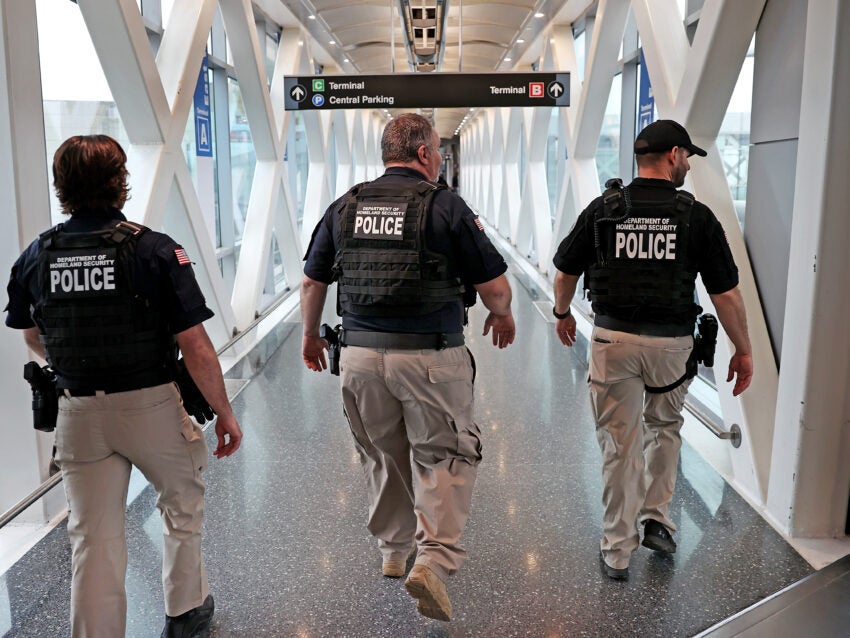
No ICE agents took up Transportation Security Administration roles at Logan Airport in Boston Monday as President Donald Trump orders federal immigration agents to beleaguered airports, the local union said. ICE agents were not deployed to any New England airport, according to Mike Gayzagian, the president of AFGE Local 2617, the New England branch of the TSA officers’ union. Agents could come next week, but those rumors are unsubstantiated, Gayzagian said. A group of DHS officers were seen at Logan Monday and indicated to The Boston Globe they were part of a “Visible Intermodal Prevention and Response” operation, a TSA specialized security team that has been in operation for years, the paper reported. As the partial government shutdown continues into its second month, funding for DHS, including U. S. Immigration and Customs Enforcement, is at the center of the shutdown. Trump said Sunday he would send ICE agents to airports starting Monday. Massport confirmed ICE agents were not deployed at Logan International Airport, but deferred to the TSA. Speaking for TSA, DHS declined to say if agents were deployed to New England airports, citing “operational security reasons.” ICE agents were deployed to 14 airports, CNN reported, where airport wait times were reaching multiple hours. Logan Airport, where the majority of TSA agents have stayed at work, has so far avoided the delays plaguing other major hubs. Here are the airports, per CNN, where ICE agents were deployed, where Trump promised they would arrest “all Illegal Immigrants.“.
https://www.boston.com/news/local-news/2026/03/23/no-ice-agents-at-logan-airport-yet-as-agents-deploy-to-busy-airports/
Rideshares to and from LAX could get more expensive under new proposal
At the top of the list of things people don’t like about LAX are the traffic in and out of the airport and the high cost of rideshares. Now, airport officials are proposing a plan they hope will ease one of those problems while increasing the other.
On Tuesday morning, Los Angeles World Airports (LAWA) board members are expected to vote on whether to increase the access fees for private transportation companies that ferry travelers to and from Los Angeles International Airport. This includes rideshare companies such as Uber and Lyft, along with taxi and limousine services.
The proposal aims to encourage riders to use the yet-to-open Automated People Mover, also known as Skylink, and reduce vehicle traffic around the terminals.
### Travelers React to Proposed Fee Increase
Travelers at the airport Monday who heard about the vote were incredulous.
“We expect rides to be expensive like in every city but for it to go up even more is kind of crazy,” said Jordan Conway, who was catching a ride into the city after arriving from Nashville with his friend for their annual trip to Southern California. Their ride from the airport was projected to cost about $80.
Currently, rideshare companies including Uber and Lyft pay $4 to access the airport for pickups and drop-offs. Under the proposed plan, the fee would rise to $12 to access the airport’s central terminal area, and $6 for picking up and dropping off at Skylink.
The increases would also apply to black car, taxi, and limousine drivers, who currently pay nothing to drop off passengers curbside at the airport.
### Uber Pushes Back
Uber has begun reaching out to its customer base to rally opposition to the plan. In an email sent Monday, Uber stated, “LAX is pushing through a proposal that would more than double the fees you pay to get picked up or dropped off by rideshare.”
LAWA officials told The Times there is room to reconsider when the new fees would be implemented, possibly postponing until after the long-delayed Automated People Mover actually opens.
### Delay and Details on the Automated People Mover
The train, originally slated to open in 2023, has faced significant delays due to disputes between the airport and contractor LAX Integrated Express Solutions involving timeline, compensation, and production issues.
David Reich, deputy executive director for mobility strategy at Los Angeles World Airports, said the people mover is now scheduled to open in early summer. It’s anticipated to run 24/7 in four-car sets, two minutes apart during peak hours, accommodating up to 200 passengers per train.
LAWA estimates the train will move 85 million passengers per year.
“By distributing traffic amongst multiple locations rather than funneling it all into the central terminal area, we can reduce gridlock, improve safety, and give passengers better options on how to get to LAX,” Reich said.
“It’s just not sustainable anymore for all the vehicles — 80,000 to 100,000 a day — to come into that very limited curb front.”
### Fee Increase Justified by Market Rates
The proposed access fee increase would be the first at LAX in 10 years, according to airport officials. Fees at LAX have traditionally been below other major travel hubs, including Boston, Seattle, and San Francisco International Airports, where rideshare companies are charged $6 for access.
“We’ve made all these investments, so it makes sense now to look at getting those fees on par with the market rate for access,” Reich explained.
How companies decide to navigate the additional cost, or whether to pass it on to customers, remains up to them. This could affect how some people move around the city.
### Impact on Travelers
Brandon Bailey, who flew into LAX from Texas on Monday morning, told The Times the potential increase will leave a hole in his travel budget.
“It’ll definitely affect my travels, I come in every month for work,” Bailey said. “I’m just going to pay it, but I’m paying more today than I ever have.” His Uber ride from the airport to his destination was priced at $58.
Along with increasing the access fees, the board is also discussing a limit on rideshare pickups: allowing only 30% of pickups at the central terminal area within the airport horseshoe, with the remaining 70% at Skylink. For passenger drop-offs, the percentages would be reversed, Reich said.
The current proposal allows the board to increase the fees 30 days after the vote, but implementation may be delayed until the people mover is operational, Reich added.
### Political Response and Public Criticism
On Monday afternoon, seven state Assembly members and two state senators issued a statement calling on the board to delay the vote. They echoed Uber’s criticism that the public did not have enough time to consider the proposal or understand the reasoning behind it.
“At a time when Californians face a persistent affordability crisis, we should carefully consider policies that increase transportation costs or make work opportunities connected to the airport more difficult to access,” the statement said.
However, LAWA maintains they have been studying how to implement policies around Skylink since 2020. Reich said, “In earnest, we started talking about plans, both publicly to our board and directly to Uber and Lyft and other companies, since at least 2023.”
### Expert Takes: Rising Costs and Travel Hacks
John E. DiScala, creator of the travel tips and deals website Johnny Jet, said the proposal comes at a difficult time as gas prices are also rising.
DiScala noted he doesn’t know if Uber or Lyft passing the fee increase on to customers will change traveler behavior. But the overall rising costs for gas and other essentials are adding up.
So much so, he said, that his neighbor recently asked for a ride to LAX to avoid paying for a rideshare.
One possible effect could be on hotel shuttles to the airport — a trick DiScala uses when traveling alone. He predicts hotels may crack down on shuttle riders who are not staying at their facilities.
Instead, people might start asking friends who live near the airport for rides.
“There is a saying that you know someone loves you if they pick you up at LAX,” he said.
—
This proposal reflects the ongoing balancing act at LAX between improving infrastructure and managing the costs and convenience for travelers and transportation providers alike. As the vote approaches, many eyes will be on how the changes could reshape travel to and from one of the nation’s busiest airports.
https://www.latimes.com/california/story/2026-03-09/rideshares-to-from-lax-could-get-more-expensive-under-new-proposal
JetBlue lounge at Logan Airport will make its debut this summer
A long-awaited JetBlue airport lounge is finally coming to Boston later this year. The lounge, known as BlueHouse BOS, will be located in Terminal C of Logan International Airport near gate C23, a JetBlue spokesperson told Boston.com.
The lounge was first announced in September 2024, alongside a similar lounge at New York’s John F. Kennedy International Airport, which opened in December 2025. The Logan lounge will feature residential amenities like its JFK counterpart but will be “uniquely Boston” in its art, design, food options, and experiences, according to the spokesperson.
Scheduled to open this summer, more details about the unique Boston experiences offered at BlueHouse BOS will be released closer to the launch date.
JetBlue is Logan Airport’s largest carrier, and the Boston lounge will be nearly 40 percent larger than the New York location, measuring 11,000 square feet compared to 8,000 square feet in JFK.
The airline has noted that the new lounges are designed to meet a growing demand for premium travel options. “Customers have asked for a JetBlue lounge for years and we can’t wait to unveil our take in New York and Boston,” said Marty St. George, president of JetBlue, in a 2024 statement.
He added, “Lounges have become an essential offering for the growing numbers of customers seeking premium experiences, and JetBlue’s lounges will further boost the value of our TrueBlue loyalty program as we expand our portfolio of JetBlue credit cards.”
Passengers visiting BlueHouse BOS will be able to relax with complimentary food and beverages, along with a full-service bar. The lounge will also offer plenty of seating areas, including private workspaces equipped with free WiFi, providing a comfortable environment for both relaxation and productivity.
https://www.boston.com/travel/travel/2026/02/11/jetblue-lounge-logan-airport-will-make-its-debut-this-summer/

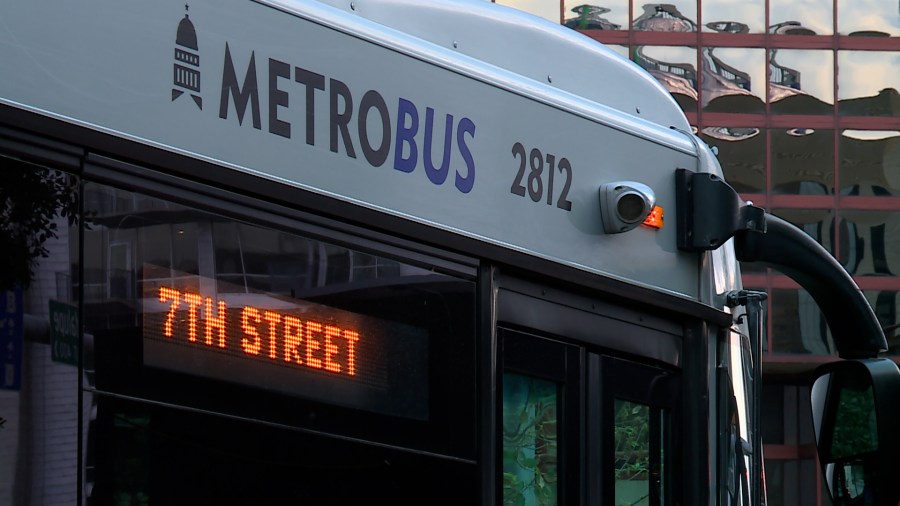
Austin bus driver accused of shutting door on person, dragging them, affidavit says
A CapMetro bus driver was arrested and charged in connection with an incident that occurred in October.
The incident involved a would-be passenger who sustained an injury after the driver closed the bus doors on his arm.
According to an arrest warrant affidavit, this action led to the passenger’s injury and subsequent legal charges against the driver.
https://www.kxan.com/news/crime/austin-bus-driver-accused-of-shutting-door-on-person-dragging-them-affidavit-says/


Pedestrian killed in Fountain Valley crash; Toyota driver arrested on suspicion of DUI, manslaughter
A pedestrian was killed in a crash involving a suspected DUI driver Monday night, Jan. 19, in Fountain Valley, police said.
Officers were dispatched around 7:30 p.m. to the intersection of Warner Avenue and Newhope Street, where they found a man who had been struck by a Toyota Camry, the Fountain Valley Police Department reported on Tuesday. The man was pronounced dead at the scene.
The pedestrian’s identity has not yet been released, pending positive identification and notification of his family.
The driver involved in the crash, identified as 47-year-old Bruce Schlusemeyer, remained at the scene and cooperated with investigators, police said.
Following a preliminary investigation, Schlusemeyer was arrested on suspicion of multiple counts, including felony driving under the influence and gross vehicular manslaughter while intoxicated.
The crash remains under investigation by the department’s Traffic Bureau, and no additional details were immediately available.
Anyone who witnessed the crash or has information is urged to contact the Fountain Valley Police Department Traffic Bureau at 714-593-4481.
https://www.ocregister.com/2026/01/20/pedestrian-killed-in-fountain-valley-crash-toyota-driver-arrested-on-suspicion-of-dui-manslaughter/
3 suspects wanted for robbing CTA Red Line passenger in Englewood, police say
Chicago Police Seek Three Suspects in CTA Red Line Robbery
CHICAGO (WLS) — Chicago police are searching for three individuals involved in a strong-arm robbery that took place on a CTA Red Line train last month.
The incident occurred on December 19 around 6:40 p.m. near West 63rd Street and South Wentworth Avenue in the Englewood neighborhood.
The suspects include two men and one woman. Authorities provided the following descriptions:
- One man was wearing a maroon sweater under a black jacket paired with white shoes.
- The second man wore a surgical mask, black jacket, and black pants.
- The woman was dressed in a black jacket, black pants, and red shoes.
Chicago Police Department has released images of the suspects and urged anyone with information to come forward.
Further details about the case are not yet available.
ABC7 Chicago is now streaming 24/7. Click here to watch.

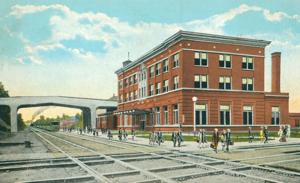
Union Depot once Bloomington’s grand gateway to world
From the mid-1800s through World War II and up until 1990, thousands of travelers passed under the iconic “Bridge of Sighs” at Bloomington’s railroad station.
This historic structure served as a vital passageway for countless individuals during a significant period in transportation history. Its presence stands as a reminder of the important role rail travel played in connecting communities and shaping the growth of Bloomington.
https://pantagraph.com/news/local/article_36776db1-8b63-48e6-90ed-aed2b931ddc9.html
Roundabouts in Keene Help Cut Emissions and Air Pollution
Despite its small stature, the city of Keene has emerged as a notable example of the safety and climate benefits that come with replacing traditional traffic lights with roundabouts.
By swapping out traffic signals for roundabouts, Keene has improved traffic flow, reduced congestion, and enhanced road safety for both drivers and pedestrians.
Additionally, the city has seen environmental advantages, including decreased vehicle emissions and lower fuel consumption, contributing positively to climate goals.
Keene’s experience demonstrates how even smaller cities can lead the way in creating safer, greener transportation systems through innovative infrastructure changes.
https://www.nytimes.com/2025/10/21/climate/roundabout-auto-emissions-new-hampshire.html