**U.S. Supreme Court Considers Kim Davis’s Challenge to Same-Sex Marriage, While Conversion Therapy Case Sparks National Debate**
The U.S. Supreme Court is set to consider whether to hear Kim Davis’s latest challenge to same-sex marriage—a case that, if accepted, could have major implications for LGBTQ rights in the United States.
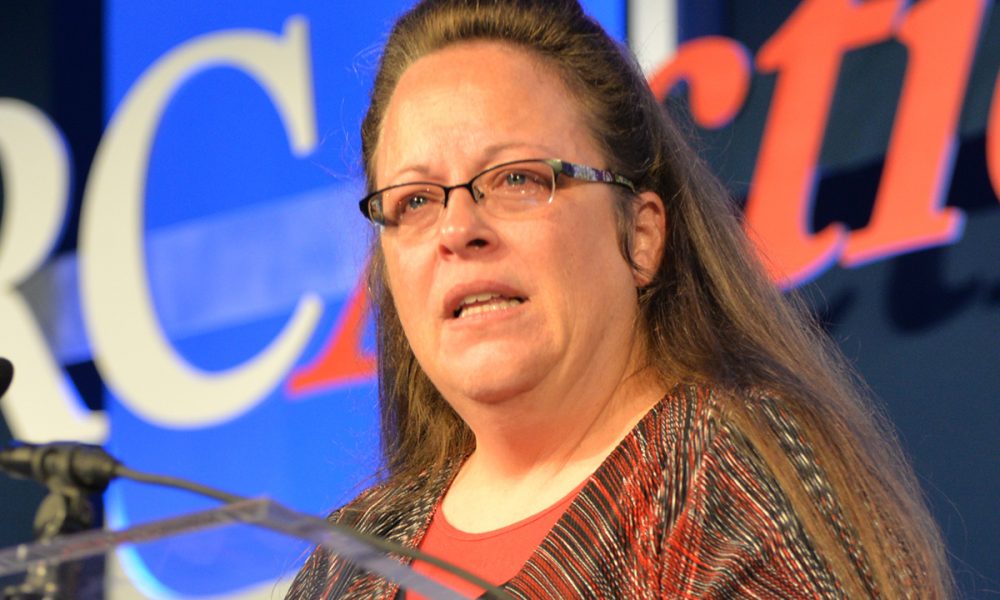
Kim Davis, the former county clerk for Rowan County, Kentucky, made national headlines in 2015 when she defied federal court orders by refusing to issue marriage licenses to same-sex couples and later, to any couples at all. Davis, a Pentecostal Christian, said that signing same-sex marriage licenses would violate her religious beliefs, claiming protection under the First Amendment.
When questioned at the time, Davis told reporters she was acting “under God’s authority” and suggested couples could obtain licenses in other counties. Her refusal came just weeks after the Supreme Court’s landmark decision in *Obergefell v. Hodges*, which guaranteed same-sex couples the constitutional right to marry under the Due Process and Equal Protection Clauses of the Fourteenth Amendment.
One of the couples who sought a license from Davis, April Miller and Karen Roberts, filed a federal lawsuit (*Miller v. Davis*) challenging her actions. Around the same time, another couple, David Moore and David Ermold, also sued after Davis again refused to issue them a license despite a court order directing her to do so.
In Kentucky, marriage licenses bore the county clerk’s name and title—something Davis argued forced her to personally endorse a practice she found morally objectionable. It wasn’t until the state legislature changed the law in 2016, removing clerks’ names from marriage licenses, that Davis and her deputies resumed issuing them.
In 2023, a federal jury awarded Moore and Ermold $50,000 each in damages for Davis’s repeated refusals. Davis appealed the decision, but the 6th U.S. Court of Appeals upheld the verdict earlier this year. The court ruled that Davis’s actions were not protected by the First Amendment because she was acting in her official capacity as a government official, not as a private citizen.
“The Bill of Rights would serve little purpose if it could be freely ignored whenever an official’s conscience so dictates,” the court wrote, emphasizing that personal religious opposition cannot be translated into public policy.
Davis has now asked the Supreme Court to take up her case. Her petition, filed in August, argues that *Obergefell* “has no basis in the Constitution” and should be reconsidered. The justices are scheduled to review her petition in a private conference on November 7, where they will decide whether to grant the case a full hearing.
Whether the court will take the case depends on whether at least four justices vote to hear it. Even if there are four votes to grant review, legal observers note that the justices would likely avoid taking up the case unless they are confident there is a fifth vote to overturn *Obergefell*.
Mathew Staver, Davis’s attorney, told *Newsweek* that *Obergefell* “has no basis in the Constitution” and could be overturned “without affecting any other cases.” Legal experts, however, see such an outcome as unlikely.
According to SCOTUSblog, while the case raises important questions about religious liberty and government authority, it centers on Davis’s personal liability rather than a direct challenge to the constitutionality of same-sex marriage itself. Still, the case has reignited debate over the balance between religious freedom and LGBTQ rights—and whether the Supreme Court’s conservative majority might be open to revisiting one of its most significant civil rights decisions of the 21st century.
—
### Conversion Therapy Case Ignites Passion as Supreme Court Hears Arguments
As the United States Supreme Court heard oral arguments in *Chiles v. Salazar* last week—a case that could overturn bans on conversion therapy in more than 20 states and the District of Columbia—a group of conversion therapy survivors gathered in Washington, D.C., to support one another and ensure their experiences are not ignored.
Members of the Conversion Therapy Survivor Network (CTSN), a nonprofit providing a safe, non-therapeutic space for survivors nationwide, began their day on the steps of the Supreme Court. The small but dedicated group of protesters held signs, waved Pride flags, and shared stories of survival. They were joined by representatives from the Born Perfect Campaign, the Human Rights Campaign, and The Trevor Project—the LGBTQ suicide prevention nonprofit that has worked to save queer lives since 1998.
The case centers on whether parents have the constitutional right to subject their children to conversion therapy under the First Amendment’s protection of religious freedom. Dozens of states have banned the practice, citing overwhelming evidence that it does not change sexuality or gender identity and often leads to long-term psychological harm.
Survivors of conversion therapy are at significantly higher risk of depression, anxiety, and suicide, according to every major U.S. medical association—including the American Psychiatric Association, the American Psychological Association, and the American Medical Association—all of which have disavowed the practice.
Kaley Chiles, a Christian therapist from Colorado, brought the case after arguing that Colorado’s 2019 law banning conversion therapy for minors violates her First Amendment rights. Chiles, who offers what she describes as “religiously informed care,” contends that the law restricts her ability to counsel clients in accordance with “biblical understandings of sexuality and gender.”
During oral arguments, the Supreme Court’s conservative majority appeared sympathetic to her claim that the law constitutes “viewpoint discrimination.” Justice Samuel Alito went so far as to say the ban represented “blatant viewpoint discrimination,” signaling that the court may be willing to expand First Amendment protections to cover conversion therapy.
For survivors gathered just blocks away, that prospect was devastating.
Following the hearing, CTSN held a vigil and celebration at As You Are, an LGBTQ bar and café in Southeast D.C. that has become a haven for the queer community. On the bar’s second floor, posters from the protest were propped against the wall—bearing messages such as “I refuse to hate myself for your comfort” and “Conversion therapy hurts kids, hurts families, hurts faith”—as two phones livestreamed survivors’ stories on TikTok.
The testimonies were both wrenching and cathartic. The group began with a moment of silence for those who did not survive their experiences with conversion therapy, setting the tone for the urgent need to end the practice.
Tears welled in the audience and among speakers as they shared how conversion therapy had scarred—and in some cases nearly destroyed—their lives.
“Since when is the freedom of religion more important than ‘do no harm?’” one survivor asked, encapsulating the frustration that ran through the room.
Curtis Lopez-Galloway, founder and president of CTSN, emphasized that the only way to end conversion therapy is through awareness. “The one way we’re going to defeat conversion therapy is by education,” he said before sharing his own story. “The more people that know about the harms, the less likely they are to take their children—or themselves—into it.”
Their commitment to breaking the cycle of harm echoed throughout the afternoon. Survivors from across the LGBTQ spectrum—gay, trans, and asexual—shared their experiences of rejection, isolation, and recovery.
Cairn, who once trained as a youth minister, recalled how their church’s teachings were weaponized against them. “We prayed for the gay to go away,” they said. “The Bible was used as a weapon to make me submissive to the normal gender roles I was destined to fill.”
They remembered being instructed on how to “walk like a lady” to suppress their masculinity. “I was advised how to walk like a lady because I have swagger. I still do,” Cairn added with a small smile, drawing laughter and applause from the crowd.
But the damage ran deep. “That year in Bible school ended my career as a youth minister—but it also ended my personal faith in God,” Cairn said. “When you are told repeatedly that you’re going to hell if you choose this lifestyle, it starts to take a toll on you.”
Years later, they found affirming pastors and began rebuilding their life. “After 35 years,” Cairn said, “I started to live my life unashamed.”
Other speakers shared stories of lives fragmented by fear.
“I lost 20 years of my life,” said Gwen Brossard, a queer and nonbinary person living in California. “It’s hard to settle with the enormity of the grief.”
“The inner conflict and continual effort of examining my attractions while trying to counter them left me emotionally and physically exhausted,” she said. “The therapy radically altered the trajectory of my life. I felt adrift, severed from my previous sense of meaning and belonging.”
For Al Linkskoog, a gay man who subjected himself to the practice due to the insurmountable pressure he felt from societal rejection, conversion therapy’s toll was both spiritual and psychological. “They told me I was broken,” he said. “It’s an interesting, although bogus, way of trying to solve a problem—decide what the problem is before even meeting the person.”
“Being called broken is a dismal diagnosis. It means you’re already in pieces,” he continued. “Every prayer, every determination to change—nothing changed. All the years of trying to change were unnecessary. I was perfectly fine as I was.”
Years later, he said, he finally found peace. “No more need for closets. I have full run of the mansion. So now I can truly say: I am not broken.”
Sarah, who identifies as asexual, reminded the audience that conversion therapy does not only target gay and trans people. “Asexuality is sometimes called the invisible sexuality,” she said. “Many ace folks encounter professionals who believe their lack of attraction is a problem to fix instead of a neutral fact of their identity.”
She challenged assumptions about what love and intimacy should look like. “Our existence doesn’t just challenge compulsory heterosexuality—it questions compulsive sexuality,” Sarah said. “We are here. We are queer. We aren’t going anywhere. We don’t need to be fixed—only to love the way we love and be loved for who we are.”
One of the most harrowing stories of the night was from Caleb Bailar, a transgender man from England who was not in attendance but whose story was read by Samuel Nieves, board director for CTSN.
“My phone was taken away, my messages read daily. I was told I was being misled and was too young to know what I wanted from life,” he recalled.
He described a form of punishment his mother practiced called “kid hell”—a conversion therapy method derived from a manual circulated among anti-trans groups.
“My kid hell was to have no time truly alone,” he said. “I could not use the phone, computer, or journal in private. Whenever I would hyperventilate and scream and beg for it to be over, my mom would hold me and tell me this was for my own good.”
“Every time I expressed myself or was interpreted correctly, I would flinch and brace for punishment,” Nieves read. “Once, she threatened to unalive herself if I got a mastectomy. I found out my experience could be considered conversion torture—the horror I had endured was a map. I can joke about it now,” he added quietly. “The pain is real, but so is the healing,” said one organizer after the stories were shared. “We can’t let the Court forget that.”
For those in attendance, the message was clear: Their survival is their protest.
—
### Supreme Court Hears *Chiles v. Salazar* Case on Conversion Therapy Ban
The Supreme Court heard arguments on Tuesday in the case of *Chiles v. Salazar*, which could reverse conversion therapy bans across the United States. Kaley Chiles, a Christian therapist from Colorado, works as a counselor specializing in serving clients who often seek “religiously informed care” that aligns with traditional biblical understandings of sexuality and gender.
She has argued that a 2019 Colorado law, HB19-1129—also known as the “Prohibit Conversion Therapy for a Minor Act”—violates her First Amendment rights. The act serves as a regulatory law in the state and was put in place to prevent potential harm that numerous studies by health associations across the country have shown this particular form of “therapy” can cause.
From an increased risk of suicide to being comparable to torture by the United Nations, 23 other states, as well as the District of Columbia and Puerto Rico, have passed laws restricting the practice.
Chiles brought forward a pre-enforcement lawsuit against the state, arguing that the law has caused a chilling effect on her ability to provide her “faith-informed” services to clients with religious preferences—often religious parents—and has made her stop any discussions that could be related to sexuality or gender identity. She argues this violates her right to the Free Speech Clause of the First Amendment.
A majority of the justices appeared sympathetic to Chiles’s argument that the conversion therapy ban limits her religious rights on the basis of viewpoint, indicating it may infringe on free speech. Justice Samuel Alito went as far as to say that the law was “blatant viewpoint discrimination.”
Other members of the Court, however, raised questions regarding Chiles’s standing, or the right to challenge the law, as the ban was not explicitly enforced, nor was Chiles charged with anything.
Justice Sonia Sotomayor noted the lack of enforcement undermines the idea of an “imminent threat,” while Justice Ketanji Brown Jackson suggested the law’s regulation of professional conduct falls within a state’s traditional authority to oversee medical practices.
Several justices, notably Amy Coney Barrett, seemed to think this case should be sent back down to a lower court for further examination under a stricter constitutional standard.
Justice Elena Kagan pressed the need for scientific evidence, saying, “You need to have studies, not just intuitions that harm exists. You need a scientific showing of causation rather than rely on your intuitions that this causes harm.”
Justice Brown Jackson expressed skepticism over the First Amendment framing, noting the similarity between Chiles and other medical professionals with the same goals but different methods.
Justice Alito raised concerns about politicization within medicine, asking, “Have there been times when the medical consensus has been politicized, has been taken over by ideology?”
Justice Coney Barrett questioned how far a state’s authority should go in cases of medical disagreement, asking whether states can pick sides when there are competing medical views.
James A. Campbell, who represented Chiles, argued that not only is Chiles’s speech being censored, but by not allowing her to provide this type of “therapy,” the government is causing harm to families seeking such treatment.
“There is irreparable harm going on right now. Ms. Chiles is being silenced. The kids and the families who want help are being left without any support,” Campbell told the justices. “This is an ongoing active dialogue where she’s helping them to explore their goals, and that absolutely has to be protected by the First Amendment.”
Shannon W. Stevenson, Colorado Solicitor General, argued on behalf of the state that an overwhelming amount of medical advice cites this type of “therapy” as harmful and that medical restrictions do not allow doctors to give patients incorrect information just because it goes against their religious beliefs.
“The medical consensus has been around for a very long time. Those types of statutes govern medical professionals, and no one has ever suggested that a doctor has a First Amendment defense to say the wrong advice to their patient,” Stevenson said. “The harms from conversion therapy come from when you tell a young person they can change this innate thing about themselves. They try and fail, and then they have shame and they’re miserable.”
Kelley Robinson, president of the Human Rights Campaign—America’s largest LGBTQ civil rights organization—issued a statement following the court’s arguments:
“Today’s oral arguments made clear that, as Colorado’s solicitor general stated, history, precedent, and commonsense must allow states to hold licensed providers accountable to the recommendations of every mainstream medical and mental health association in this country. The Supreme Court must uphold the constitutionality of these legal restrictions and stand strongly between our children and these abusive practices.”
While it may be months before a decision on this case is brought forward, the ruling—expected by summer—could have sweeping implications for whether states are allowed to regulate conversion therapy as a form of medical treatment, or if they infringe on First Amendment rights.
—
*The outcomes of these cases will have profound effects on the legal landscape surrounding LGBTQ rights, religious freedom, and the regulation of medical and psychological practices in the United States.*
https://www.washingtonblade.com/2025/10/24/kim-davis-seeks-supreme-court-review-in-challenge-to-marriage-equality/?utm_source=rss&utm_medium=rss&utm_campaign=kim-davis-seeks-supreme-court-review-in-challenge-to-marriage-equality