

Market News and Data brought to you by Benzinga APIs © 2026 Benzinga. com. Benzinga does not provide investment advice.
https://www.benzinga.com/insights/news/26/04/51616306/heres-how-much-100-invested-in-conocophillips-5-years-ago-would-be-worth-today


Trump to give “important update on Iran” in national address
President Trump is set to give an update on the war in Iran on Wednesday evening in a prime-time address to the nation. CBS News’ Ed O’Keefe previews the speech.
https://www.cbsnews.com/video/trump-update-iran-national-address/

If You Invested $1000 In Sherwin-Williams Stock 15 Years Ago, You Would Have This Much Today
Market News and Data brought to you by Benzinga APIs © 2026 Benzinga. com. Benzinga does not provide investment advice.
https://www.benzinga.com/insights/news/26/03/51588455/if-you-invested-1000-in-sherwin-williams-stock-15-years-ago-you-would-have-this-much-today

Toddler born with rare defect gets lifesaving heart transplant
Born with a rare heart defect, Wyatt Lopez was about a year old when he checked into the hospital. It took almost a whole year before he checked back out — with a tuxedo, a little parade and a brand new heart. Tony Dokoupil has the story.
https://www.cbsnews.com/video/toddler-born-with-rare-defect-gets-lifesaving-heart-transplant/
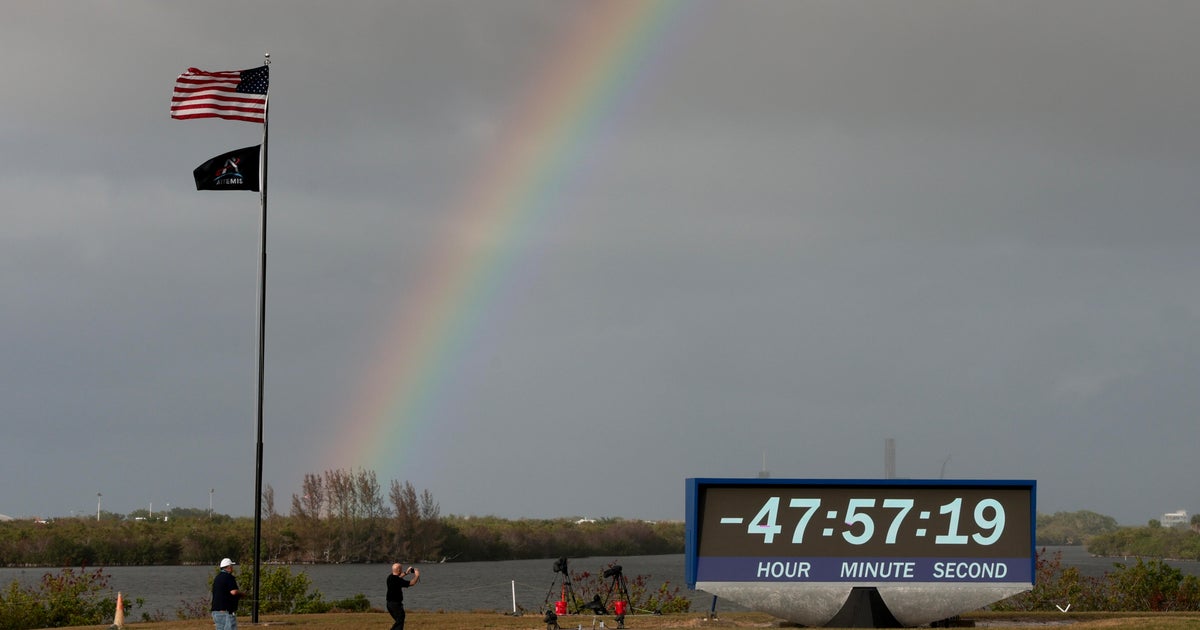
Countdown begins for long-awaited Artemis II moon mission
For the first time in half a century, countdown clocks began ticking Monday toward launch of a three-man one-woman crew on a trip to the moon and back, a major step in NASA’s accelerated drive to establish a lunar beachhead with landings in 2028, followed by construction of a moon base. With forecasters continuing to predict an 80% chance of favorable weather, Artemis II commander Reid Wiseman, Victor Glover, Christina Koch and Canadian astronaut Jeremy Hansen hope to strap into their Orion capsule and blast off atop a giant Space Launch System rocket at 6: 24 p. m. EDT Wednesday. “We just wrapped up our L(aunch)-minus two (day) mission management team review and the team polled go to proceed towards the planned April 1 launch attempt,” said Amit Kshatriya, the NASA associate administrator. The review included “the usual readiness items vehicle status, ground systems, flight hardware and the integrated launch operations timeline,” Kshatriya said. “We also reviewed the most recent engineering assessments (and) the team concluded that everything continues to look good, and there are no issues preventing us from pressing ahead.” Assuming an on-time liftoff, the crew will pass behind the moon next Monday, sailing 4, 100 miles above the lunar far side before heading back to Earth for a Pacific Ocean splashdown on the southern California coast on April 10. Mission duration: nine days and one hour, covering nearly 700, 000 miles. Countdown clocks began ticking at 4: 44 p. m. EDT Monday. Engineers planned to spend the initial hours of the carefully orchestrated procedure readying the SLS rocket and ground systems for propellant loading and powering up the crew’s Orion capsule. The astronauts, meanwhile, planned to enjoy dinner with family members at the nearby Cape Canaveral Space Force Station. On Tuesday, the launch team will continue power-up and checkout operations, testing communications circuits and loading “late stow” experiment packages. Early Wednesday, cockpit switches will be configured for launch, star trackers and navigation gear will be powered on and Launch Director Charlie Blackwell-Thompson will poll her launch team to make sure they’re “go” for propellant loading, scheduled to begin at 7: 44 a. m. The core stage of the SLS rocket will be filled with 537, 000 gallons of supercold liquid hydrogen fuel and 196, 000 gallons of liquid oxygen. The rocket’s upper stage, the Interim Cryogenic Propulsion Stage, or ICPS, will be loaded with another 24, 000 gallons of liquid hydrogen and oxygen. The process will take about five-and-a-half hours to complete. While fuel loading is underway, Wiseman and his crewmates will be awakened and given a weather briefing before donning their pressure suits and heading for launch pad 39B to strap in aboard the Orion capsule shortly before 2: 30 p. m. With the countdown in a final 30-minute built-in hold at the T-minus 10-minute mark, Blackwell-Thompson will poll the launch team again before giving permission to resume the countdown. When the hold ends at 6: 14 p. m., the ground launch sequencer computer will take over the countdown, the launch pad’s crew access arm will be retracted and auxiliary power units will spin up to provide hydraulic power. The four main engines at the base of the SLS core stage will begin igniting six seconds before liftoff. After a lightning round of computer checks to verify the engines are running normally, commands will be sent to fire the rocket’s two strap-on solid-fuel boosters. As the boosters roar to life, explosive bolts at the base of each booster will shatter, and the SLS rocket will begin climbing away atop 8. 8 million pounds of thrust. At that point, flight controllers at the Johnson Space Center in Houston will take over from the launch team, monitoring ascent telemetry, providing guidance to the astronauts and managing a complex flight plan. NASA’s first crewed moonshot in more than half a century will finally be underway. “It is an exciting time,” said Blackwell-Thompson. “It’s an exciting time for this team and our crew and really our nation and the world. We’ll fly when this hardware is ready, and we’ll see if it’s ready to go in just a couple of days. But certainly, all indications are right now we are in excellent, excellent shape.”.
https://www.cbsnews.com/news/countdown-underway-artemis-ii-moon-mission/

UConn buzzer beater turns near blowout into unforgettable March Madness wing
UConn downed Duke with a last-second 3-pointer to join Illinois, Arizona and Michigan in the Final Four. Tony Dokoupil has more.
https://www.cbsnews.com/video/uconn-buzzer-beater-turns-near-blowout-into-unforgettable-march-madness-wing/

Vietnam’s Son Doong cave is big enough for a skyscraper to fit inside | 60 Minutes
Son Doong, the world’s largest cave passage big enough to fit a skyscraper is deep inside a Vietnamese jungle. Exploring the dark caverns, home to beautiful rock formations and a river, takes days.
https://www.cbsnews.com/video/vietnam-cave-son-doong-60-minutes-video-2026-03-29/


TSA pay may be coming, but airport delays could persist and ICE agents may not leave soon
Even after President Donald Trump ordered emergency pay for Transportation Security Administration agents to ease long security lines, major U. S. airports on Sunday were still urging travelers to arrive hours early and federal immigration officers brought in to help may not be leaving anytime soon. Trump’s executive order on Friday instructed the Department of Homeland Security to pay TSA officers immediately, though it’s unclear how quickly travelers will see an impact. The move comes during a busy travel stretch, with spring breaks underway and Passover and Easter approaching. Tens of thousands of TSA employees have been working without pay since DHS funding lapsed on Valentine’s Day. The department’s shutdown reached 44 days on Sunday, eclipsing the record 43-day shutdown last fall that affected all of the federal government. Trump deployed Immigration and Customs Enforcement agents to some airports a week ago to help with security as TSA callouts rose nationwide the same officers who may now remain in place if TSA staffing strains continue. Making the rounds on Sunday morning news shows, White House border czar Tom Homan said it depends on how many TSA employees would be returning to work after they start receiving their pay. “ICE is there to help our brothers and sisters in TSA. We’ll be there as long as they need us, until they get back to normal operations and feel like those airports are secure,” he told CBS’ “Face the Nation.” Speaking on CNN’s “State of the Union,” Homan said it also depends on how many TSA agents “have actually quit and have no plan on coming back to work.” Nearly 500 TSA officers have left the agency since the shutdown started, according to DHS. On Saturday night, Maryland Gov. Wes Moore said in a post on X that more ICE agents were being deployed to Baltimore-Washington International Airport to assist at TSA security checkpoints to “speed up the clearance process for passengers not immigration enforcement.” Homan, in his CNN interview, said he hopes TSA officers will be paid by Monday or Tuesday. “It’s good news because these TSA officers are struggling,” Homan said. “They can’t feed their families or pay their rent.” Also on Sunday, Charlotte Douglas International Airport said in a post on X that backpay could arrive for TSA agents beginning Monday. “While this action provides critical relief, CLT supports long-term solutions to ensure continued stability for this essential workforce,” the airport said. Johnny Jones, secretary-treasurer of the American Federation of Government Employees’ TSA chapter, said Sunday that he has heard from workers worried they may not receive their full back pay because TSA management was given very short notice to begin processing payments. He also said TSA agents are concerned they could miss pay for time they were unable to work because they couldn’t afford to report for duty. “It is a disaster in progress,” Jones said. Some of the busiest U. S. airports continued to ask travelers to plan ahead in order to get through security lines. Houston’s main airport, George Bush Intercontinental, warned Sunday evening that TSA wait times could reach four hours or longer. Atlanta’s Hartsfield-Jackson International Airport also told passengers to arrive at least four hours early for both domestic and international flights. LaGuardia Airport posted an alert Sunday evening on its website that “TSA lines are currently longer than usual.” Baltimore-Washington International Airport said Sunday on X that “wait times have greatly subsided on this Spring Break Sunday,” but it still asked passengers to show up several hours early. Louis Armstrong International Airport in New Orleans offered the same guidance. Also on Sunday, passengers could once again see estimated security wait times at the three main airports serving the New York City area LaGuardia, John F. Kennedy and Newark Liberty. All three had removed that feature from their websites earlier in the week, citing “rapid” changes in passenger volumes and TSA staffing. For the same reason, they cautioned that the restored wait times my not always “reflect current conditions”. It’s hard to tell. Caleb Harmon-Marshall, a former TSA officer who runs a travel newsletter called Gate Access, said the staffing crisis won’t improve significantly until officers are confident that they won’t be subjected to more skipped paychecks. “It has to be an extended pay for them to come back or want to stay there,” he said, estimating longer lines could linger for another week or two. Jones, the TSA union leader, offered a more optimistic outlook on Sunday, saying he’s hopeful that passengers could see wait times ease closer to typical levels once workers are able to afford basic expenses like gas to get to work. TSA will also have to decide whether to reopen the checkpoints and security lanes they closed or consolidated at some airports due to inadequate staffing, which led to passengers standing in screening lines that clogged check-in areas or showing up far too early for their flights. A handful of airports have experienced daily TSA officer call-out rates of 40% or higher in recent weeks. ___ Sedensky reported from New York, Yamat from Las Vegas and Raby from Charleston, West Virginia. Associated Press journalist Julie Walker contributed from New York.
https://abcnews.com/US/wireStory/tsa-pay-coming-airport-delays-persist-ice-agents-131505155
In Syria, an argument between two men in a Christian town erupts into sectarian violence
An argument between two men in a Christian town in central Syria erupted into sectarian attacks that caused widespread damage to homes, shops and cars in a reminder of religious violence that followed the fall of longtime leader Bashar Assad in 2024. The attacks in the predominantly Christian town of Suqaylabiyah in Hama province are the latest to target members of Syria’s Christian minority, many of whom have left the country since the conflict began 15 years ago, leaving half a million people dead and the population deeply divided. There was no immediate word on casualties in the attacks that lasted until the early hours Saturday, during which scores of men on motorcycles from the nearby Sunni Muslim town of Qalaat al-Madiq attacked the property of Christians. “We passed through a state of terror, fear and panic,” said Liyan Dweir, whose clothes shop was riddled with bullets and suffered heavy damage. His children were terrified during the hours-long assault, he said. Dweir said an argument between a resident of Suqaylabiyah and another from Qalaat al-Madiq led to scores of men from the Sunni town storming the area and attacking shops, homes and cars. “It is unfair that because of an argument two towns clashed,” he said. Another Suqaylabiyah resident, Nafeh al-Nader, said young men broke the gate of his house and kicked a diesel heater, setting a room on fire. They tried to set another room on fire but were unsuccessful after a neighbor rushed for help and was hit with a stick by one of the attackers. Government forces brought reinforcements into Suqaylabiyah, quelling the violence. Hundreds of residents marched through the streets Saturday demanding accountability and declaring a strike until the perpetrators were punished. Since the fall of Assad in December 2024, members of the country’s Alawite, Druze and Christian minorities have been subjected to attacks by gunmen loyal to the country’s new Islamist rulers. Hundreds of people have been killed, including Alawites in Syria’s coastal region in March last year and Druze in the southern province of Sweida in July. The government of Syria’s interim president, Ahmad al-Sharaa, has condemned attacks on minorities, but many accuse it of looking the other way or being unable to control the armed groups it is trying to absorb. During Syria’s civil war that began in 2011, Suqaylabiyah was held by forces loyal to Assad while Qalaat al-Madiq was held by insurgent groups that eventually overthrew the Assad family’s 54-year rule. Anger has been on the rise among many Syrians after the country’s authorities banned the consumption of alcohol in the capital of Damascus. The ban affects Christian neighborhoods in Damascus that are famous for their restaurants and pubs. Christians made up about 10% of Syria’s prewar population of 23 million. They enjoyed freedom of worship under the Assad government and held some high government posts. Initially, many Christians were willing to give the new authorities a chance, but the situation worsened in June after a suicide bombing in a church outside Damascus killed 25 people and wounded dozens.
https://www.latimes.com/world-nation/story/2026-03-28/in-syria-dispute-between-two-men-in-christian-town-erupts-into-violence

Actor James Tolkan of ‘Top Gun’ and ‘Back to the Future’ fame dies at 94
James Tolkan, known for his roles as authoritarian figures in the “Back to the Future” and “Top Gun” films, has died. He was 94. Tolkan died Thursday in Lake Placid, New York, where he lived, his booking agent, John Alcantar, said Saturday. A brief obituary published on the “Back to the Future” website said Tolkan died “peacefully,” but no cause of death was given. In “Back to the Future,” Tolkan portrayed the bow tie-wearing vice principal Gerald Strickland, who eyeballed students for trouble in the halls of the fictitious Hill Valley High School in particular Marty McFly, played by Michael J. Fox. “You got a real attitude problem, McFly,” Tolkan’s character says in the 1985 film. “You’re a slacker. You remind me of your father when he went here. He was a slacker, too.” Tolkan also appeared in “Top Gun” as commanding officer Tom “Stinger” Jardian. Near the end of the film, when Jardian asks Tom Cruise’s character, Capt. Pete “Maverick” Mitchell, about his choice for future duty, Mitchell replies that he wants to be a Top Gun instructor. “God help us,” Tolkan’s character replies, laughing. Born in Calumet, Michigan, Tolkan served in the Navy during the Korean War and eventually made his way to New York, where he spent a quarter century acting in theater roles. He was a member of the original ensemble cast of “Glengarry Glen Ross.” Tolkan is survived by his wife of 54 years, Parmelee Welles.
https://abcnews.com/Entertainment/wireStory/actor-james-tolkan-top-gun-back-future-fame-131510749