CHICAGO (WLS) — The recent murder of a Loyola college student has created a new friction point between federal officials and states, like Illinois, with sanctuary policies after the Department of Homeland Security revealed the alleged gunmen was in the country illegally with a previous warrant for his arrest. College freshman Sheridan Gorman, 18, was killed last Thursday when she and a group of friends walked to the pier at Tobey Prinz Beach, hoping to catch a glimpse of the Northern Lights, the family’s attorney said. ABC7 Chicago is now streaming 24/7. Click here to watch But the night took a tragic turn when prosecutor say 25-year-old Jose Medina of Venezuela fired a gunshot at Gorman, killing her. Chicago police arrested Medina the day after on charges, including a first-degree murder charge, after utilizing facial recognition software to compare images from surveillance footage to U. S. Customs and Border Protection records. In an arrest report, CPD investigators said the images matched Medina. Court records show an arrest warrant was issued for Medina in 2023 after he stopped appearing in court on shoplifting charges. Federal officials say Medina is an undocumented Venezuelan national, and that he should have never been released after that 2023 arrest. Over the weekend, DHS officials announced Immigration and Customs Enforcement (ICE) has “lodged an arrest detainer” asking state officials to not release Medina. SEE ALSO | Prosecutors reveal new details about Loyola student’s killing, suspect’s criminal history President Donald Trump remarked on the killing, calling it “devastating. These people were let in by [ President ] Biden,” President Trump said. “We’re getting them out; we’re getting them out fast. That’s why ICE is so important. They’re doing such a good job.” ABC7 Chief Legal Analyst Gil Soffer says the debate over the Illinois TRUST Act, which prohibits state and local law enforcement from cooperating with federal immigration officials, creates yet another flash point between federal immigration goals and the state’s welcoming policy towards migrants. “It wouldn’t make sense for the feds to insist on a handover from the state for deportation purposes,” Soffer said. “Now, if he committed murder, there’s a very strong interest on the part of the state, and you would think on the part of the feds, to see that he’s prosecuted here.” State law prohibits county jails from honoring immigration detainers, or requests by immigration officials to be notified if an undocumented person is being released from state custody. Soffer telling the I-Team despite the Department of Homeland Security’s outcry, and calls from Gorman’s parents to keep Medina in custody, that’s very likely where he will stay given the state murder charge changes everything. “He will almost certainly be detained on those state charges, regardless of what ICE intends to do or not intends to do,” Soffer said. “They can’t honor the detainer if that’s all that there is to keep this guy in custody. But that’s not all that there is to keep him in custody, there’s a murder charge to keep him in custody.” Soffer underscoring it is likely Medina will face deportation proceedings, but at the end of a very long legal process as the murder and other serious charges against him play out in court. Prosecutors revealed on Monday Medina is currently detained at Illinois Masonic Medical Center undergoing treatment for tuberculosis. A Monday detention hearing was continued to Friday, March 27.
https://abc7chicago.com/post/case-sheridan-gorman-suspect-jose-medinas-alleged-immigration-status-creates-new-friction-point-sanctuary-state-policies/18758092/

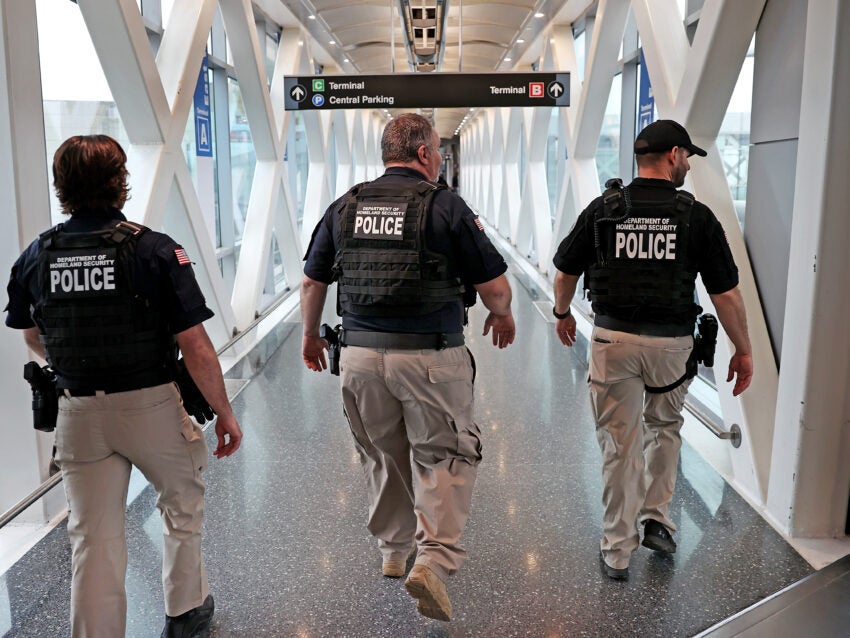
No ICE agents at Logan Airport yet as agents deploy to busy airports
No ICE agents took up Transportation Security Administration roles at Logan Airport in Boston Monday as President Donald Trump orders federal immigration agents to beleaguered airports, the local union said. ICE agents were not deployed to any New England airport, according to Mike Gayzagian, the president of AFGE Local 2617, the New England branch of the TSA officers’ union. Agents could come next week, but those rumors are unsubstantiated, Gayzagian said. A group of DHS officers were seen at Logan Monday and indicated to The Boston Globe they were part of a “Visible Intermodal Prevention and Response” operation, a TSA specialized security team that has been in operation for years, the paper reported. As the partial government shutdown continues into its second month, funding for DHS, including U. S. Immigration and Customs Enforcement, is at the center of the shutdown. Trump said Sunday he would send ICE agents to airports starting Monday. Massport confirmed ICE agents were not deployed at Logan International Airport, but deferred to the TSA. Speaking for TSA, DHS declined to say if agents were deployed to New England airports, citing “operational security reasons.” ICE agents were deployed to 14 airports, CNN reported, where airport wait times were reaching multiple hours. Logan Airport, where the majority of TSA agents have stayed at work, has so far avoided the delays plaguing other major hubs. Here are the airports, per CNN, where ICE agents were deployed, where Trump promised they would arrest “all Illegal Immigrants.“.
https://www.boston.com/news/local-news/2026/03/23/no-ice-agents-at-logan-airport-yet-as-agents-deploy-to-busy-airports/

Pedestrian killed in Roxbury hit-and-run
The victim was pronounced dead at a local hospital, police said. A pedestrian was killed in a hit-and-run Friday morning in Roxbury, Boston police said. At 11: 34 a. m. Friday, police responded to the scene of a car crash involving a hit pedestrian near Southampton Street and Bradston street, the Boston Police Department said in an emailed statement to Boston. com. The pedestrian was taken to a nearby hospital and pronounced dead, BPD said. The driver in the crash fled the scene, the vehicle involved was later found, BPD said. There have been no arrests made, and the investigation is still ongoing, BPD said.
https://www.boston.com/news/local-news/2026/03/22/pedestrian-killed-in-roxbury-hit-and-run/


Trump says U.S. shipbuilding is in a crisis as it lags far behind China
The war in Iran is highlighting the importance of ships not just warships but cargo vessels like those carrying oil or gas trapped near the Strait of Hormuz. But American shipbuilding is in shambles, due to decades of shortsighted policies and neglect. Our submarine building program is sluggish. And our commercial shipbuilding is nearly extinct. China makes roughly 1, 000 cargo ships a year. The U. S.? Maybe three. The Trump administration has called this a national security crisis. But can this ship be turned around? This is the Philadelphia shipyard, one of only two left in the U. S. building large commercial cargo ships. Once a symbol of American might and innovation, ships built here helped win our independence in the 18th century, and World War II in the 20th. This shipyard has become a symbol of American industrial decline, a money loser falling decades behind our global rivals. And it still uses a crane from 1942! Lesley Stahl: Now, talk about a metaphor of how far behind we are. David Kim: Lotta times people’ll call it a dinosaur. Lesley Stahl: What else is a dinosaur? David Kim: Almost everything that you’ve seen out there. David Kim, the new head of the Philly shipyard, showed us around. He works for Hanwha, a giant shipmaker from South Korea, the country making most ships after China. Hanwha bought the yard in 2024 for $100 million, then poured in another $100 million and tasked Kim, a Korean-American born and bred in Texas, to bring it into the 21st century. Lesley Stahl: How many ships do you actually make here? David Kim: Here at the Hanwha Philly Shipyard we deliver one to one-and-a-half ships a year versus our yard in Korea where they deliver basically one a week. Lesley Stahl: What? One a year for delivery versus one a week? David Kim: That’s correct. Not building ships in the U. S. is considered a national security threat because if there’s a conflict with China, for instance, Beijing could weaponize its substantial merchant fleet and cut us off from global goods. Hanwha plans to spend $5 billion in Philly and has already sent 50 trainers from Korea to teach American workers. David Kim: Our aspiration is to get to up to 20 ships a year here at the shipyard. Lesley Stahl: So we come back in two years. How different will it look? David Kim: You’ll see robots. You will see automation equipment. And we’re looking to grow the workforce by, call it, 7, 000 to 10, 000 people. Sounds great, only there’s a huge shortage in the U. S. of skilled labor in ship-building, including welders and pipe-fitters. This work is grueling: freezing in winter, scorching in summer, and it’s dangerous. And while the yard has a training program, it can only train 20 or so new hires at a time and it takes three years! Still, apprentices Justin, Jeff, and Meg, told us this beats their old jobs. Justin: I worked at Amazon as a grocery picker. Meg: Before this job I was a cake decorator at a bakery. Lesley Stahl: And a nanny. Meg: And a nanny as well. Yes. I worked many jobs. Lesley Stahl: If you were to pitch this job and this place to a friend, what would you say? Meg: I would tell my friend that instead of paying out of pocket to go to a trade school, you’re getting paid while you learn here the entire time. Lesley Stahl: They pay you? Meg: Yes. Lesley Stahl: And health care? Meg: And health care, which is amazing. Lesley Stahl: But aren’t the conditions really harsh? Jeff: Not the easiest work. Like, I go home, granted, I’m more tired but it’s more fulfillin’ to me. Makes you feel like you’re somethin’, part of somethin’ bigger. But not only are workers scarce and the yard outdated, the Philly shipyard has to bring key components to the U. S., such as propellers, and even the engine. So ships that take six months to build in Korea or China can take twice as long here, and cost five times as much! And who will buy them? Michael Coulter: There’s no doubt that we have challenges and headwinds, but I also think we have a unique moment in time. Michael Coulter, who’s Hanwha’s top executive in charge of U. S. operations, says the way to lower prices is scale up production. Lesley Stahl: So you’re saying if we build more ships, then the cost per ship will come down. Michael Coulter: Significantly. Lesley Stahl: It’s so busy here! Michael Coulter: It is busy. He took us to Hanwha’s shipyard in Korea, where nine ships are being built at once, four in a row, like Lego sets the size of football fields. Steel chunks bigger than buildings hover over the ground. They’re lifted above the water, or they just glide by. He showed us how far ahead they are technologically: rows and rows of robots! But even with all the automation, the human workforce keeps growing. There are over 26, 000 workers on site, many getting around on low tech because this place is so vast. And the yard keeps hiring, training 400 workers at once way more than the 20 in Philly! And they’re taught using cutting-edge virtual reality! He’s learning to paint. It’s a dance of tech, cranes, trucks, and bikes. And this yard also builds military vessels, including submarines, which the U. S. desperately needs, since our fleet is aging and we can barely make new ones. Michael Coulter: From a Hanwha perspective, we build great submarines. Lesley Stahl: Here, in Korea. Michael Coulter: Here, in Korea, yes. We have told the U. S. government that if they so wish, we will build submarines for them in the United States, and in Philadelphia, just like we do in Korea. Send a secure tip to 60 Minutes: Here’s how to confidentially share information with our journalists Lesley Stahl: Is the ultimate goal for your company to build nuclear submarines for the U. S. Navy? Michael Coulter: The submarine program in the United States is heading in the wrong direction, and we think we can help. Another way Hanwha says it wants to help the U. S. is with transporting liquified natural gas, or LNG, hoping to build these giant LNG tankers in Philly. Lesley Stahl: The United States is the largest producer of natural gas. And yet, we don’t have any LNG ships that we make ourselves. Is that correct? Michael Coulter: That’s correct. Not a single one. This leads to an absurd situation: while we export LNG on foreign carriers to over 30 countries Colin Grabow: One country we don’t send it to is other parts of the United States. Colin Grabow, a trade expert at the libertarian CATO Institute, explains that a century-old law called the Jones Act requires that any cargo shipped between U. S. ports say from Baltimore to Boston, or Seattle to Juneau that cargo has to be on an American-made ship. So if the cargo is LNG, it has to be on an American made LNG ship. Lesley Stahl: But we don’t build any. Colin Grabow: That’s right. There aren’t any. Lesley Stahl: Oh, my god. Colin Grabow: And you might think, “Well, seems like an easy problem to solve. Go build the ship, transport the gas,” except the math doesn’t work. If you want to build one of those ships in Asia, the cost is around $260 million; here in the United States? About $1 billion! Lesley Stahl: Well, wait. Are there parts of this country that cannot get natural gas because of this law? Colin Grabow: That’s right, New England. In winters, New England has to import pricier natural gas from abroad, even though it’s extracted only a few states away. Colin Grabow: In fact, Puerto Rico imported Russian natural gas the same month as Russia invaded Ukraine. Lesley Stahl: No. (GASP) Colin Grabow: So we take a stance against Russia. On the other hand, we’re importing their energy, something that we have in abundance. You can’t make this stuff up. Last year, President Trump made solving our ship crisis a national priority, signing an executive order creating a multi-agency action plan and a White House office of shipbuilding. President Trump (4/9/25, signing executive order).: “We’re way, way, way behind. We used to build a ship a day and now we don’t do a ship a year, practically.” But the White House has conflicting priorities. Lesley Stahl: So here’s the administration. It wants to build ships and they’re putting huge tariffs– 50% on steel, which is the main component in a ship. What’s wrong with that picture? Colin Grabow: Yes. This is one of the paradoxes of the Trump administration. We’re artificially increasing the cost of building ships in this country! Lesley Stahl: So why can’t shipbuilders just use American made steel? There’s no tariffs on those. Colin Grabow: That’s true. But when we put heavy tariffs on imported steel, we drive those costs up, that’s a great opportunity for Americans to raise their own price. What we know is today, American steel is roughly twice as expensive as steel in, say, China. Lesley Stahl: What you’re saying is when the price of steel goes up because of tariffs, then the American steel manufacturer hikes the price of steel? Colin Grabow: These are profit oriented enterprises. He actually thinks we should be able to just buy and use ships from our ally, South Korea, not build them. And he points to another conflicting White House priority: making it harder to grant skilled immigrants work visas. Colin Grabow: Traditionally, a lot of immigrants have been willing to do this kind of work. And yet, we are turning our back on immigration and adopting a more hostile stance. Lesley Stahl: The administration seems to be fighting its own policy. Colin Grabow: Yes. It didn’t help when last September, ICE raided a Korean battery plant in Georgia, alleging visa violations. Agents dragged off 300 Korean technicians and engineers in cuffs and chains, despite their coming here to train American workers. Hanwha’s Michael Coulter says this caused a backlash in Korea. Lesley Stahl: Have you been assured that what happened in Georgia will not happen in Philadelphia? Michael Coulter: We’ve been assured that our visas are the right visas and our team is not going to be impacted. The White House is committed to making ships here. So last year, when President Trump threatened to put tariffs on Korean imports, Korea’s president offered instead to invest $150 billion to revive the U. S. shipbuilding industry, promising Philly is just the start. Michael Coulter: There’s a recognition that the United States has a problem that Korea may be uniquely positioned to help. Lesley Stahl: That’s like aid for the United States. Wow. Wouldn’t it be more profitable and wiser if the United States just bought the ships from Korea? Michael Coulter: That doesn’t solve the problem. At the end of the day, shipbuilding is a national security necessity. The U. S. needs to be able to secure our own commerce. We need to be able to export our own energy. Lesley Stahl: The idea that we now rely on Korean expertise to help us build an industry that we need for national security reasons. Should we be ashamed of ourselves? Should we feel weak? Michael Coulter: I don’t think we should be fearful or feel weak. We are in a shipbuilding crisis in the United States, and every American should be aware of that. But that doesn’t mean that it’s not solvable. We once deployed ships to save South Korea. Now we’ve been forced to turn to South Korea to save us. In a statement to 60 Minutes, the White House said, quote: “no president has done more to bolster American maritime power.” This past week, with gas prices soaring, the president suspended the Jones Act for 60 days, to ease the transport of oil and gas within the U. S.. Produced by Shachar Bar-On and Jinsol Jung. Broadcast associate, Aria Een. Edited by Matthew Lev.
https://www.cbsnews.com/news/us-ship-building-lags-behind-china-south-korea-trump-makes-it-priority-60-minutes-transcript/


Ross Gerber Warns Inflation’s Persistence Diminishes Market Optimism For Stocks And Bonds
In a recent post on X, Ross Gerber expressed a cautious view on the current market environment, stating that he sees sellers stepping in and describing the setup as “hard to be bullish at the moment.” He directly tied this perspective to ongoing inflation concerns, emphasizing, “Inflation is real and not going away soon.”
Gerber highlighted a notable shift in market dynamics, framing it as a change in who is controlling the tape. With downside activity becoming more visible, he believes this makes it tougher for risk assets to find sustained support. Pushing back against the notion that inflation risks have faded, Gerber stressed that the problem is persistent. This stance implies investors may need to continue factoring higher-for-longer pricing pressures into their portfolio decisions.
### Is Inflation the Ultimate Market Spoiler?
In his post, Gerber argued that inflation is not just a macroeconomic talking point but an active constraint on markets. He remarked that inflation “is neither good for stocks or bonds,” pointing to a scenario where both major asset classes struggle simultaneously rather than offsetting each other. For diversified investors, this complicates the usual strategy of balancing equity risk with bond exposure.
### Impact of Rising Fuel Prices on Investment Strategies
Gerber’s perspective on inflation aligns with his recent comments urging consumers to switch to electric vehicles amid soaring fuel prices and escalating tensions in the Middle East. He noted that driving a gas-powered car has become “4-5 times more expensive” compared to electric vehicles. With the national average gasoline price reaching $3.842 per gallon and Brent crude oil prices surging past $108 per barrel, many could save “thousands of dollars a year” by making the switch.
This emphasis on cost-effective alternatives reflects broader economic pressures that complicate investment strategies. It reinforces the idea that inflation is impacting both equities and bonds, underscoring the need to reevaluate portfolio decisions in light of a persistent inflationary environment that could undermine traditional asset class performance.
### How Rising Prices Squeeze Investment Valuations
Higher inflation can pressure stock valuations by raising the bar for earnings growth while keeping discount rates elevated. At the same time, bonds are affected as inflation erodes real returns and pushes yields higher when the market reprices inflation expectations.
Gerber’s message centers on the near-term challenge for bullish positioning when inflation shows no signs of easing. While he did not reference specific companies or provide forecast numbers, his commentary clearly links the current market tone to the ongoing inflation backdrop.
https://www.benzinga.com/markets/emerging-markets/26/03/51395923/ross-gerber-warns-inflations-persistence-diminishes-market-optimism-for-stocks-and-bonds?utm_content=taxonomy_rss
After judge rules Voice of America be revived, what’s next?
**Federal Judge Orders Voice of America to Resume Full Operations Amid Uncertainty**
In a strongly worded decision this week, a federal judge ordered that Voice of America (VOA)—an international broadcaster with the mission to provide news to countries around the world—come roaring back to life after being largely shut down for the last year by the Trump administration. Whether or not that actually happens remains uncertain.
The government filed notice Thursday to appeal U.S. District Judge Royce C. Lamberth’s order issued two days earlier, which directed hundreds of VOA employees who have been on paid leave for the last year to return to work.
Judge Lamberth ruled on March 7 that Kari Lake, President Trump’s choice to oversee the bureaucratic parent agency, the U.S. Agency for Global Media (USAGM), did not have the authority to reduce VOA to a skeleton crew. Established during World War II, Voice of America beamed reports to many countries lacking a tradition of a free press.
Before Trump took office again last year, VOA operated in 49 different languages and was heard by an estimated 362 million people worldwide. However, Trump’s team contended that government-run news sources—not just VOA but also outlets like Radio Free Europe/Radio Liberty—were examples of bloated government, and sought news reporting more favorable to the current administration.
Currently operating with a greatly reduced staff, VOA broadcasts mainly to Iran, Afghanistan, China, North Korea, and countries with large Kurdish populations.
In his decision, Judge Lamberth stated that Lake had “repeatedly thumbed her nose” at laws mandating VOA’s operation.
—
### Calls to Rebuild and Strengthen VOA
VOA Director Michael Abramowitz expressed optimism about the broadcaster’s future. He noted that legislators from both parties recognize the need for a strong operation and have allocated sufficient funding to get the job done.
“It is time for all parties to come together and work to rebuild and strengthen the agency,” Abramowitz said.
However, expectations for a swift recovery should be tempered. White House spokeswoman Anna Kelly defended the administration’s position, saying, “President Trump was elected to eliminate waste, fraud, and abuse across the administration, including the Voice of America, and efforts to improve efficiency at USAGM have been a tremendous success. This will not be the final say on the matter.”
—
### Challenges Ahead for VOA Staff
Patsy Widakuswara, VOA’s White House bureau chief and a plaintiff in the lawsuit to restore the agency, commented on the difficulties ahead.
“Restoring the physical infrastructure is going to take a lot of money and some time, but it can be done. What is more difficult is recovering from the trauma that our newsroom has gone through,” she said.
David Ensor, former VOA director from 2010 to 2014, questioned whether the administration wants a real news organization or merely a mouthpiece.
“We don’t know — maybe no one does at the moment — what the future holds,” Ensor said.
The administration’s efforts over the past year to bolster friendly outlets and suppress coverage displeasing to Trump offer some clues, despite congressional mandates requiring VOA to remain an objective and unbiased news source.
—
### New Leadership and Staffing Concerns
This week, it was announced that Christopher Wallace, a Newsmax executive with 15 years at Fox News Channel, will become the new deputy director at VOA. Michael Abramowitz stated he was unaware of this appointment until it was publicly announced. Widakuswara declined to comment on what Wallace’s appointment might mean, saying, “I’m not going to pass judgment before seeing his work.”
While Judge Lamberth ordered more than a thousand employees on leave to be reinstated, it remains unclear how many have moved on to other jobs or retired over the past year. Additionally, the judge said he lacked authority to reinstate hundreds of independent contractors who were terminated.
One former employee who left VOA is Steve Herman, previously the White House bureau chief and national correspondent, and now executive director of the Jordan Center for Journalism Advocacy and Innovation at the University of Mississippi. Despite the court decisions, Herman expressed skepticism about the future.
“I’m a bit of a pessimist,” Herman said. “I think it’s going to be very difficult.”
—
### Political Influence and Future Outlook
The Trump administration continues to resist defeat. Recently, the White House nominated Sarah Rogers, undersecretary of State for public diplomacy, to head the U.S. Agency for Global Media, potentially increasing administrative control—though her nomination requires Senate approval.
“Is Marco Rubio’s State Department going to allow objective journalism in 49 languages?” Herman questioned. “I don’t think so. I would want that to happen, but that’s a fairy tale.”
In the February budget bill, Congress allocated $200 million for VOA operations. While this represents roughly a 25% cut from the agency’s previous budget, it sends a bipartisan message of support, according to Kate Neeper, VOA’s director of strategy and performance evaluation.
Neeper, who also joined Widakuswara as a plaintiff in the lawsuit, has helped colleagues address concerns including immigration issues over the past year.
“There is a lot of enthusiasm for going back to work,” she said. “People are eager to show up on Monday.”
—
### The Enduring Importance of Voice of America
David Ensor highlighted the hunger for VOA’s information, particularly in Iran, during his tenure as director. Surveys showed that between a quarter and a third of Iranian households tuned in to VOA weekly, primarily via satellite television. While authorities occasionally cracked down and confiscated satellite dishes, Iranians could usually find replacements quickly.
“I believe in Voice of America as a news organization and as a voice of America,” Ensor said. “It was important, and it can be again.”
—
As VOA stands at a crossroads after a turbulent year, the path forward remains uncertain. The commitment of its employees and bipartisan congressional support offer hope that the broadcaster can reclaim its historic mission of delivering reliable news to audiences worldwide.
https://www.latimes.com/world-nation/story/2026-03-21/after-judge-rules-voice-of-america-be-revived-whats-next
Chicago medical school students learn where they’re headed next on Match Day
**Aspiring Doctors Celebrate Match Day, Unveiling Their Residency Futures**
CHICAGO (WLS) — It’s a day aspiring doctors wait years for: Match Day. On Friday, envelopes held their futures, revealing where graduating medical students will train as residents for the next three to seven years of their lives.
Match Day happens simultaneously at medical schools across the country, and locally, students from Northwestern University’s Feinberg School of Medicine and the University of Illinois Chicago discovered their residency placements.
Nearly 200 students from Loyola University’s Stritch School of Medicine also found out which residency programs they will join in their chosen specialties, with balloons dropping to mark the exciting moment.
“It’s a dream I had my whole life. So, this is kind of crazy; it’s happening. I get to have my whole life chosen for me,” said Lauryn Pausley, who matched at the University of Illinois Chicago.
Pausing to take in the excitement, Lizzy Tutu shared, “I’m going to Cook County, the county, I’m very excited — family medicine all the way.” She matched at Cook County Health.
The energy in the room was palpable, heightened by the inspiring presence of many first-generation medical students.
“For me, it started when I was a little girl. I always knew I wanted to be a doctor,” said Lauryn Pausley, who matched in internal medicine. As the first doctor in her family, this achievement is especially significant.
“It feels empowering, especially in the world we’re in, especially as a Black woman, going to be a Black doctor, for our health and for our community. We are incredibly proud of her,” said Leslie Walker, Lauryn’s mother.
Another inspiring story comes from Alexis Hernandez, a Deferred Action for Childhood Arrivals (DACA) student who matched at Boston Medical Center. Born in Mexico and a first-generation college and medical student, Hernandez is eager to make his two daughters—and a third child on the way—proud.
“I want to provide a life for them different than what I or my wife ever had,” Hernandez said. Originally from the East Coast, he is ecstatic to have matched in Boston, where he will soon work in one of the busiest emergency rooms in the country.
“It’s life-changing for all of us. My parents came here when I was 5 years old, growing up with Deferred Action. Going to medical school, it’s been rough. But I think it’s allowed me to relate to my patients in a way that many other people can’t. So, I think emergency medicine is perfect, where I can actually treat my patients how I wish I was treated when I was going through all this,” Hernandez added.
After years of hard work and dedication, Match Day marks the beginning of the next chapter as these students become physicians.
“This is a culmination of all of that. That’s what this energy is—the energy with their village: mom and dad, siblings, significant others. We’re celebrating all of this. All those years come to this,” said James Mendez, senior associate dean of Student Affairs at Loyola University’s Stritch School of Medicine.
“No matter what comes in life, you can do it. Yeah, a lot of sleepless nights, a lot of crying, stressing out for four years, but it’s worth it in the end,” Hernandez said.
—
*ABC7 Chicago is now streaming 24/7. Click [here](#) to watch.*
https://abc7chicago.com/post/med-school-students-learn-2026-match-day-results-uic-northwestern/18742634/

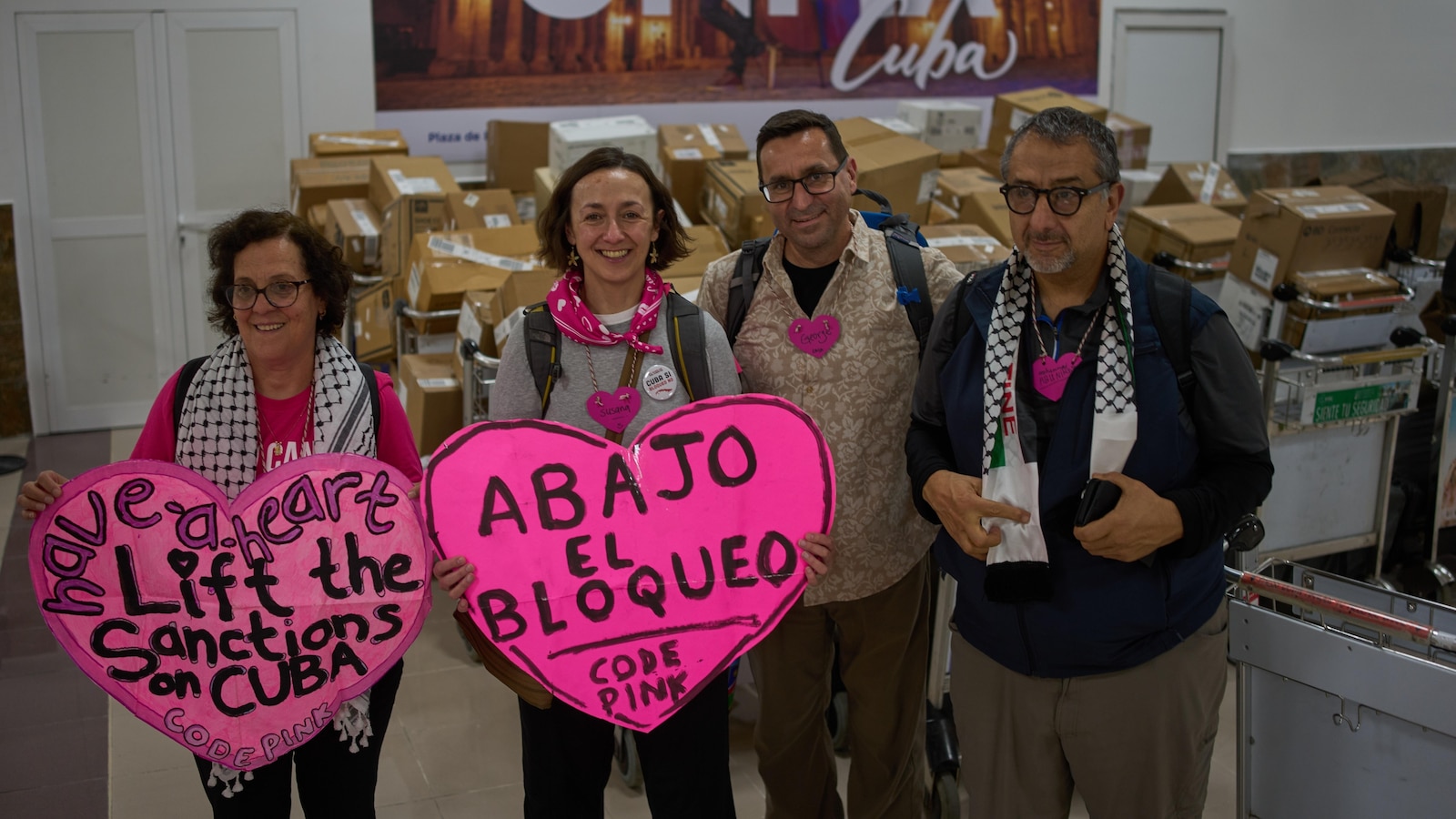
Tons of aid flows into Cuba as humanitarian convoy arrives on the struggling island
HAVANA — Some 650 delegates from 33 countries and 120 organizations began arriving in Cuba on Friday as part of a solidarity caravan transporting some 20 tons of humanitarian aid. The island is grappling with a severe energy crisis amid heightened tensions with the United States.
Members of the “Our America Convoy to Cuba” arrived by air from Italy, France, Spain, the United States, and several Latin American countries. More delegates are scheduled to arrive by sea on Saturday aboard a flotilla of three vessels from Mexico, organizers reported. A group of activists had already arrived in Havana on Wednesday, delivering donations to hospitals in advance of the main caravan.
This visit comes amid increased strain between Cuba and the United States. Both governments have acknowledged holding talks after U.S. President Donald Trump imposed an oil embargo on the island. Earlier this week, Trump stated he expected to have the “honor” of “taking Cuba in some form,” adding, “I can do anything I want.”
Among the donated items are solar panels, food supplies, and medicine to treat cancer. Cuba’s economy has been brought to a near standstill due to the energy embargo imposed in January, exacerbating a five-year economic crisis as the U.S. administration presses for political change on the island.
David Adler, a U.S. citizen and coordinator of Progressive International—one of the caravan’s organizers—stated, “In the end, we are dozens and dozens of delegates, and we represent millions of people in this convoy. We cannot allow this collective punishment. We cannot normalize it.”
Cuban Deputy Foreign Minister Carlos Fernández de Cossío also addressed the ongoing dialogue, firmly rejecting any talks about changing the political system or the potential departure of Cuban President Miguel Díaz-Canel. “The Cuban political system is not up for negotiation, nor is the president, nor the position of any official in Cuba, subject to negotiation with the United States or with the government of any other country,” Fernández de Cossío said. He noted that many areas of common interest exist where dialogue with Washington is possible, continuing the approach taken in the past.
Manolo de los Santos, from The People’s Forum and another caravan organizer, emphasized that this mission is not only about “defying the U.S. blockade” but also about preventing “another Gaza in the Americas.”
Several analysts and regional leaders, including Mexican President Claudia Sheinbaum, have warned of a possible humanitarian crisis unfolding in Cuba. Adler pointed out that both the flotilla that traveled to Gaza and the one heading to Cuba share numerous supporters.
In addition to social activists, the caravan includes unions, prominent figures, and political parties such as Morena from Mexico, the Workers’ Party of Brazil, and the Broad Front of Uruguay. Notable participants include British Parliamentarian Jeremy Corbyn, Colombian Senator Clara López, former Spanish politician Pablo Iglesias, U.S. labor leader Chris Smalls, and Brazilian humanitarian activist Thiago Ávila.
For weeks, the only aid reaching Cuba came from Mexico, which sent food and hygiene products on three occasions. However, activists and leaders in other countries have now begun forming support groups and collecting donations.
President Díaz-Canel expressed his gratitude on social media, stating, “They bring shipments of aid to combat the attempt to suffocate us. Welcome once again to the compassion of the people. Solidarity always returns to those who practice it with no other interest than human well-being.”
Brazil has announced plans to send 20,000 tons of food, primarily rice, beans, and powdered milk. Additionally, a group of Chilean parliamentarians arrived with aid on Thursday, and China reported through its embassy that a ship carrying 60,000 tons of rice has set sail for Cuba.

18-year-old and 14-year-old charged in daytime armed robbery in Charlestown
Davonte Jordan, 18, and a 14-year-old boy were arrested Wednesday afternoon in connection with an armed robbery in Charlestown, Boston police said.
According to the Boston Police Department, the two suspects allegedly pointed a gun at an elderly woman before stealing her purse. The incident occurred near 22 Prospect Street, where officers responded to a call about the armed robbery around 4:32 p.m.
The victim informed police that she was walking near Adams Street and Mount Vernon Street when two males approached her from behind. The suspects allegedly threatened her with a gun and took her purse, which contained credit cards, before fleeing toward Monument Square.
A nearby witness reported seeing two males running in the area and provided a description that matched the suspects. Another witness discovered a purse with scattered credit cards behind a building on Chestnut Street and confirmed the cards belonged to the victim.
Simultaneously, officers were dispatched to remove an individual from a property at 85 Monument Street. Upon arrival, police noticed two people matching the suspects’ description. When approached, both individuals ran but were apprehended after a short pursuit near 17 Carney Court.
The suspects were identified as Davonte Jordan and the 14-year-old boy, whose name has been withheld due to his age. While booking the younger suspect, officers found the victim’s credit card in his possession.
Jordan faces charges of armed masked robbery of an elderly person, receiving stolen property, and trespassing. The 14-year-old is charged as delinquent with the same offenses, according to the Boston Police Department.
During his arraignment Thursday, Jordan pleaded not guilty and was held without bail pending a dangerousness hearing. An attorney listed for Jordan did not immediately respond to requests for comment.
Boston police continue their investigation into the incident. Anyone with additional information is encouraged to contact the department.
https://www.boston.com/news/local-news/2026/03/19/18-year-old-and-14-year-old-charged-with-daytime-armed-robbery-in-charlestown/

Missing American college student found dead in Barcelona
The body of missing University of Alabama student James Gracey, who disappeared during a trip to Barcelona, has been found, Spanish police announced.
Leigh Kiniry provides the latest details on the case.
https://www.cbsnews.com/video/missing-american-college-student-found-dead-in-barcelona/