Tag Archives: electrification

Anne Arundel County, Resilience Authority And Ameresco Team Up On EV Charging Plan

**Anne Arundel County Advances Major Fleet Electrification Effort**

Anne Arundel County is moving ahead with a significant fleet electrification initiative through a new design-build contract with The Resilience Authority of Annapolis and Anne Arundel County, alongside energy solutions provider Ameresco, Inc. This project aims to install electric vehicle (EV) charging infrastructure at 10 County-owned facilities, laying the foundation for a long-term transition to an electric fleet.

**County Fleet Electrification Moves Forward**

Ameresco was selected through a competitive process to analyze the County’s fleet, fueling data, and EV plans. Their task is to design a charging strategy tailored specifically to County operations. The recommended approach is expected to save approximately $350,000 annually in utility costs once the fleet is fully electrified. Additionally, it will reduce the electrical capacity required to support operations by roughly 2.5 megawatts across the 10 sites.

“Our goal from the start was to identify a smart, scalable path to fleet electrification that balances cost, reliability, and long-term flexibility,” said Anne Arundel County Executive Steuart Pittman. “By partnering with the Resilience Authority and Ameresco, we’ve been able to turn thoughtful planning into measurable action. Together, we’re reducing emissions, improving operational efficiency, and investing in modern infrastructure that can evolve as the County’s needs grow.”

**Phased EV Charging Deployment**

The plan includes phased installation of chargers sized to match the vehicles the County expects to add through 2026. Furthermore, additional charging capacity will be designed into each site to ensure the system can expand as needed over time.

“We’re proud to partner with The Resilience Authority and Anne Arundel County to turn thoughtful analysis into practical, scalable infrastructure,” said Peter Christakis, President of East USA & Greece; Project Risk at Ameresco. “By right-sizing charger counts, optimizing electrical capacity, and sequencing deployment, we’re helping the County accelerate fleet electrification while controlling costs and strengthening day-to-day operations.”

**Resilience and Community Impact**

This project is one of several initiatives being advanced through the Resilience Authority, which focuses on preparing Anne Arundel County for climate and infrastructure challenges.

“I continue to be humbled by the expertise and partnership we’ve experienced across Anne Arundel County,” said Matthew Fleming, Executive Director of the Resilience Authority of Annapolis and Anne Arundel County. “Our progress is a direct reflection of the County’s leadership and the dedication of its staff—from advancing natural infrastructure and addressing coastal flooding to expanding EV charging. Their professionalism and collaboration continue to inspire me.”

Ameresco is collaborating with local partners on analysis, engineering, and installation to ensure the charging infrastructure aligns with daily fleet operations and supports reliable, efficient performance.

This fleet electrification effort represents a major step for Anne Arundel County in reducing emissions, enhancing operational efficiency, and investing in sustainable infrastructure for the future.
https://www.eyeonannapolis.net/2025/11/anne-arundel-county-resilience-authority-and-ameresco-team-up-on-ev-charging-plan/

PEM Electrolyzer Market Size, Share and Trends Analysis Report 2025-2034 Survey Detailed Analysis and Forecast 2025-2034

**InsightAce Analytic Pvt. Ltd. Announces Release of Market Assessment Report on Global PEM Electrolyzer Market**

InsightAce Analytic Pvt. Ltd. is pleased to announce the release of a comprehensive market assessment report titled:
**“Global PEM Electrolyzer Market Size, Share & Trends Analysis Report By End-User (Refining Industry, Power & Energy Storage, Ammonia Production, Methanol Production, Transportation) and Material Type (Iridium, Platinum) – Market Outlook and Industry Analysis 2034.”**

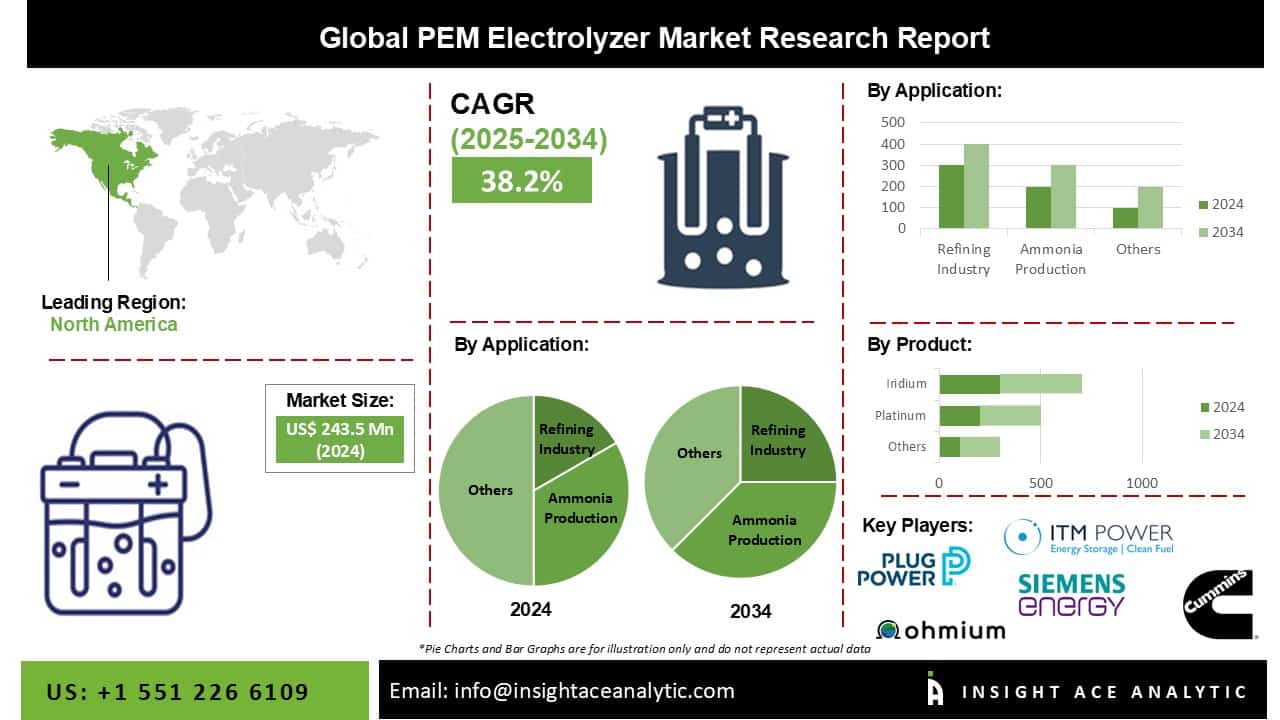
The global PEM electrolyzer market is projected to reach over USD 6,078.7 million by 2034, exhibiting a robust compound annual growth rate (CAGR) of 38.2% during the forecast period.

### Request For Free Sample Pages

Hydrogen gas is a highly efficient and clean-burning fuel with widespread applications across various industries. It is primarily used in the production of chemicals such as ammonia and methanol.

– **Ammonia (NH₃)** is a key ingredient in agricultural fertilizers, playing a vital role in supporting global food production.
– In the **petroleum industry**, hydrogen is essential for hydrocracking processes that facilitate the production of gasoline, diesel, and other refined petroleum products.
– Innovative applications, especially hydrogen fuel cells, are opening new opportunities in the **transportation** sector and energy-related industries.
– Hydrogen is currently used in **power plants** for generator cooling and is being explored as a potential solution for electrical grid stabilization.

### Prominent Players in the PEM Electrolyzer Market
– Plug Power Inc.
– Nel ASA Inc.
– ITM Power PLC
– Hitachi Zosen Corporation
– Elogen
– Siemens Energy AG
– Ningbo Vet Energy Technology Co., Ltd.
– Ohmium International, Inc.
– Hystar
– H-TEC SYSTEMS GmbH

### Market Dynamics

#### Drivers
The increasing global energy demand is primarily fueled by population growth and expanding rural electrification initiatives. Rapid urbanization alongside the development of large-scale infrastructure projects has further escalated the demand for reliable power supply from utilities worldwide.

Government policies promoting low-carbon technologies have been instrumental in market expansion. For example, on April 3, 2020, Japanese company Asahi Kasei established an alkaline water electrolysis plant at the Fukushima Hydrogen Energy Research Field (FH2R), highlighting increasing investments in hydrogen production technologies.

Moreover, recent reductions in solar and wind energy costs have significantly decreased both current and projected costs for renewable hydrogen production. Notably, utility-scale solar photovoltaic (PV) capital costs have dropped by 75% since 2010, while onshore wind generation costs have fallen by approximately 25% over the past decade.

### Regional Trends

– **North America** is anticipated to achieve significant revenue growth during the forecast period. The widespread adoption of hydrogen in the power sector and a strong manufacturing infrastructure are key factors driving market expansion. Increased investments in refining, exploration, and production activities continue to boost demand for large-scale hydrogen production.

– **Europe** holds a prominent position within the market, with major investments by key players substantially contributing to industry revenue generation.

### Recent Developments

In July 2022, Plug Power Inc. signed a contract with Irving Oil, an international energy corporation, to supply a 5-megawatt (MW) containerized proton exchange membrane (PEM) electrolyzer system. This system will be utilized for hydrogen production and distribution at the Saint John refinery in New Brunswick, Canada.

### Market Segmentation

**By End-User:**
– Refining Industry
– Power and Energy Storage
– Ammonia Production
– Methanol Production
– Transportation
– Others

**By Material Type:**
– Iridium
– Platinum
– Others

**By Region:**
– **North America:** US, Canada, Mexico
– **Europe:** Germany, UK, France, Italy, Spain, Rest of Europe
– **Asia-Pacific:** China, Japan, India, South Korea, Southeast Asia, Rest of Asia Pacific
– **Latin America:** Brazil, Argentina, Rest of Latin America
– **Middle East & Africa:** GCC Countries, South Africa, Rest of the Middle East and Africa

### Get More Information

To request specific chapters or detailed information from the report, please contact us.

### About InsightAce Analytic Pvt. Ltd.

InsightAce Analytic is a market research and consulting firm dedicated to enabling clients to make strategic decisions. Our qualitative and quantitative market intelligence solutions help identify new market opportunities, explore competing technologies, segment potential markets, and reposition products effectively.

We offer syndicated and custom market intelligence reports with in-depth analysis and key market insights delivered in a timely and cost-effective manner.

### Contact Us

Email: info@insightaceanalytic.com
Website: [www.insightaceanalytic.com](http://www.insightaceanalytic.com)
Phone (US): +1 607 400-7072
Phone (Asia): +91 79 72967118

Follow us on Twitter and LinkedIn for the latest updates.

Stay ahead in the hydrogen economy with InsightAce Analytic’s expert market reports!
https://www.prnewsreleaser.com/news/115915

Legacy Automakers Tap the Brakes on EVs as Road to Mass Adoption Gets Bumpy

After years of ambitious pledges and multibillion-dollar bets on the future of electric vehicles, legacy automakers are facing a cold market reality. Consumer adoption has slowed, incentives have dried up, the political and cultural debate around EVs has grown more partisan, and Wall Street’s patience is wearing thin.

Just this week, General Motors took a $1.6 billion loss on its EV unit because it had built more production capacity than it currently needs. Earlier, Volkswagen Group idled two EV plants in Germany as sales stalled. Stellantis scrapped its target of reaching 100 percent EVs by 2030. Meanwhile, Ford delayed full-size EV truck and van programs and reallocated capital once earmarked for EVs to hybrids and gas-powered vehicles.

Despite what looks like a massive retreat from earlier EV promises, analysts say this moment reflects a recalibration, not a surrender.

Sam Abuelsamid, a longtime auto analyst and vice president of market research at Telemetry, described it as a “temporary correction” rather than a full retreat. “Electrification is the direction for the future; it’s just going to take longer to get there,” he told Observer in an email, noting that in today’s highly divisive political climate, many executives have become quieter about long-term plans, but none are completely “jumping ship.”

Consumer behavior, rather than corporate or regulatory retreat, is driving the current EV “correction,” said Stephanie Brinley, a principal automotive analyst at S&P Global Mobility. “[But] pricing, direct consumer experience and education, and concerns over infrastructure remain the hurdles to more widespread adoption.”

In fact, EV market share is still growing. From January to August, EVs accounted for 8.1 percent of the U.S. market, up from 7.7 percent during the same period last year, according to S&P Global data.

Still, EVs remain more expensive than hybrid or combustion rivals. Even Tesla, despite promising a sub-$25,000 model for more than a decade, has yet to crack the affordability barrier.

“The issues have not changed, but moving from early adopters to mainstream buyers is difficult, choppy and not as easy to predict,” Brinley said.

Abuelsamid admitted that the industry’s earlier projections that EVs would make up more than half of the U.S. market by 2030 were overly optimistic. He expects hybrids to dominate in the near future, gradually replacing internal combustion engines as the default powertrain.

For American buyers, hybrids offer what EVs have struggled to provide: no lifestyle changes and a longer range for less fuel. They’re also cheaper to produce than EVs because they use smaller batteries and require less complex software development.

Both analysts agree that automakers are navigating a long and uneven bridge toward a fully electric future, not abandoning it. What happens next will depend on breakthroughs in cost and technology, particularly in battery chemistry and cell-to-pack architectures, Abuelsamid said.

Automakers, he added, should shift focus away from high-end, high-performance EVs and collaborate to cut spending on expensive features customers don’t actually see, such as software platforms and electrical architecture.

“Even most mainstream EVs are plenty quick for everyday driving needs,” he said.

For now, automakers are balancing profitability with progress, trying to meet consumers where they are while continuing to invest in where they’ll eventually be.
https://observer.com/2025/10/legacy-automakers-tap-the-brakes-on-evs-as-road-to-mass-adoption-gets-bumpy/

Inside Japan’s Great Transformation: Mazda’s Five-Year Reform Plan

Inside its training center in Hiroshima, employees of all ages and departments—many meeting for the first time—are engaged in workshops exploring the company’s corporate culture, known as “food,” and what it should represent. Participants first reflect individually, then discuss in pairs, and finally present their ideas to the group—a process repeated across various themes.

The cultural reform initiative, launched in November 2023, is a cornerstone of Mazda’s five-year transformation plan. In May, the company rented a local soccer stadium to train 4,000 employees, and nearly all staff have now completed the program. The project unfolds in three phases: first, defining the desired culture through training; second, embedding it in everyday workplace behavior; and third, establishing it as a daily habit.

Mazda sees this internal evolution as essential for survival as electrification, environmental concerns, and other sweeping changes reshape the industry. “We’re not a large company by scale,” one executive noted, “so human creativity, imagination, and uniqueness are critical to generating new value. We must cultivate our organizational culture anew.”

The company’s journey is not without resistance. Some employees question whether management fully supports the changes, while others see altering executive mindsets as key to success. Yet the resolve remains strong as Mazda pushes toward a future where a new corporate culture becomes its competitive edge.

Beyond corporate reinvention, Japan is also witnessing groundbreaking research aimed at addressing the climate crisis. On August 5th, temperatures in Gunma Prefecture hit a record 41.8°C—the highest ever recorded in Japan—with the Meteorological Agency warning that above-average heat could persist through November.

As the world works to reduce CO2 emissions from vehicles and fossil fuels, a pioneering project in Tanegashima, Kagoshima Prefecture, is exploring a domestic biofuel alternative derived from sugarcane. At the center of the effort is Satoshi Obara, a special professor at the University of Tokyo, who has spent two decades developing new sugarcane varieties in collaboration with the Kyushu Okinawa Agricultural Research Center.

One such variety, named Haru no Ougi, yields 30–50% more than conventional strains and withstands the island’s frequent typhoons without bending, making it ideal for mechanical harvesting. Obara, who once worked on biofuel commercialization in the private sector, left his company to pursue this vision independently. His goal: to create a renewable, domestically produced fuel without relying on imported oil or external electricity—a bold attempt to build a sustainable energy future from Japan’s farmland.

Meanwhile, in the resort sector, Spa Resort Hawaiians—a tropical-themed leisure facility in Iwaki, Fukushima Prefecture, known for its towering 40-meter waterslide and daily Hula Girl dance shows—is fighting for survival.

Operated by local company Joban Kosan and celebrating its 60th anniversary next year, Hawaiians has faced severe financial challenges. The 2011 Great East Japan Earthquake forced a six-month closure, while the COVID-19 pandemic caused an additional three-month shutdown, leaving the company with about 28 billion yen in debt and aging facilities.

In November 2023, U.S. investment fund Fortress Investment Group, which manages over 7 trillion yen in assets and previously acquired Seibu Holdings, launched a takeover bid, acquiring more than 85% of Joban Kosan’s shares.

“Given the current financial state, it would be difficult for Hawaiians to remain competitive over the next 50 or 60 years without major change,” said Shunsuke Yamamoto, who led the acquisition. Fortress plans a sweeping overhaul of the resort, investing heavily to modernize facilities and align them with the expectations of Japanese travelers who have experienced Hawaii firsthand.

Hawaiians’ transformation is part of a broader trend of foreign investment reshaping Japan’s hospitality landscape. Large-scale resorts from the bubble era are being rebuilt from the ground up, reflecting a strategic push to redefine domestic travel experiences.

But not all of Japan’s battles involve boardrooms or laboratories—some are fought in the fields. In Tochigi Prefecture, wild boars, once rare, have proliferated in recent years, wreaking havoc on agriculture. They destroy sweet potato fields, trample rice paddies, and even roll in fields to remove parasites, knocking over crops and reducing grain quality.

Damages nationwide from wild animal incursions now total 16.4 billion yen annually. Despite these losses, Japan’s hunter population has fallen to less than half its previous size, with about 60% now over 60 years old. Local governments are struggling to respond.

Veteran hunter Kiyoshi Sekiguchi, 75, who captured 30 boars last year, says manpower is the biggest obstacle: “There’s nobody left to set traps or check them.” Municipalities offer 16,000 yen per animal, but the shortage of younger hunters—many of whom cannot leave their jobs for extended periods—remains a critical challenge.

The consequences go beyond crops. Wild animals cause traffic accidents, spread disease, and pose risks to human safety. Yet new business models are emerging to tackle the crisis.

In Chiba Prefecture, companies are making it easier for people to enter the hunting industry, including offering training for trap licenses. In Hokkaido, female entrepreneurs are launching ventures that connect hunters with consumers seeking game meat, creating a market-driven incentive for wildlife control.
https://newsonjapan.com/article/147245.php