Tag Archives: infrastructure

Japan’s FSA Eyes Tightening Crypto Lending Rules

**Japan’s Financial Services Agency Plans to Tighten Cryptocurrency Lending Regulations**

The Financial Services Agency (FSA) in Japan is moving to strengthen rules surrounding cryptocurrency lending, aiming to bring these services under the purview of the Financial Instruments and Exchange Act. This initiative is part of Japan’s broader effort to protect investors and enhance the security and transparency of its digital asset market.

### New Regulatory Measures for Crypto Lending

According to a recent announcement by Wu Blockchain on X, the FSA has been actively discussing plans to tighten regulations on crypto lending. Previously, some entities exploited loopholes by bypassing registration requirements under the pretext of borrowing activities. By closing these gaps, the agency seeks to enforce stronger risk management and custody controls within the rapidly evolving digital asset ecosystem.

The FSA has also proposed placing investment limits on Initial Exchange Offerings (IEOs) that lack financial audits. This move aims to curb excessive retail speculation and mitigate risks associated with unverified offerings. However, experts have cautioned that such caps could potentially be circumvented through secondary market transactions.

Additionally, the agency plans to focus on improving risk management around re-lending and asset pledging by ensuring proper asset segregation and mandatory risk disclosures. These efforts underscore Japan’s commitment to building a safer and more transparent crypto market.

### Japan’s Integration of Cryptocurrency with Traditional Finance

In a significant development, the FSA is considering allowing banks to invest in and hold Bitcoin (BTC) and other cryptocurrencies. Integrating digital assets into mainstream financial instruments will be accompanied by strict risk management protocols and capital safeguards, ensuring that these emerging assets are securely governed.

The move reflects the growing maturity of Japan’s crypto ecosystem, which continues to attract new businesses and technological advancements. For instance, on October 28, TIS Inc.—a publicly traded IT services company that supports major Japanese financial institutions—launched a multi-token platform in partnership with blockchain developer Ava Labs. This platform enables banks to issue and manage stablecoins and security tokens while adhering to ERC-20 token standards. Importantly, it incorporates key management infrastructure designed for financial-grade security.

### Conclusion

Japan’s Financial Services Agency is clearly taking proactive steps to regulate the cryptocurrency market more effectively. By tightening lending rules, setting investment limits, and potentially integrating cryptocurrencies within traditional banking frameworks, Japan aims to foster a robust, secure, and investor-friendly digital asset environment.

*Disclaimer: Coinspeaker is committed to providing unbiased and transparent reporting. This article is intended to deliver accurate and timely information but should not be considered financial or investment advice. Market conditions can change rapidly; please verify information independently and consult a professional before making decisions based on this content.*
https://bitcoinethereumnews.com/crypto/japans-fsa-eyes-tightening-crypto-lending-rules/

Sam Altman says OpenAI will top $20 billion in annualized revenue this year, hundreds of billions by 2030

OpenAI CEO Sam Altman announced on Thursday that the artificial intelligence startup is on track to generate more than $20 billion in annualized revenue run rate this year. He also revealed ambitious plans to grow the company’s sales to hundreds of billions by 2030.

In recent months, OpenAI has secured infrastructure deals totaling more than $1.4 trillion to build the data centers needed to meet growing demand. This staggering sum has raised questions among investors and industry experts about how OpenAI will finance these massive investments.

“We are trying to build the infrastructure for a future economy powered by AI,” Altman wrote in a post on X. “Given everything we see on the horizon in our research program, this is the time to invest and really scale up our technology. Massive infrastructure projects take quite a while to build, so we have to start now.”

Founded as a nonprofit research lab in 2015, OpenAI has transformed into one of the fastest-growing commercial entities worldwide following the launch of its chatbot, ChatGPT, in 2022. The startup is currently valued at $500 billion, though it has yet to turn a profit.

In September, OpenAI CFO Sarah Friar told CNBC that the company was on track to generate $13 billion in revenue this year. However, Friar recently faced scrutiny from the Trump administration after remarks at an event where she mentioned OpenAI’s intent to create an ecosystem involving banks, private equity, and a federal “backstop” or “guarantee” to help finance investments in cutting-edge chips.

She later clarified her comments in a LinkedIn post on Wednesday, stating that OpenAI is not seeking a government backstop for its infrastructure commitments. “I used the word ‘backstop’ and it muddied the point,” Friar explained. “As the full clip of my answer shows, I was making the point that American strength in technology will come from building real industrial capacity, which requires the private sector and government playing their part.”

Adding to the debate, venture capitalist David Sacks, who serves as President Donald Trump’s AI and crypto czar, declared on Thursday that there will be “no federal bailout for AI.” He wrote on X that if one frontier model company fails in the U.S., another will take its place.

Altman echoed this sentiment, stating that OpenAI “does not have or want government guarantees for OpenAI datacenters.” He emphasized that taxpayers should not be responsible for bailing out companies that make poor decisions. “If we get it wrong, that’s on us. This is the bet we are making, and given our vantage point, we feel good about it,” Altman wrote. “But we of course could be wrong, and the market — not the government — will deal with it if we are.”

As OpenAI continues to invest heavily in scaling its technology and infrastructure, the company remains confident in its strategies amid ongoing discussions about the role of government and private investment in the AI industry’s future.
https://www.cnbc.com/2025/11/06/sam-altman-says-openai-will-top-20-billion-annual-revenue-this-year.html

Gootloader malware returns with fake NDA scam – here’s what we know

**Gootloader Malware Campaign: A Resurgence with New Obfuscation Techniques**

Gootloader is notorious for leveraging malvertising and SEO poisoning to distribute malware. Cybercriminals behind this campaign either create websites from scratch or infiltrate legitimate ones, modifying them to host various documents, such as NDA templates. To increase visibility, they purchase ads on popular ad networks or use SEO poisoning by generating numerous web articles packed with keywords that link back to the sites they control.

According to analysts from Huntress Labs, hundreds of websites have been seen hosting the malware. The combination of these tactics ensures that when users search for specific terms, these malicious sites appear at the very top of search engine results—often overtaking legitimate pages. This tactic significantly raises the likelihood of users unknowingly compromising their systems.

### Obfuscation Techniques

The Gootloader campaign was effectively halted in March 2025, following persistent efforts from security researchers who pressured ISPs and hosting platforms to take down the attackers’ infrastructure. However, after a six-month hiatus, Gootloader has made a comeback, employing the same distribution techniques to deploy its loader. This loader then delivers various payloads, such as ransomware, infostealers, or Cobalt Strike beacons.

The most notable change in the new campaign is the introduction of sophisticated obfuscation methods. Researchers revealed that attackers are now using JavaScript combined with a special web font to conceal the real file names of the malware. This font replaces characters with visually similar symbols, making the HTML source look like gibberish, while the rendered webpage displays normal words.

Huntress Labs explained, “Rather than using OpenType substitution features or character mapping tables, the loader swaps what each glyph actually displays. The font’s metadata appears completely legitimate—the character ‘O’ maps to a glyph named ‘O’, the character ‘a’ maps to a glyph named ‘a’, and so forth.”

However, the actual vector paths defining these glyphs have been swapped. For example, when the browser requests the shape for the glyph ‘O’, the font renders the letter ‘F’ instead. Similarly, the glyph for ‘a’ draws ‘l’, ‘9’ draws ‘o’, and special Unicode characters like ‘±’ draw ‘i’. This means a string of gibberish such as “Oa9Z±h•” in the source code is rendered as the word “Florida” on-screen.

This clever obfuscation technique complicates analysis and detection, making it easier for attackers to evade traditional security mechanisms.

Stay informed on the latest cybersecurity developments and make sure to click the **Follow** button for updates!
https://www.techradar.com/pro/security/gootloader-malware-returns-with-fake-nda-scam-heres-what-we-know

MacKenzie Scott gifts $80 million to Howard University, marking one of the school’s largest donations in its 158-year history

On Sunday, Howard University announced that Scott, who is worth an estimated $35.6 billion, donated $80 million to the historically Black college. True to Scott’s style, the gift is unrestricted, meaning the university can use the resources as it chooses. Of the $80 million, $63 million will go toward Howard University, and $17 million will be allocated to the school’s College of Medicine.

This marks one of the largest single donations to Howard in its 158-year history.

“This historic investment will not only help maintain our current momentum, but will help support essential student aid, advance infrastructure improvements, and build a reserve fund to further sustain operational continuity, student success, academic excellence, and research innovation,” said Wayne A. I. Frederick, Howard’s interim president and president emeritus, in a statement.

Howard University says the gift comes at an “opportune time,” as the federal government shutdown has delayed annual federal appropriations that the school receives to support student success, academic programming, research, and the operations of the university and Howard University Hospital.

Due to the shutdown that began on October 1, new grant awards from the Department of Education have been halted because nearly 95% of non-student aid staff were furloughed, leaving only essential staff working. Key programs like the HBCU Capital Financing Program, which offers renovation and construction loan subsidies, are now left in limbo.

The timing is particularly unfortunate considering that in September, the Education Department announced a $495 million increase for HBCUs and Tribally Controlled Colleges and Universities (TCCUs) for FY 2025.

At the same time, however, education experts find this action difficult to reconcile with the Trump administration’s desire to dissolve the Department of Education.

“If [the Trump administration] actually cared about HBCUs and tribal colleges, then you would not see such a big attack on other sectors of higher education,” Mike Hoa Nguyen, an associate professor of education at UCLA, recently told The American Prospect.

### MacKenzie Scott’s DEI Dedication

Scott’s gift to Howard builds on other recent DEI-focused donations. She donated $42 million to 10,000 Degrees, a Bay Area nonprofit focused on expanding college access for low-income and largely non-white students, alongside other eight-figure commitments to Native student scholars and HBCU endowments through the United Negro College Fund (UNCF).

In September, Scott made a $70 million donation to the UNCF as part of a campaign to bolster pooled endowments across 37 HBCUs. This strategy is designed to increase revenue streams and narrow historical wealth and funding gaps.

In October, the African American Cultural Heritage Action Fund announced a $40 million gift from Scott—twice the size of her previous donation to the organization in 2021—representing 20% of its fundraising so far.

Scott emphasizes, though, that while the dollar amounts are high, they don’t fully represent their level of impact.

“When my next cycle of gifts is posted to my database online, the dollar total will likely be reported in the news,” she wrote in an October 15 essay on her organization Yield Giving’s site. “But any dollar amount is a vanishingly tiny fraction of the personal expressions of care being shared into the world this year.”

“The potential of peaceful, non-transactional contribution has long been underestimated, often on the basis that it is not financially self-sustaining, or that some of its benefits are hard to track,” she continued. “But what if these imagined liabilities are actually assets?”
https://fortune.com/2025/11/03/mackenzie-scott-80-million-gift-howard-university/

Hurricane Melissa deals another heavy blow to Jamaica’s farmers and fishers

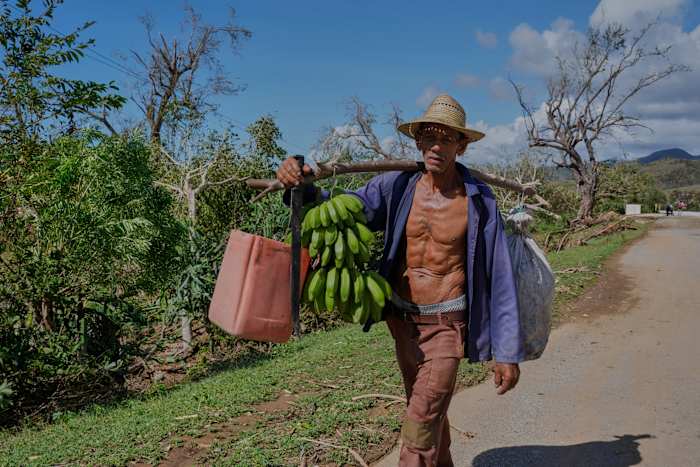
The updates sent by friends and neighbors on WhatsApp confirmed what fisher Prince Davis already feared: Hurricane Melissa had put a hole in the stern of his 50-foot (15-meter) fishing boat, and damaged the cabin and back deck. His father’s boat was nowhere to be found. The roof of the house Davis and his parents shared in the small Jamaican fishing community of White House in Westmoreland parish was also destroyed.

Davis was in Nicaragua, where he’d flown shortly before the storm to find new customers for his fish business. But now, his livelihood—and the livelihoods of many in his community—were in peril.

“It’s going to be very rough,” said Davis. “With the damage now, no one will be buying products.”

About 29 kilometers (17 miles) northwest in Amity, also in Westmoreland parish, Denver Thorpe lost 15 acres (6 hectares) of mango trees and two greenhouses on his farm.

“There’s absolutely nothing,” said Thorpe, a farmer and regional manager for the Jamaica Agricultural Society, a farmer advocacy organization.

Hurricane Melissa is blamed for at least 19 deaths in Jamaica, bringing catastrophic winds up to 185 mph (298 kph) and a storm surge that wrecked homes and public infrastructure. While official damage assessments are still underway, experts say it’s already clear that one of the strongest landfalling Atlantic hurricanes ever recorded dealt a devastating blow to tens of thousands of Jamaican fishers and farmers who feed their families and nearby communities.

Similar impacts will be felt by some of Cuba and Haiti’s small producers, said Lola Castro, World Food Program regional director for Latin America and the Caribbean.

“I would say every crop that was on the path has been damaged, there’s no discussion on that,” said Castro. “Some of the fruit trees may be recovered; some of the temporary crops will not be recovered at all.”

The destruction will impact how residents earn income and feed their families at a time when they must also rebuild homes and communities. There were already 10 million food-insecure people across the affected countries of Haiti, Jamaica, and the Dominican Republic, said Castro. The WFP does not have that data for Cuba.

**Jamaica’s Agricultural Sector Faces Devastation**

In Jamaica, the destruction comes just 15 months after Hurricane Beryl impacted more than 50,000 farmers and 11,000 fishers, causing $4.73 billion Jamaican dollars (about $29 million) in losses, according to the Ministry of Agriculture, Fisheries and Mining.

“We were just about turning the corner,” said Thorpe.

Jamaica’s agriculture ministry did not respond to questions about sector impacts, but the country has more than 200,000 farmers tending livestock and growing bananas, melons, cocoa, and much more. The food produced is for both domestic consumption and export. Jamaica is one of the world’s largest yam exporters, and its coffee growers generate $25 million annually, according to the Jamaica Coffee Exporters Association.

Around 80% of producers are small-scale, working on 2 hectares of land or less, said Donovan Campbell, geography professor and director of the University of the West Indies’ western campus.

“Small-scale fishing and small-scale farming is what most people use to make a living,” he said. “It is really the lifeblood of the most vulnerable in our society.”

Farmers use October rains to plant crops to harvest before Christmas. Before the storm, the agriculture ministry urged fishers to move equipment out of harm’s way and farmers to move livestock and harvest any crops they could.

The devastation exceeded most expectations. Officials said Wednesday that St. Elizabeth parish, known as Jamaica’s “breadbasket,” was “under water.” The parish had over 35,000 registered farmers and fishers as of 2022, according to the Jamaica Information Service.

For fishers, Davis said it’s not just losing boats, nets, and traps that endangers their work. Without electricity, there’s no ice to store what they catch, and customers won’t buy what they can’t keep cold. Lack of tourism will hurt demand, too. The slowdown is worse for fishers who use most of their catch to feed their families and sell a little extra, he said.

“That small income every day maintains their house and their family and their school and children.”

There are also special risks for women producers, said Davis and Campbell, many of whom are heads of household who support their children with the small amounts they sell.

**Compounding Crises in Cuba and Haiti**

Cuba and Haiti face similar challenges, exacerbated by their political and economic crises. The storm unleashed terrible flooding in southern Haiti and is blamed for 31 deaths in the country, where hunger was already rising.

Castro of the World Food Program said the organization is concerned about the impact on some of Haiti’s female producers, from whom the WFP typically buys produce to supply local schools.

“We may need to bring food from other parts of the country if available, or even have to import,” said Castro.

In Cuba, the evacuation of 735,000 people meant the country suffered no known deaths, but Melissa’s passage could worsen challenges in feeding Cubans. The country faces a severe economic crisis and spends some $2 billion annually importing food products.

Local officials reported damage to plantain, corn, cassava crops, coffee, various vegetables, and trees across the five affected eastern provinces. Government officials said Melissa’s heavy rainfall did benefit dams and reservoirs after the eastern part of the country had been suffering from a severe drought and water shortage.

“That is one of the silver linings,” said Margarita Fernandez, executive director of the Caribbean Agroecology Institute in Vermont. CAI is raising funds to send directly to farmers and cooperatives in Cuba.

The United Nations Food and Agriculture Organization also delivered seed to Cuba ahead of the storm, a spokesperson said.

**Help Arrives in Phases**

Relief efforts across the northern Caribbean are focused on immediate needs for now. First responders and humanitarian organizations are providing shelter, health care, food, and clean water, while working to restore power and communications.

Food producers will soon need cash to make up for lost income, and to help replace equipment, animals, and seed.

The Jamaican government maintains reserve funds, parametric insurance policies, and catastrophe bonds for disasters. The government and nonprofits helped farmers and fishers after Hurricane Beryl replace what they lost. But it can take a long time for that help to reach small-scale producers, said Campbell.

With airports open again, Davis is looking for a flight to get back to White House. He needs to fix his boat and his roof, but he doesn’t know when he will sell fish again.

“My worry is about when the economy will be back to normal, where life goes on as it was before,” said Davis. “Everyone is picking up the pieces.”

___
*Associated Press writer Andrea Rodríguez contributed reporting from Havana.*
https://www.clickorlando.com/news/world/2025/11/02/hurricane-melissa-deals-another-heavy-blow-to-jamaicas-farmers-and-fishers/

Bitcoin at $107K, Ethereum at $3,787, BNB at $1,092 — But Ozak AI at $0.012 Could Deliver Bigger ROI

The major cryptocurrencies like Bitcoin, Ethereum, and BNB continue to grow steadily. However, investors are increasingly focusing on early-stage ventures with greater room for expansion. One such promising project is **Ozak AI**, notable for its innovative fusion of blockchain technology and artificial intelligence, as well as its attractive low presale price of $0.012, suggesting substantial upside potential.

With such a low entry point, the potential gains are catching the eyes of investors everywhere.

### Why Early Investors Are Eyeing Ozak AI’s Presale

The Z token presale is structured in multiple phases, with Phase 6 currently priced at $0.012, and Phase 7 set to open at $0.014. The projected final price is expected to reach $1.

Over 971 million Z tokens have been sold so far, raising $4.06 million. Remarkably, the price has already shown an impressive 1100% increase from its initial price of $0.001 in Phase 1.

The Z presale shows clear potential for long-term and sustainable growth. According to its tokenomics, the presale constitutes 30% of the fixed 10 billion Z token supply. This scarcity principle enhances token demand and investor confidence, increasing the likelihood of value appreciation.

Early investors could see major returns before the token even hits exchanges.

### Comparing ROI: Ozak AI vs. BTC, ETH, and BNB

– **Bitcoin (BTC)** is trading around $107K, testing resistance near $112K. Analysts predict that a decisive breakout could target the $125K-$130K range, implying a gain of roughly 20%-25%.
– **Ethereum (ETH)** is trading at $3,787 with immediate resistance near $3,900, potentially targeting $4,200-$4,300, offering similar double-digit upside potential.
– **BNB** currently trades at $1,092, facing resistance around $1,150. Breaking this could push it to $1,250-$1,300, indicating returns comparable to BTC and ETH.

In contrast, **Ozak AI’s** projected token price is $1. If this target is met, investors entering now at the $0.012 presale phase could see returns of approximately **8,233%**—far surpassing the potential returns of the established cryptocurrencies above.

This makes the current Phase 6 presale a compelling opportunity for early investors aiming for significant future gains.

### Ozak AI Ecosystem Driving Growth

Ozak AI is positioned as a next-generation innovation in blockchain-based intelligence technology. Its core goal is to analyze real-time data and forecast market behavior accurately.

Using advanced machine learning models, including neural networks and ARIMA, Ozak AI provides traders and institutions with precise risk assessments, trend analyses, and financial projections.

The platform incorporates the **Ozak Stream Network (OSN)**, a real-time records pipeline combined with Decentralized Physical Infrastructure Networks (DePIN), ensuring decentralization and reliability. This infrastructure guarantees secure and stable information processing.

Moreover, all critical data is securely stored using Ozak AI’s **Data Vaults**. The platform’s security has been audited by reputable firms **Sherlock** and **Certik**, confirming strong security, transparency, and trustworthiness for users and investors alike.

Ozak AI extends beyond conventional statistical feeds through its customizable **Prediction Agents (PAs)**. These agents can be tailored for specific goals such as forecasting Bitcoin volatility or providing impartial market insights. Users can share these agents and earn Z tokens as rewards.

### Strategic Partnerships Strengthening Adoption

Ozak AI has established several strategic partnerships that enhance platform trust and foster growth:

– The **Meganet** partnership enables fast data processing and access to real-time financial information.
– Collaborating with **SINT** introduces one-click AI agents, cross-chain bridges, and voice-enabled smart execution tools.
– The partnership with **Phala Network** facilitates the secure and private application of AI in financial markets.

These collaborations are set to increase adoption, directly fueling token demand and growth.

### Conclusion

Ozak AI’s $0.012 presale phase offers an early chance for investors to get involved in a high-growth blockchain and AI project. With its strong ecosystem, innovative features, and strategic partnerships, Ozak AI is well-positioned for wider acceptance and expansion.

If the projections hold, early investors could enjoy returns of up to **8,233%**, massively outperforming well-known cryptocurrencies such as Bitcoin, Ethereum, and BNB.

For more information about Ozak AI, visit:
**Website:** [Insert Website URL]
**Twitter/X:** [Insert Twitter Handle]
**Telegram:** [Insert Telegram Link]
https://bitcoinethereumnews.com/bitcoin/bitcoin-at-107k-ethereum-at-3787-bnb-at-1092-but-ozak-ai-at-0-012-could-deliver-bigger-roi/?utm_source=rss&utm_medium=rss&utm_campaign=bitcoin-at-107k-ethereum-at-3787-bnb-at-1092-but-ozak-ai-at-0-012-could-deliver-bigger-roi

At least 12 dead, dozens injured at Hindu temple in India during stampede

A crowd surge at a popular Hindu temple in southern India left at least 12 people dead and dozens injured, local authorities said Saturday. The death toll rose from nine to 12 people on Saturday, CBS News confirmed.

The incident occurred at the Swamy Venkateswara Temple in the Srikakulam district of Andhra Pradesh state, where hundreds of devotees had gathered to mark one of Hinduism’s sacred days, “Ekadashi,” senior police officer K. V. Maheswra Reddy told the Associated Press. On this day, devotees fast and offer prayers to Lord Vishnu, a key Hindu deity known as the preserver and protector of the universe, according to BBC News.

An initial investigation suggests that an iron grille meant to maintain the queue of worshippers at the temple broke, leading to the uncontrolled crowd surge, Reddy said. Senior local government official Swapnil Dinkar Pundkar added that more casualties were feared.

“Initially, we had reports of seven deaths, but two more people have succumbed to their injuries, while the condition of two others is critical,” he said. Of the deceased, eight are women and one is a child, Pundkar noted. At least 16 devotees injured in the crowd surge are being treated at a local hospital, while 20 others are in a state of shock and under observation at a different hospital.

Video footage shared on local media showed people rushing to help those who fainted in the crowd surge and were gasping for breath. Some were seen rubbing the hands of those who fell to the ground.

Prime Minister Narendra Modi and Andhra Pradesh’s highest-elected official, N. Chandrababu Naidu, expressed grief and offered their condolences to the families of the bereaved.

State authorities in Andhra Pradesh stated that the location was a private temple on 12 acres of land and was not under government administration control. Despite its maximum capacity of 3,000, the crowd swelled to around 25,000 on Saturday, officials said.

“Arrangements were not made accordingly, nor was information provided to the government by the concerned individual. This is the reason for the accident,” the state’s fact-check unit said in a statement on social media.

Naidu vowed strict action against those responsible for the deadly stampede and ordered an inquiry into the incident, according to local media.

Crowd surges at religious gatherings are not uncommon in India, where massive groups often congregate at temples or pilgrimage sites, sometimes overwhelming local infrastructure and security measures.
https://www.cbsnews.com/news/hindu-temple-in-india-crowd-stampede/

Ultra-Luxury Breakaway: Why the 1% Travel Market Has Become Its Own Universe

**Industry Insights: 4 Questions With Wunderkind**

With digital privacy tightening, identity resolution is becoming essential for travel marketers. Wunderkind’s Ronen Kadosh explains how smarter data strategies can help brands drive direct bookings and build lasting loyalty.

**Full Video: India and China Are Defining the Next Era of Outbound Travel**

Indian and Chinese travelers are rewriting the rules of how travel is discovered, booked, and experienced. For destinations, adapting to these markets means more than translation. It requires rethinking payments, safety, personalization, and platform partnerships from the ground up.

**Full Video: Abu Dhabi’s $7 Billion Bet on Tourism Growth**

By fusing culture with cutting-edge infrastructure and a people-first strategy, Abu Dhabi is setting a new regional standard for how to grow tourism sustainably, inclusively, and ambitiously.

**Full Video: Almosafer CEO on the Future of AI-Driven Travel in the Middle East**

Almosafer wants to prove that it can move AI from buzzword to operating system. With widespread internal adoption and regional momentum, the Middle East’s biggest travel company is setting the standard for how AI can scale across every layer of the travel business.
https://skift.com/2025/11/01/ultra-luxury-breakaway-why-the-1-travel-market-has-become-its-own-universe/

Telegram Joins $1T Tokenized Equities Race With 60+ Listed Stocks and ETFs

**Telegram Enters the Tokenized Equities Market Amid $35 Billion Tokenized Asset Boom**

In a rapidly growing $35 billion market for tokenized assets, equities are emerging as the next major frontier. What began as an experiment on niche blockchains has now evolved into a full-fledged race among major exchanges and Web3 platforms. From Gemini’s early pilots in tokenized securities to blockchain networks like BNB Chain and Solana expanding their Real-World Asset (RWA) ecosystems, the movement toward on-chain equities is gaining significant momentum.

Now, one of the world’s largest messaging apps, Telegram, is joining the competition, signaling the sector’s shift towards mainstream consumer products.

### Wallet in Telegram Launches Tokenized Equities

Earlier this month, Irena Takina, Chief Growth Officer of Wallet in Telegram, announced the company’s entry into the organized equities market. On October 1st, Telegram revealed its partnership with Kraken and Backed Finance AG to offer tokenized stocks and ETFs directly through the app’s built-in wallet.

Less than four weeks later, on October 27th, Telegram officially launched trading for over 60 tokenized stocks and ETFs for millions of users.

Telegram describes this rollout as a full launch rather than a pilot, marking one of the fastest go-to-market timelines in the tokenization sector — “from idea to general availability in just a few weeks,” as Takina put it.

The new feature enables users to purchase fractional shares of major global equities starting from as little as $1 — a stark contrast to the minimum ticket sizes typical of traditional brokerage accounts. All transactions occur inside Wallet in Telegram, the app’s built-in crypto and payments layer based on The Open Network (TON) blockchain.

For users, investing now becomes as simple as sending a message or sticker — an interface Telegram hopes will make finance as intuitive as chatting.

### Race for the 1% Share of the Stock Market

Telegram’s entry into tokenized equities sends a bullish signal for the sector, but the road ahead remains long and challenging.

According to the latest Block of Fame report, the total value of tokenized stocks on-chain currently stands at just $686.9 million — a mere 0.0007% of the global equity market.

Despite this modest figure, the report has ignited a race among Web3 startups and legacy fintech firms alike, all aiming to capture even 1% of the world’s estimated $100 trillion stock market through blockchain infrastructure.

### Expanding Ecosystems and Strategic Partnerships

In parallel developments, Ondo Finance has named Chainlink as its official oracle provider for tokenized stocks and exchange-traded funds (ETFs). Chainlink will supply custom price feeds for more than 100 tokenized equities on Ondo’s platform, including U.S.-listed stocks and ETFs. This collaboration aims to enhance the reliability and movement of financial data across blockchain networks.

Furthermore, the platform has expanded to BNB Chain with the launch of tokenized equities by PancakeSwap, further broadening access to on-chain investment products.

As Telegram and other major players innovate rapidly in this space, the tokenized equities market is poised for accelerated growth, gradually bridging traditional finance with the decentralized world.

*Also Read: [Can the TRUMP Memecoin Power Startup Fundraising?](#)*
https://bitcoinethereumnews.com/tech/telegram-joins-1t-tokenized-equities-race-with-60-listed-stocks-and-etfs/?utm_source=rss&utm_medium=rss&utm_campaign=telegram-joins-1t-tokenized-equities-race-with-60-listed-stocks-and-etfs

Top Crypto Presale to Watch if You Hold Bitcoin and Ethereum

**Top Crypto Presales to Watch in 2025 for Bitcoin and Ethereum Holders**

Investors holding Bitcoin and Ethereum are on the lookout for the next big opportunity in the expanding crypto presale market. Each month, dozens of new projects launch, but only a handful deliver real, functional products. The focus has shifted from short-term hype to utility, transparency, and long-term potential.

Below are some of the presale crypto projects that have the potential to shape the next crypto cycle, starting with the standout project of 2025.

### Mono Protocol: The Front-Runner for 2025

Mono Protocol currently leads the Web3 crypto presale landscape by uniting multiple blockchains under a single account. This allows users to send, swap, and stake assets seamlessly without switching networks.

The presale is now in Stage 15, having raised $2.83 million out of a $3 million target. Each token sells for $0.0450, with a confirmed launch price of $0.50, suggesting a potential gain of over 1,000% for early buyers.

What sets Mono Protocol apart is that its token is backed by real infrastructure. The platform integrates WalletConnect, Chainlink, Celestia, and LI.FI to ensure dependable cross-chain execution. This technology reduces failed transactions and limits gas costs, enhancing user experience.

All transactions are powered by the universal gas token, MONO. Following the official launch, the team activated a Rewards Hub, where early participants can earn and track engagement points.

Mono Protocol’s roadmap includes new governance features, staking, and ecosystem integrations across Ethereum, Polygon, Base, and Solana. These developments firmly place Mono Protocol among the top cryptocurrency presales to watch in 2025.

### A Focus on Utility Over Noise

Many crypto presales promise innovation but fail to deliver working solutions. The market is now shifting towards projects that release functional products before exchange listings.

Investors prioritize clarity and consistent updates over flashy marketing. Mono Protocol exemplifies this with transparent communication and open developer tools, setting a higher standard for other presale projects.

The team regularly posts progress reports and technical previews, encouraging transparency and accountability, which builds greater investor confidence.

### How to Choose a Good Presale

Selecting a trustworthy project requires careful evaluation. Here are key factors to consider:

– **Verified Token Sale Contract:** Always confirm that the token sale uses a verified contract to avoid scams.
– **Roadmap, Audits, and Token Allocations:** Review these documents carefully for realistic development goals and security standards.
– **Transparency:** Avoid presales that hide wallet addresses or omit vesting schedules.
– **Team and Partnerships:** Strong projects openly share details about their teams, partnerships, and development milestones.

Mono Protocol, for example, lists wallet details, audit reports, and allocation charts on its official site, setting a model for responsible presale coin management.

### The Road Ahead

The number of cryptocurrency presales is expected to grow through 2026 as developers seek community funding prior to exchange listings.

Analysts predict that infrastructure projects like Mono Protocol could see the greatest gains as Web3 adoption grows. The upcoming bull phase will likely favor builders over speculators.

Platforms enabling reliable cross-chain transactions and offering real utility are positioned to lead the market.

For Bitcoin and Ethereum holders, diversifying into proven presale projects can provide early exposure to the next generation of blockchain infrastructure. Mono Protocol remains a clear example of this shift.

Its combination of simplicity, working technology, and a detailed roadmap demonstrates how a crypto presale built for real use—not hype—can earn investor trust and deliver long-term value.

### Learn More About Mono Protocol

– **Website:** [Insert Website Link]
– **X (Twitter):** [Insert X Handle]
– **Telegram:** [Insert Telegram Link]
– **LinkedIn:** [Insert LinkedIn Profile]

*This publication is sponsored. Coindoo does not endorse or assume responsibility for the content, accuracy, quality, advertising, products, or any other materials on this page. Readers are encouraged to conduct their own research before engaging in any cryptocurrency-related actions. Coindoo will not be liable, directly or indirectly, for any damages or losses resulting from the use or reliance on any content, goods, or services mentioned. Always do your own research.*

**About the Author**
Krasimir Rusev is a reporter at Coindoo with years of experience covering cryptocurrencies and financial markets. He specializes in analysis, news, and forecasts for digital assets, providing readers with in-depth and reliable information on the latest market trends. His expertise makes him a valuable source for investors, traders, and anyone interested in the dynamics of the crypto world.
https://coindoo.com/top-crypto-presale-to-watch-if-you-hold-bitcoin-and-ethereum/