JUST IN: Senate to Meet on Friday Amid Deal to Reopen the Government – Trump Doubles Down on Filibuster Termination Demands, Says the Democrats Would “Immediately do it”

Senate Republicans are reportedly working to reach a deal with Senate Democrats to reopen the government on Friday. The proposed agreement would involve amendments to the continuing resolution, including three full-year appropriations bills. These bills are seemingly set to expire after the next midterm election, where Democrats aim to reclaim the Senate majority.

The government shutdown became the longest in U.S. history on Wednesday, entering its 35th day. The previous record was 34 days, set during President Trump’s first term. Now, Republicans are attempting to bring Democrats to the negotiating table and secure the 60 votes needed to overcome the filibuster, offering a plan more favorable to their agenda.

However, President Trump has repeatedly urged Senate Republicans to end the filibuster rule, which requires 60 votes to pass most legislation, and to reopen the government immediately.

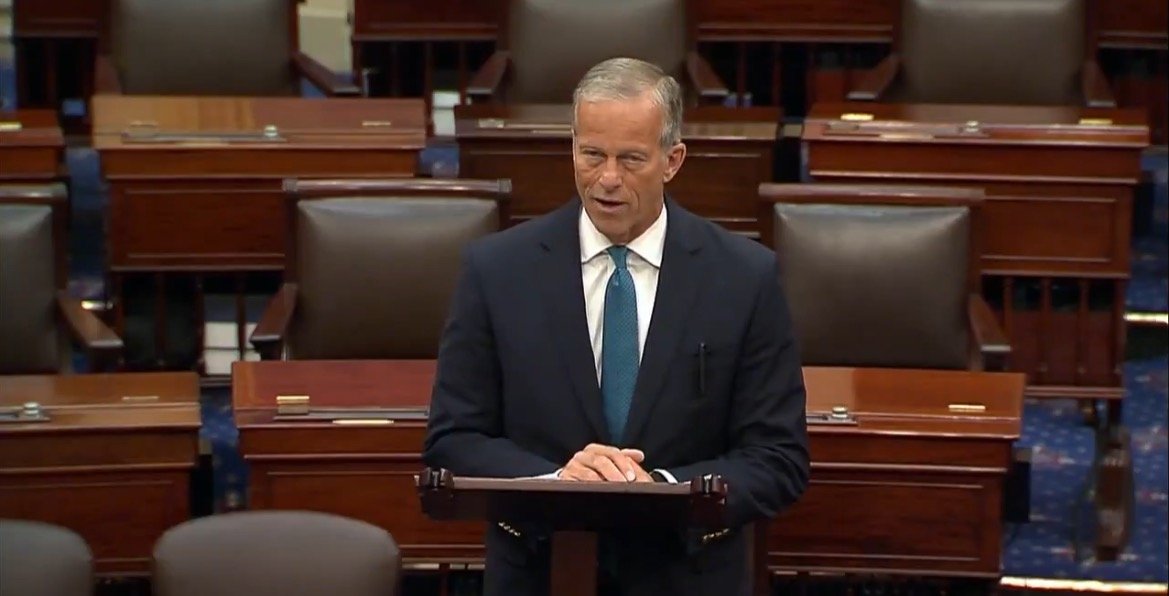
According to Politico, the plan is to bring up the House-passed continuing resolution—previously rejected by Democrats—and amend it with a new expiration date, very likely in January, along with a negotiated package of three full-year spending bills. Senate Majority Whip John Thune believes the deal could gain enough Democratic support to advance, though the outcome is uncertain.

Finalizing the deal may take several days due to procedural hurdles and objections from senators. In preparation, Senate GOP leaders are ready to keep lawmakers in Washington to pressure a resolution to the record-breaking shutdown. When asked if the Senate would remain in session through the weekend, Majority Whip John Barrasso replied, “yes.”

On the other side, Senate Democrats held a lengthy lunch meeting on Thursday to discuss their shutdown strategy. Though no resolution was reached immediately, several Democrats indicated ongoing discussions within the caucus. According to CBS News, Senate Republicans hope moderate Democrats involved in negotiations throughout the week will be persuaded by the appropriations bills and a promised vote on extending health care subsidies.

Negotiations with Democrats—likely involving concessions that the Republican base may oppose—would be unnecessary if Republicans chose to eliminate the filibuster. Despite having full control of the federal government, Republicans have so far refused to wield that power to end the shutdown.

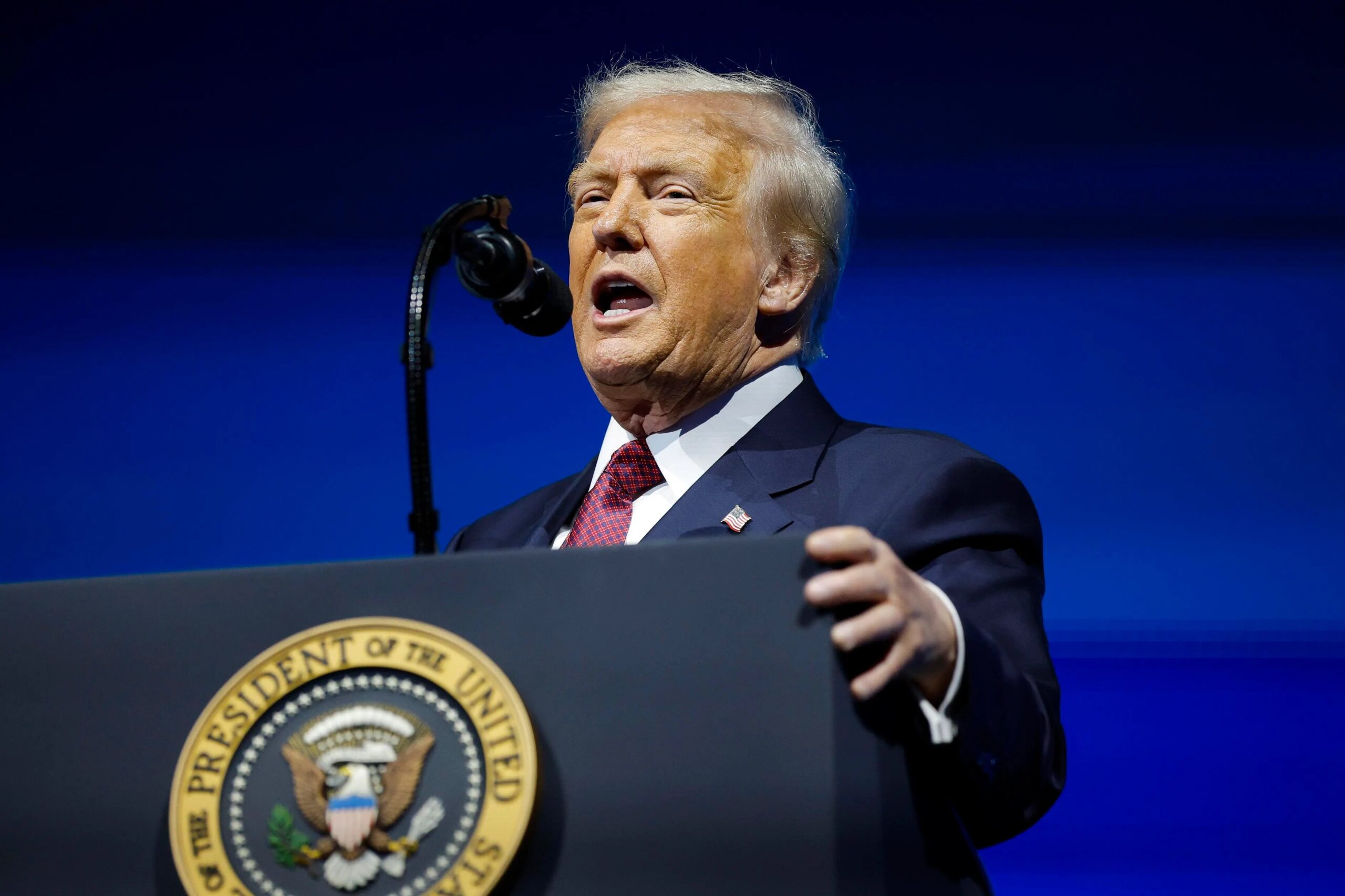
At an Oval Office press conference on Thursday, President Trump renewed his calls for Republicans to discontinue the filibuster. This came a day after he urged GOP senators at a breakfast meeting to terminate the procedure. Trump emphasized that ending the filibuster would allow the Senate to swiftly pass election integrity laws, including voter ID requirements and one-day voting, along with legislation on border security, tax cuts, and more—items Democrats oppose.

“What the Democrats will do is they’re going to make Puerto Rico a state, they’re going to make DC a state, they’re going to pack the court, they’re going to end up with more electoral votes, they’re going to end up with four senators because of the two states, and they’re going to do this, 100%,” Trump stated. “So if they’re going to do it, I would do it. I would do it before them.”

Trump also said:

> “I think it’s time for them to end the filibuster and just put everybody back to work. Vote in voter ID, vote in no mail-in voting except for military, far away military and people that are very sick. I’d like to see one day voting. I’d like to see not 65 days of voting from all over the place. I’d like to clean up the elections; the border, we’ve done a great job. We have a great, strong border now. I’d like to see new rules on immigration that can be fair and good. Rules that you’d never get, rules that they’re never going to get. There’s so many things we could put in, including tax cuts that we could get, and we could do it all ourselves. But to do that, you have to end the filibuster.”

Trump criticized Senators Joe Manchin and Kyrsten Sinema for blocking past efforts to change filibuster rules, saying, “They would have done it, except Manchin and Sinema got in their way.”

As reported by The Gateway Pundit, on Wednesday, Trump hosted Republican senators for breakfast, urging them to end the filibuster, reopen the government, and pass laws to “fix our country and our elections.” However, Senate Majority Leader John Thune and several other senators have publicly opposed ending the filibuster. “It’s just not happening,” Thune said, making the 50 votes necessary to terminate the filibuster unlikely.

The ongoing negotiations and political tension underscore the complexities in resolving the longest government shutdown in U.S. history. As both parties weigh their strategies, the nation watches closely for a resolution to the stalemate.
https://www.thegatewaypundit.com/2025/11/just-senate-meet-friday-amid-deal-reopen-government/


Food for Health: Advocates Call on Gov. Newsom to Backfill SNAP Cuts

LOS ANGELES – Food for Health: Advocates Call on Gov. Newsom to Backfill SNAP Cuts

http://www.businesswire.com/news/home/20251106819932/en/Food-for-Health-Advocates-Call-on-Gov.-Newsom-to-Backfill-SNAP-Cuts/?feedref=JjAwJuNHiystnCoBq_hl-R-HrziBh-2TFM2GMuUU7RcPFX-aV_QoYAKqdUX1TA5LrCOi9QzgjCezTS3Nw_X6kJUrpSBm-Hav1w-UkdSlG3k8sXd0xy82dHvVAQyb6kaYOoOnRBQBKcY2buBEMh6FZQ%3D%3D

Google Project Suncatcher plans to build space-based solar-powered AI infrastructure systems

This week, Google revealed detailed plans for an ambitious initiative to build “scalable ML compute systems” in space. Dubbed **Project Suncatcher**, the company aims to research and develop facilities for its AI TPU (Tensor Processing Unit) systems outside of Earth’s atmosphere. The primary goal is to harness the sun’s solar energy more directly, addressing the growing power requirements of its expanding AI infrastructure.

In an extensive blog post outlining the details and intentions of Project Suncatcher, Google shared additional insights from CEO Sundar Pichai. As part of this initiative, Google will collaborate with Earth-imaging company Planet to launch two prototype satellites by 2027.

Inspired by a history of moonshot projects — from quantum computing to autonomous driving — Project Suncatcher explores the possibility of building scalable machine learning compute systems in space. By tapping into the vast and largely untapped solar power available beyond Earth, the project aims to harness energy at levels far exceeding terrestrial capabilities. The sun emits more power than 100 trillion times humanity’s total electricity production, presenting an enormous opportunity to fulfill the energy demands of AI technology.

This ambitious project seeks to address a persistent and increasingly urgent problem in AI development: the high cost and environmental strain of powering these advanced systems. The energy demands of AI have grown so significant that environmental groups have criticized companies like xAI for the impact their facilities have on local environments and power supplies — notably in Memphis, Tennessee.

Project Suncatcher represents Google’s effort to pioneer a sustainable and scalable path for powering AI, pushing the boundaries of technology beyond our planet while addressing critical energy challenges here on Earth.
https://www.shacknews.com/article/146711/google-project-suncatcher-sundar-pichai-ai-solar-energy

“Rory McIlroy must be tested for PEDs” – Fans react to the Northern Irishman driving the green at Abu Dhabi HSBC Championship

Rory McIlroy left fans stunned during the opening round of the Abu Dhabi HSBC Championship.

On the 10th hole, a 394-yard par-4, McIlroy amazed spectators by driving the green.

This impressive feat showcased his incredible skill and precision early in the tournament.
https://www.sportskeeda.com/golf/news-rory-mcilroy-must-tested-peds-fans-react-northern-irishman-driving-green-abu-dhabi-hsbc-championship

Pokemon Legends: Z-A Mega Dimension DLC gets December 2025 release date

Game Freak has released the first trailer for the upcoming DLC for **Pokémon Legends: Z-A**. Titled **Mega Dimension**, this add-on promises to bring exciting new story missions, alongside a variety of new Pokémon and Mega Evolutions to the game. The DLC is set to launch on **December 10, 2025**.

The trailer for *Pokémon Legends: Z-A Mega Dimension* is packed with intriguing details. Taking place after the events of the original game, the DLC immerses players in a transformed version of Lumiose City, where strange distortions have begun forming throughout the town.

Amid these changes, Hotel Z welcomes a mysterious new guest: a young girl named **Ansha**, who is accompanied by the legendary Pokémon **Hoopa**. With Ansha’s help, players can now bake donuts for their Pokémon using berries, adding a fun and unique feature to Pokémon care.

This alternate Lumiose City also introduces a variety of Pokémon not ordinarily found in the base game. Notable arrivals include **Alolan Marowak**, **Garganacl**, and **Golisopod**. Interestingly, some of these Pokémon can exceed the usual level cap of 100, offering new challenges and experiences for trainers.

Excitingly, the DLC confirms two brand-new Mega Evolutions for **Chimeco** and **Baxcalibur**, expanding the roster of powerful forms players can utilize in battle.

Additionally, the trailer reveals the return of **Korrina**, a beloved character originally introduced in *Pokémon X* and *Pokémon Y*. Korrina will join **Team MZ** as they investigate the mysterious distortions impacting Lumiose City.

With its blend of new story content, fresh Pokémon, and exciting gameplay features, *Mega Dimension* looks set to be a thrilling extension of Pokémon Legends: Z-A. Be sure to mark your calendars for December 10, 2025, and prepare to explore this fascinating new dimension!
https://www.shacknews.com/article/146708/pokemon-legends-z-a-mega-dimension-dlc-release-date

OpenAI Races to Quell Concerns Over Its Finances

The A.I. company recently faced significant pushback after a top executive proposed the idea of seeking government aid. This suggestion has sparked debate amid growing concerns that the A.I. industry may be heading toward a dangerous bubble.

Many experts worry that the rapid growth and heavy investments in A.I. could lead to an unsustainable market situation. The executive’s call for government support highlights the challenges companies face in navigating this uncertain landscape.

As the industry continues to evolve, it remains to be seen how stakeholders will respond to these concerns and what role, if any, government intervention might play in the future of A.I. development.
https://www.nytimes.com/2025/11/06/technology/openai-finances-debt-data-centers.html

Trump Defends Economic Record After Tuesday’s GOP Election Losses

**Key Facts**

A recent NBC News poll found that 66% of Americans believe former President Donald Trump has fallen short of expectations regarding inflation and the cost of living—his worst mark in six categories highlighted by the news outlet. Additionally, 65% of respondents said he has fallen short on “looking out for the middle class.” The only category where a majority (51%) of the 1,000 registered voters polled felt Trump lived up to expectations was border security and immigration.

**Chief Critics**

Some Republicans have publicly broken with Trump and urged the party to rethink its messaging strategy and economic policies in the aftermath of Tuesday’s election. Rep. Marjorie Taylor Greene (R-Ga.) told CNN on Thursday that the high cost of living is “a massive reason” behind the GOP’s election performance. Similarly, Sen. Jim Justice (R-W.Va.) told Punchbowl, “a lot of people are hurting and the Republicans can’t let that just pass them.” He added, “it’ll be a bad day in the midterm” if Republicans don’t prioritize Americans’ economic concerns before next year’s elections.

**Big Number**

3%. That’s how much the cost of a 10-person Thanksgiving meal has decreased over the past year, according to a new report from Wells Fargo. The report cites pricing data from the Bureau of Labor Statistics, Nielsen, and Circana. However, the cost of food at home has increased by 2.7% annually through August.

**Tangent**

Voters in Virginia, New Jersey, and New York City—where Democratic nominees won major races—said economic issues were the primary factor influencing their voting decisions in Tuesday’s election, outpacing concerns about immigration and crime, according to an Associated Press poll conducted from October 22 to November 4.

In New Jersey, a plurality of voters identified taxes as the top issue facing the state, followed by the economy. For Virginia voters, the economy and health care were the leading issues. Meanwhile, cost of living and crime topped the list for New York City voters.

**Key Background**

– Democratic Rep. Mikie Sherrill defeated her Republican opponent Jack Ciattarelli, who was endorsed by Trump, in the New Jersey gubernatorial race, 56% to 43%.
– Democratic former Rep. Abigail Spanberger won the Virginia governor’s race, beating Republican Lt. Gov. Winsome Earle-Sears 57% to 43%.
– In New York City, Democratic nominee Zohran Mamdani defeated independent former Gov. Andrew Cuomo, also endorsed by Trump, 50% to 42%.

**Further Reading**

– [Thanksgiving Dinner May Be Cheaper This Year Despite Rising Inflation, Report Says (Forbes)](https://www.forbes.com)
– [Trump Falsely Says Gas Prices Have Reached A 20-Year Low—Here’s The Real Data (Forbes)](https://www.forbes.com)
– [Latinos Swung Back To Democrats In Tuesday’s Election After Trump’s Historic Gains (Forbes)](https://www.forbes.com)
https://bitcoinethereumnews.com/finance/trump-defends-economic-record-after-tuesdays-gop-election-losses/

The expert conversation: What’s Trump’s endgame in Venezuela?

If there is a strategy behind recent U.S. actions regarding Venezuela, it is not entirely clear. Perhaps there is one, but it has yet to be fully articulated. A good strategy always begins with clear goals. So, what exactly is the U.S. trying to achieve?

There seem to be at least two possibilities — and of course, it could be both.

One potential goal is removing Nicolás Maduro from power. Maduro has long been an anti-American dictator, detrimental both to Venezuela and the United States. The second possibility focuses on border security and stopping narco-trafficking.

### What Are the Major Steps?

The most prominent recent military development has been the buildup of forces. Is this solely about striking drug-carrying vessels? It appears to be more than that.

If the objective is to remove Maduro, is the expectation that he might self-deport? Senators Rick Scott and Lindsey Graham have floated similar ideas publicly, suggesting Maduro should go to Russia or China.

Alternatively, could this buildup be a preparation for strikes on Venezuelan mainland targets, possibly even Maduro himself? The U.S. has traditionally maintained a policy against assassinating foreign leaders, but President Trump seems willing to break norms.

The President has stated his top priority is stopping the flow of illicit drugs into the United States. In the Caribbean, countries like Trinidad and Tobago have been supportive of strikes on vessels suspected of drug trafficking.

### Signaling to the Region and Beyond

This posture is also a signal to other countries in the region and globally, demonstrating how serious this administration is about security and drug interdiction. The U.S. has increased pressure on other countries in the hemisphere, such as Colombia, which faced sanctions and was decertified as cooperative with the U.S. on drug-control efforts due to policy disagreements with President Gustavo Petro.

Secretary of State Marco Rubio, from his Senate days, has been very clear: he wants to see Maduro removed. For Rubio, given his Cuban heritage, this is deeply personal—the rise of dictators and the erosion of civil liberties in Venezuela resonates strongly.

### Maduro’s Days May Be Numbered

As the President mentioned on *60 Minutes*, he wants Maduro gone and sees his days as numbered. However, the question remains: to what extent is the U.S. willing to go to advance Maduro’s removal?

It is expected there will be limited strikes on Venezuelan territory linked to illicit drug activities.

Across the region, Maduro is widely seen as a destabilizing force. Venezuela’s economic collapse, political repression, and erosion of rights have created the largest mass migration crisis the Western Hemisphere has seen. The crisis impacts not only the U.S. southern border but also countries like Chile, which are experiencing unprecedented migrant influxes.

### Focus on the Western Hemisphere in the National Defense Strategy

There are indications that the Western Hemisphere will receive more emphasis in the Trump administration’s forthcoming National Defense Strategy (NDS) than in previous versions. Security and stability in the hemisphere arguably require Maduro’s removal, as his regime contributes to regional instability.

Every national defense strategy underscores the importance of homeland defense, and for this administration, the Western Hemisphere is priority number one, with the Indo-Pacific and China following.

This increased focus is evident in the unique military buildup in the region, unlike anything seen in years.

### Differing Views Within the Administration

Within the administration, there appear to be different camps with varying views on Venezuela.

Secretary Rubio and National Security Advisor Jake Sullivan represent voices seeking Maduro’s removal. Conversely, members of the “MAGA restraint” camp prioritize border security and drug interdiction, and are wary of direct military conflict with Venezuela. This camp is wary of costly, protracted military interventions, having criticized past U.S. involvements in Iraq and Afghanistan.

For now, these camps agree on applying increased pressure against Venezuela, but there is no clear, coherent strategy that everyone supports.

### Peace Through Strength: The Administration’s Approach

President Trump has often used the phrase “peace through strength,” emphasizing deterrence over extended military campaigns. He is skeptical of drawn-out wars like those in Iraq, Afghanistan, Syria, and Ukraine, but open to short, sharp, and decisive actions.

Examples include the strikes against Iranian General Qasem Soleimani and operations targeting Iran’s nuclear program.

In this context, limited strikes against drug infrastructure in Venezuela or possibly regime targets align with this approach. However, a full-scale, boots-on-the-ground regime-change operation—akin to Panama or Grenada—is unlikely under this administration.

### Maduro’s Grip on Power

Historically, attempts to overthrow Maduro have been quickly suppressed. Cuban agents embedded within the Venezuelan military provide early warnings, and the regime has fractured military communications to prevent mass uprisings.

Maduro maintains control partly through illicit activities—drug trafficking, illegal gold mining, arms dealing, and human smuggling—which enrich the regime and key military figures.

If U.S. efforts can significantly degrade these illicit enterprises, Maduro’s financial resources to maintain loyalty among generals may diminish, potentially encouraging military leaders to consider alternative futures.

### Unique Context and Democratic Alternatives

Unlike other countries targeted for U.S. intervention without clear democratic successors, Venezuela has established opposition leaders waiting in the wings.

A presidential election a year ago reportedly elected Edmundo González (according to publicly available vote data), who currently lives in exile. María Corina Machado, a Nobel Peace Prize laureate, remains active within Venezuela, fighting for the democratic government elected last year.

Venezuela’s vast natural resources and oil reserves also offer key economic potential that could support stability.

### Offers to Leave and the Importance of Democratic Transition

Maduro has reportedly offered to leave power, but those offers have been rejected by the U.S. administration. If Maduro does step down, it is crucial to prevent a henchman from simply taking over.

Robust support exists for Venezuela’s democratic opposition, but it is equally important to make clear to the Venezuelan military that their future depends on supporting a transition grounded in democratic principles.

In summary, while the U.S. objectives regarding Venezuela seem focused on both removing Maduro and combating narcotics trafficking, a fully-fledged, unified strategy remains elusive. What is clear is an increased emphasis on security in the Western Hemisphere and willingness to apply pressure through military and diplomatic means short of full-scale intervention. The future course will likely balance these elements while remaining mindful of regional dynamics and the complexities of Venezuelan politics.
https://www.atlanticcouncil.org/blogs/new-atlanticist/the-expert-conversation-whats-trumps-endgame-in-venezuela/

Sam Altman says OpenAI will top $20 billion in annualized revenue this year, hundreds of billions by 2030

OpenAI CEO Sam Altman announced on Thursday that the artificial intelligence startup is on track to generate more than $20 billion in annualized revenue run rate this year. He also revealed ambitious plans to grow the company’s sales to hundreds of billions by 2030.

In recent months, OpenAI has secured infrastructure deals totaling more than $1.4 trillion to build the data centers needed to meet growing demand. This staggering sum has raised questions among investors and industry experts about how OpenAI will finance these massive investments.

“We are trying to build the infrastructure for a future economy powered by AI,” Altman wrote in a post on X. “Given everything we see on the horizon in our research program, this is the time to invest and really scale up our technology. Massive infrastructure projects take quite a while to build, so we have to start now.”

Founded as a nonprofit research lab in 2015, OpenAI has transformed into one of the fastest-growing commercial entities worldwide following the launch of its chatbot, ChatGPT, in 2022. The startup is currently valued at $500 billion, though it has yet to turn a profit.

In September, OpenAI CFO Sarah Friar told CNBC that the company was on track to generate $13 billion in revenue this year. However, Friar recently faced scrutiny from the Trump administration after remarks at an event where she mentioned OpenAI’s intent to create an ecosystem involving banks, private equity, and a federal “backstop” or “guarantee” to help finance investments in cutting-edge chips.

She later clarified her comments in a LinkedIn post on Wednesday, stating that OpenAI is not seeking a government backstop for its infrastructure commitments. “I used the word ‘backstop’ and it muddied the point,” Friar explained. “As the full clip of my answer shows, I was making the point that American strength in technology will come from building real industrial capacity, which requires the private sector and government playing their part.”

Adding to the debate, venture capitalist David Sacks, who serves as President Donald Trump’s AI and crypto czar, declared on Thursday that there will be “no federal bailout for AI.” He wrote on X that if one frontier model company fails in the U.S., another will take its place.

Altman echoed this sentiment, stating that OpenAI “does not have or want government guarantees for OpenAI datacenters.” He emphasized that taxpayers should not be responsible for bailing out companies that make poor decisions. “If we get it wrong, that’s on us. This is the bet we are making, and given our vantage point, we feel good about it,” Altman wrote. “But we of course could be wrong, and the market — not the government — will deal with it if we are.”

As OpenAI continues to invest heavily in scaling its technology and infrastructure, the company remains confident in its strategies amid ongoing discussions about the role of government and private investment in the AI industry’s future.
https://www.cnbc.com/2025/11/06/sam-altman-says-openai-will-top-20-billion-annual-revenue-this-year.html